Introduction
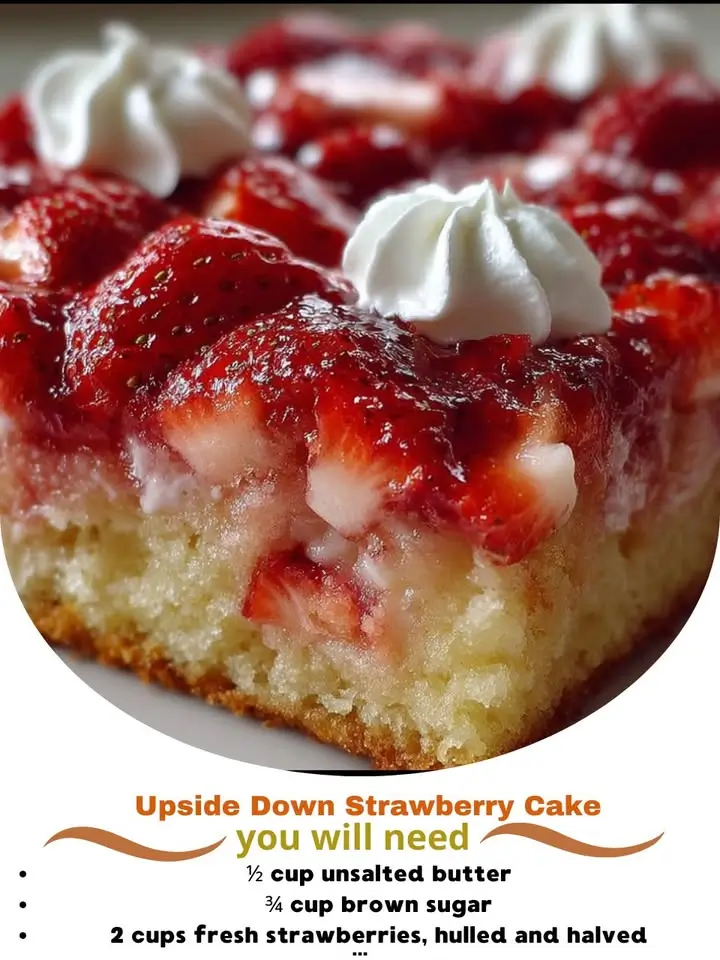
Upside Down Strawberry Cake is a luscious, nostalgic dessert that marries the vibrant sweetness of fresh strawberries with the tender richness of a buttery vanilla cake—served in glorious reverse. Unlike traditional layer cakes, this showstopping treat begins its journey caramelized and fruit-forward: ripe strawberries are arranged artfully in the bottom of a buttered and sugared pan, then blanketed with a light, moist cake batter. After baking, the cake is inverted—revealing a glossy, ruby-red mosaic of softened, syrup-glazed berries crowning a golden, tender crumb. It’s rustic yet elegant, simple to prepare yet deeply impressive—perfect for spring brunches, summer gatherings, or any moment that calls for a little edible poetry. More than just a dessert, it’s a celebration of seasonal abundance, old-fashioned technique, and the quiet magic of gravity-defying transformation.
The History
The upside-down cake traces its roots to early 20th-century American home cooking, emerging as a clever, economical solution during times when kitchen tools were limited and resourcefulness was essential. Before electric mixers and nonstick pans, bakers relied on cast-iron skillets and stovetop-to-oven transitions—and the upside-down method eliminated the need for delicate cake removal or frosting alignment. While pineapple upside-down cake became the iconic standard after its popularization by the Dole Pineapple Company in the 1920s (via a national recipe contest in 1925), regional variations flourished long before: German Streuselkuchen traditions, Southern peach cobblers baked under batter, and French tarte Tatin (invented accidentally in the 1880s when a caramelized apple tart was flipped mid-service) all share philosophical kinship with the genre. Strawberry versions gained traction in the mid-20th century as refrigerated transport improved berry availability, and home economists began adapting the format for seasonal produce. Today’s Upside Down Strawberry Cake honors that legacy—blending European caramelization techniques, American pantry practicality, and modern appreciation for local, ripe fruit—making it both historically grounded and deliciously contemporary.
Ingredients Breakdown
Every element in this cake serves a precise purpose—no ingredient is arbitrary. Here’s why each one matters:
- Unsalted Butter (for the topping): Provides rich flavor, aids caramelization of sugar, and creates a luxurious, glossy glaze as it melts and emulsifies with strawberry juices during baking. Salted butter can overwhelm the delicate balance—unsalted gives you full control over seasoning.
- Granulated Sugar (for the topping): Not just sweetener—it’s the foundation of the caramelized layer. When heated with butter and fruit, it dissolves into a viscous, amber-hued syrup that intensifies strawberry flavor and adds structural sheen. Avoid brown sugar here unless intentionally seeking molasses notes (which can compete with strawberry’s brightness).
- Fresh Strawberries: The star. Choose ripe, fragrant, medium-firm berries—overripe ones release too much water and dilute the glaze; underripe ones lack sweetness and aroma. Hull and slice uniformly (¼-inch thick) for even cooking and visual harmony. Frozen berries are discouraged—they introduce excess ice crystals and murky liquid, resulting in a soggy, grayish topping.
- Lemon Zest & Juice: A small amount brightens the entire profile—zest contributes volatile citrus oils that lift the strawberry fragrance, while juice adds subtle acidity to balance sweetness and prevent cloyingness. Never skip this; it’s the secret dimension.
- All-Purpose Flour: Provides structure without toughness. For tenderness, it’s paired with cake flour in many refined versions—but AP flour ensures reliability for home bakers. Sifting is non-negotiable: aerates the flour, prevents pockets of density, and ensures seamless incorporation.
- Baking Powder & Baking Soda: A dual-leavening system. Baking powder provides primary lift, while baking soda reacts with the natural acidity in strawberries and buttermilk (if used) for extra rise and fine crumb. Too much causes bitter aftertaste; too little yields a dense cake.
- Granulated Sugar (for the batter): Sweetens and tenderizes by interfering with gluten formation. Some recipes use brown sugar for depth—but granulated maintains clarity of strawberry flavor.
- Large Eggs: Act as emulsifiers, binders, and leaveners. Room temperature eggs incorporate air more efficiently during creaming, yielding greater volume. Cold eggs can cause batter to curdle and deflate.
- Pure Vanilla Extract: Use only real, double-fold Madagascar or Tahitian vanilla—not imitation. Its complex phenolic compounds enhance fruit perception and add warm, floral undertones that echo strawberry’s ester notes.
- Whole Milk or Buttermilk: Adds moisture, fat, and acidity. Buttermilk yields a slightly tangier, more tender crumb due to its lactic acid; whole milk offers neutrality and richness. Always bring to room temperature to prevent shocking the batter.
- Unsalted Butter (for the batter): Creamed until pale and fluffy, it traps air for leavening and delivers incomparable mouthfeel. Over-creaming leads to greasiness; under-creaming yields heaviness. The “ribbon stage” (when batter falls from beaters in thick, slow ribbons) signals ideal aeration.
Step-by-Step Recipe
- Preheat & Prep Pan: Position oven rack in the center third. Preheat oven to 350°F (175°C). Generously butter a 9-inch round cake pan (preferably with straight sides and a heavy base—like USA Pan or Wilton) or a well-seasoned 10-inch cast-iron skillet. Line the bottom with parchment paper (optional but recommended for foolproof release), then butter the parchment. Sprinkle ½ cup granulated sugar evenly across the bottom—tilt and tap to coat every surface.
- Prepare Strawberry Layer: Hull and thinly slice 1½ pints (about 3 cups) of fresh strawberries. In a bowl, gently toss slices with 1 tbsp fresh lemon juice, 1 tsp finely grated lemon zest, and a pinch of flaky sea salt (e.g., Maldon). Let sit 5 minutes to draw out juices. Pat slices *very* dry with paper towels—this step is critical for concentrated flavor and clean caramelization.
- Arrange Fruit: Starting from the outer edge, arrange strawberry slices in concentric circles, overlapping slightly like shingles. Nestle a few whole small berries or halved larger ones in the center for visual impact. Press gently to embed into the sugar layer.
- Make Batter: In a medium bowl, whisk together 1¾ cups all-purpose flour, 1½ tsp baking powder, ¼ tsp baking soda, and ½ tsp fine sea salt. Set aside. In a large bowl, beat ¾ cup unsalted butter (room temp) with an electric mixer on medium-high for 2 minutes until creamy. Gradually add 1 cup granulated sugar; beat 3–4 minutes until pale, fluffy, and nearly doubled in volume. Add 2 large room-temp eggs one at a time, beating well after each (about 30 seconds per egg), then beat in 2 tsp pure vanilla extract.
- Incorporate Dry & Wet: Reduce mixer speed to low. Add one-third of dry ingredients; mix just until combined. Add ½ cup room-temp whole milk (or buttermilk); mix until absorbed. Repeat, alternating dry-milk-dry, beginning and ending with dry ingredients. Scrape bowl thoroughly with a silicone spatula. Mix only until *no streaks remain*—do not overmix (under 30 seconds total after final addition).
- Pour & Spread: Gently spoon batter over strawberries. Using an offset spatula or back of a spoon, carefully spread batter evenly to cover all fruit—avoid pressing down hard or disturbing the arrangement. Smooth top completely.
- Bake: Place pan on a rimmed baking sheet (to catch potential drips). Bake 45–55 minutes—until a wooden skewer inserted into the *center of the cake* (not fruit) comes out clean or with a few moist crumbs (no wet batter). Edges should be deeply golden and pulling slightly from pan. If top browns too quickly, tent loosely with foil after 30 minutes.
- Cool & Invert: Let cake cool in pan on a wire rack for exactly 15 minutes—no more, no less. Cooling too long causes glaze to set and stick; too short risks collapse. Run a thin knife around inner edge. Place a wide, heat-safe serving plate or cake stand face-down over pan. With oven mitts, grip both firmly and swiftly flip in one confident motion. Lift pan straight up. If any berries cling, gently coax them free with a spatula and reposition.
- Final Rest: Let cake rest inverted for 5 minutes to allow residual heat to loosen the glaze, then carefully lift parchment (if used) and peel away. Serve warm or at room temperature—never chilled (cold dulls flavor and firms glaze unpleasantly).
Tips
- Strawberry Selection Matters: Seek berries with deep red color from crown to tip, firm texture, and intense perfume—even if they’re not picture-perfect. Local farmers’ market berries at peak season (late May–early July in most zones) deliver unmatched sweetness and complexity.
- Sugar Layer Science: Don’t skip the pre-sugar coating. It’s not just for sweetness—it creates a barrier that prevents berries from steaming instead of caramelizing, and initiates Maillard reactions for deeper flavor development.
- Dry Fruit = Brilliant Glaze: Moisture is the enemy of shine. Patting berries dry may seem tedious—but it’s the difference between a jewel-toned, glossy finish and a cloudy, watery mess.
- Room Temperature Is Non-Negotiable: Cold eggs, butter, or milk cause the batter to seize, leading to uneven texture and poor rise. Plan ahead: take ingredients out 1–2 hours before baking.
- Don’t Peek Early: Opening the oven before 35 minutes risks thermal shock and collapse. Trust the timer—and use the oven light instead.
- Perfect Flip Timing: Set a timer for 15 minutes post-bake. Use a sturdy, flat-bottomed plate larger than your pan—slight overhang ensures safety. Flip over a sink first if nervous—you can always re-flip!
- Rest Before Serving: Though tempting to cut immediately, waiting 10–15 minutes after flipping allows the glaze to settle and the cake to stabilize—resulting in cleaner slices and enhanced flavor integration.
- Storage Wisdom: This cake is best enjoyed the day it’s made. If storing overnight, cool completely, cover *loosely* with parchment (not plastic wrap—traps steam and softens crust), and keep at cool room temperature. Refrigeration dries it out and clouds the glaze.
Variations and Customizations
This versatile canvas invites creativity—while honoring its core principles of balance, texture, and seasonal integrity:
- Berry Medley: Replace ⅓ of strawberries with sliced ripe raspberries or blackberries for tart contrast and jewel-toned variation. Add ½ tsp black pepper to the sugar layer for a surprising, sophisticated warmth.
- Herb-Infused: Stir 1 tsp finely chopped fresh basil or mint into the strawberry mixture before arranging. The herbal note elevates without overpowering—especially lovely with lemon zest.
- Nutty Crumble Accent: Sprinkle ¼ cup toasted sliced almonds or pistachios over the batter before baking for crunch and visual drama. Toast nuts separately in a dry skillet until fragrant, then cool completely.
- Spiced Version: Add ½ tsp ground cardamom + ¼ tsp ground ginger to the dry ingredients. Cardamom’s citrusy-floral notes harmonize beautifully with strawberry—a Scandinavian-inspired twist.
- Gluten-Free Adaptation: Substitute 1:1 gluten-free all-purpose flour blend (with xanthan gum included) and add 1 extra tbsp milk. Let batter rest 10 minutes before pouring to hydrate flours fully. Expect slightly denser crumb—but still tender and flavorful.
- Vegan Option: Replace butter with high-fat vegan butter (e.g., Miyoko’s or Melt), eggs with flax eggs (2 tbsp ground flax + 6 tbsp water, rested 10 mins), and milk with unsweetened oat milk. Increase baking powder to 2 tsp for lift. Top with coconut sugar for richer caramel notes.
- Mini Individual Cakes: Use six 4-inch round cake pans or ramekins. Reduce bake time to 22–28 minutes. Perfect for dinner parties—guests get their own personal masterpiece.
- Boozy Upgrade: Brush cooled cake top lightly with 1 tbsp Chambord (raspberry liqueur) or Grand Marnier. Or stir 1 tbsp into warm glaze before inverting.
- Breakfast Twist: Reduce sugar in batter by ¼ cup, add ½ cup rolled oats and 2 tbsp chia seeds. Serve with Greek yogurt and extra fresh berries—still indulgent, but with wholesome heft.
Health Considerations and Nutritional Value
While Upside Down Strawberry Cake is undeniably a celebratory dessert, thoughtful preparation allows for mindful enjoyment without guilt:
- Nutrient Highlights: Fresh strawberries contribute significant vitamin C (one cup provides ~149% DV), folate, manganese, and antioxidant-rich ellagic acid and anthocyanins—linked to reduced inflammation and cardiovascular support. Their natural fiber also promotes satiety and gut health.
- Sugar Awareness: The topping contains concentrated sugar for caramelization—but much is absorbed by the fruit and transformed into complex syrups during baking. Total added sugar per generous slice is approximately 28–32g. To reduce: decrease topping sugar to ⅓ cup and increase lemon juice by ½ tsp to preserve brightness.
- Fat Profile: Butter supplies saturated fat—but also beneficial conjugated linoleic acid (CLA) and fat-soluble vitamins A, D, E, and K2. Opting for grass-fed butter increases omega-3s and antioxidants. For lighter texture, replace ¼ cup butter in batter with unsweetened applesauce—but retain at least ½ cup butter for flavor and structure.
- Refined Flour Notes: All-purpose flour offers B vitamins and iron (often enriched), but lacks the fiber and phytonutrients of whole grains. A 50/50 blend with white whole wheat flour adds nuttiness, fiber, and minerals without compromising tenderness.
- Glycemic Considerations: The combination of fruit’s natural sugars, fiber, and fat slows glucose absorption—making this cake gentler on blood sugar than many highly refined desserts. Pairing with a protein-rich topping (e.g., crème fraîche or mascarpone) further moderates response.
- Allergen Transparency: Contains dairy, eggs, and wheat. Gluten-free and vegan adaptations (detailed above) make it inclusive for many dietary needs. Always verify labels on vanilla and baking powder for hidden gluten or corn derivatives if sensitive.
- Mindful Indulgence Principle: Enjoying dessert consciously—savoring aroma, texture, and flavor slowly—activates satisfaction pathways more effectively than restrictive dieting. One slice, shared with loved ones, embodies nourishment beyond nutrition.
Ingredients
- ½ cup (100g) granulated sugar, for topping
- ¾ cup (170g) unsalted butter, divided (3 tbsp for topping, ½ cup/115g for batter)
- 1½ pints (about 3 cups / 450g) fresh strawberries, hulled and sliced ¼-inch thick
- 1 tbsp fresh lemon juice
- 1 tsp finely grated lemon zest
- Pinch of flaky sea salt (e.g., Maldon)
- 1¾ cups (220g) all-purpose flour, sifted
- 1½ tsp baking powder
- ¼ tsp baking soda
- ½ tsp fine sea salt
- 1 cup (200g) granulated sugar, for batter
- 2 large eggs, room temperature
- 2 tsp pure vanilla extract
- ½ cup (120ml) whole milk or buttermilk, room temperature
Directions
- Preheat oven to 350°F (175°C). Butter a 9-inch round cake pan or 10-inch cast-iron skillet. Line bottom with parchment (optional), then butter parchment. Sprinkle ½ cup sugar evenly over bottom; tilt and tap to coat.
- In a bowl, gently toss strawberry slices with lemon juice, zest, and pinch of flaky salt. Let sit 5 minutes, then pat *very* dry with paper towels.
- Arrange strawberries in concentric circles over sugar layer, overlapping slightly. Press gently to embed.
- In a medium bowl, whisk flour, baking powder, baking soda, and ½ tsp fine salt. Set aside.
- In a large bowl, beat 3 tbsp butter (for topping) with remaining ½ cup butter (for batter) until smooth. Add 1 cup sugar; beat 3–4 minutes until pale and fluffy.
- Add eggs one at a time, beating well after each. Beat in vanilla.
- On low speed, add one-third dry ingredients; mix until just combined. Add half the milk; mix until absorbed. Repeat, ending with dry ingredients. Mix only until no streaks remain—do not overmix.
- Gently spoon batter over strawberries. Spread evenly with offset spatula—do not press down.
- Bake 45–55 minutes, until skewer in cake center comes out clean. Cool in pan 15 minutes exactly.
- Run knife around edge. Place heat-safe plate face-down over pan. Flip confidently. Lift pan. Let rest 5 minutes, then peel off parchment (if used). Serve warm or at room temperature.
FAQ
- Can I make this cake ahead of time?
- Yes—with caveats. Bake and invert up to 8 hours ahead. Keep uncovered at cool room temperature (not refrigerated). Re-warm gently in a 300°F oven for 10 minutes before serving to revive aroma and soften glaze. Frosting or glazes should be added just before serving.
- Why did my strawberries turn brown or gray?
- Most commonly caused by using overripe or bruised berries, insufficient drying before arranging, or excessive lemon juice (which accelerates enzymatic browning). Also occurs if cake sits inverted too long before serving—residual heat continues cooking fruit. Always use firm, ripe berries and pat thoroughly dry.
- My cake stuck to the pan! What went wrong?
- Three main culprits: insufficient butter/sugar coating, cooling too long before flipping (glaze sets and bonds), or using a nonstick pan with scratches (where glaze seeps in). Ensure generous, even coating—and flip at precisely 15 minutes. A well-buttered, parchment-lined heavy pan is your safest bet.
- Can I freeze Upside Down Strawberry Cake?
- Freezing is not recommended—the delicate glaze separates and becomes grainy upon thawing, and strawberries weep excessively, compromising texture. However, unfrosted *cake layers only* (without fruit) freeze well for up to 3 months—wrap tightly in plastic + foil. Thaw overnight in fridge, then refresh in 325°F oven for 12 minutes before assembling.
- What’s the best way to serve leftovers?
- Store uncovered at room temperature. To refresh, place slice on parchment-lined baking sheet and warm in 325°F oven for 6–8 minutes. Never microwave—melts glaze unevenly and makes cake rubbery. Serve with a dollop of crème fraîche or lightly sweetened whipped cream to balance richness.
- Can I use frozen strawberries in a pinch?
- Not ideally—but if absolutely necessary: thaw completely, drain *all* liquid through a fine-mesh sieve (press gently), then pat berries *extremely* dry. Expect softer texture and milder flavor. Increase topping sugar to ⅔ cup to compensate for lost sweetness. Reduce bake time by 5 minutes and check early.
- Is there a lower-sugar version that still works?
- Absolutely. Reduce topping sugar to ⅓ cup and batter sugar to ¾ cup. Boost flavor with extra lemon zest (2 tsp), ½ tsp almond extract, and 1 tbsp orange juice in place of some milk. Add 2 tbsp ground flaxseed to batter for binding and fiber. Texture will be slightly denser but still moist and satisfying.
- Why does my cake dome or crack?
- Overmixing the batter develops excess gluten, causing tight structure and splitting. Also occurs if oven temperature is too high (use an oven thermometer!) or if batter is poured into a pan that’s too small. Always use correct pan size and mix *just* until combined.
Summary
Upside Down Strawberry Cake is a timeless, technique-driven dessert where seasonal strawberries transform into a jewel-toned, caramel-kissed crown atop a tender, golden vanilla cake—flipped with confidence to reveal its stunning, syrup-glazed glory. Rooted in frugal ingenuity and elevated by mindful ingredient choices, it balances nostalgia with nuance, simplicity with sophistication, and indulgence with intention.