Introduction
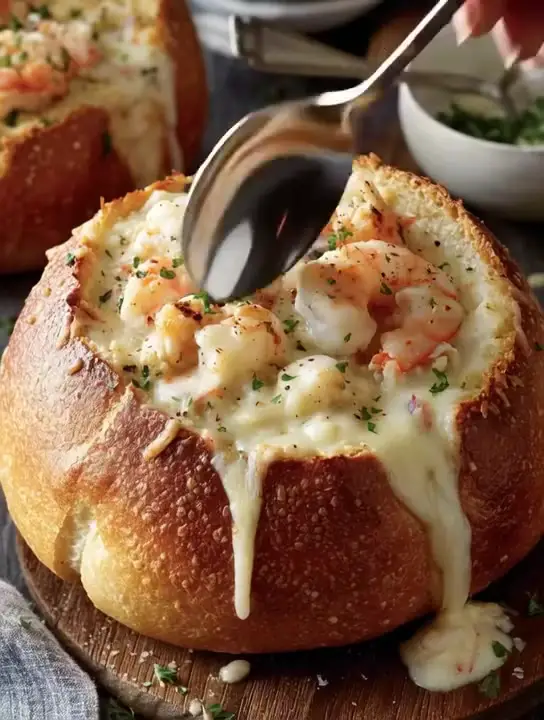
Welcome to the ultimate celebration of coastal elegance and rustic charm—the Stuffed Seafood Bread Bowl. This showstopping dish marries the warmth of artisanal bread with the ocean’s finest treasures, delivering a harmonious blend of textures, aromas, and flavors in every bite. More than just a meal, it’s an immersive culinary experience—ideal for summer soirées, holiday feasts, date-night dinners, or impressing guests at your next gathering. The hollowed-out bread bowl acts not only as a vessel but as a flavorful, soak-up-the-sauce companion, while the rich, creamy, herb-flecked seafood filling offers layers of savory depth, subtle sweetness, and delicate brininess. Whether you’re a seasoned seafood enthusiast or a curious home cook eager to elevate your repertoire, this recipe balances approachability with gourmet appeal—no fancy equipment required, just fresh ingredients, thoughtful technique, and a generous spirit of hospitality.
The History
The origins of the stuffed bread bowl trace back centuries across Mediterranean and European culinary traditions, where resourceful cooks repurposed day-old loaves into edible containers for soups, stews, and grain-based dishes. In coastal regions like Provence, Liguria, and the Greek islands, fishermen’s families often combined locally caught shellfish—shrimp, mussels, calamari—with garlic, olive oil, tomatoes, and herbs, then served them nestled in crusty boules or ciabatta rounds. The concept evolved through 20th-century American bistro culture, where chefs began elevating the idea with premium ingredients and refined techniques—think creamy bisque-filled sourdough bowls in San Francisco or lobster-stuffed baguettes in Boston seafood shacks. The modern Stuffed Seafood Bread Bowl emerged as a fusion of these influences: a hearty, shareable centerpiece that honors provenance (sustainably sourced seafood), craftsmanship (hand-shaped artisan loaves), and communal dining. It reflects a broader culinary movement toward “zero-waste” cooking (using the entire loaf—crumb for breadcrumbs, crust for crunch) and experiential eating—where presentation, aroma, temperature contrast, and interactive serving all contribute to the narrative of the dish.
Ingredients Breakdown
Every element in this Stuffed Seafood Bread Bowl serves a distinct purpose—building flavor, enhancing texture, ensuring balance, and supporting structural integrity. Let’s explore each component in detail:
- Bread Bowl Base: A large, round, high-hydration sourdough or rustic country boule (approx. 8–10 inches diameter, ~1.5 lbs) is ideal—its thick, caramelized crust holds up to moisture without disintegrating, while its open crumb absorbs sauce without becoming mushy. Avoid soft sandwich loaves (they collapse) or overly dense rye (they overpower). The bread must be *day-old*—slightly dried out for optimal scoopability and heat resistance.
- Seafood Medley: A thoughtfully curated trio ensures complexity: wild-caught Gulf shrimp (peeled, deveined, tail-off; ½ inch pieces for even cooking), Atlantic sea scallops (dry-packed, coral-removed, sliced ¼-inch thick), and lump blue crabmeat (pasteurized, picked free of shell). Optional additions include finely diced calamari rings (blanched 30 sec first) or minced clams (steamed and strained). All seafood should be *chilled* before cooking to prevent premature protein coagulation.
- Aromatics & Mirepoix: Yellow onion (finely diced), fennel bulb (thinly sliced—adds anise-like brightness), celery (small dice), and garlic (minced, not pasted) form the aromatic base. Fennel is non-negotiable—it bridges the gap between seafood’s delicacy and richness without competing.
- Liquid Foundation: A trifecta of dry white wine (Sauvignon Blanc or Pinot Grigio), homemade or low-sodium seafood stock (preferably made from shrimp shells), and a splash of heavy cream (10–12% fat) creates a luscious, emulsified sauce that clings to every morsel without splitting.
- Herbs & Seasonings: Fresh tarragon (the quintessential seafood herb—earthy, licorice-tinged, floral), flat-leaf parsley (for grassy freshness and color), chives (mild onion note), lemon zest (bright citrus oils), and a whisper of Old Bay seasoning (for Chesapeake-inspired depth—use sparingly!). Ground white pepper is preferred over black for subtlety and visual appeal.
- Thickening Agent: A *beurre manié* (equal parts softened butter + all-purpose flour, kneaded smooth) is whisked in at the end—providing velvety body without floury taste or risk of lumps. Cornstarch or roux are avoided here—they mute seafood’s purity.
- Finishing Touches: High-quality extra-virgin olive oil (drizzled post-bake), flaky sea salt (Maldon or Fleur de Sel), micro-cilantro or dill fronds, and lemon wedges served tableside for acidity adjustment.
Step-by-Step Recipe
- Prep the Bread Bowl (24–48 hrs ahead): Select a fully cooled, day-old boule. Using a serrated knife, cut a 3-inch-wide circular lid from the top. Carefully scoop out the interior crumb with a grapefruit spoon or small ice cream scoop, leaving a ½-inch-thick shell wall and intact bottom. Reserve the removed bread for breadcrumbs (pulse in food processor, toast in olive oil until golden). Lightly brush the interior and lid with melted unsalted butter and bake at 325°F for 12 minutes to crisp—cool completely. Store uncovered at room temp.
- Prepare Seafood & Aromatics: Pat all seafood *extremely* dry with paper towels—moisture is the enemy of sear and sauce clarity. Dice shrimp and scallops uniformly. Mince fennel, onion, and celery; mince garlic separately. Pick through crabmeat for cartilage. Zest one lemon; juice reserved separately.
- Sauté Aromatics: In a wide, heavy-bottomed Dutch oven or stainless steel sauté pan, heat 3 tbsp olive oil over medium-low. Add fennel, onion, and celery; sweat 8–10 mins until translucent but *not browned*. Stir in garlic; cook 1 min until fragrant. Remove 2 tbsp mixture for garnish; set aside.
- Build Flavor Base: Increase heat to medium-high. Add shrimp and scallops in a single layer—do not crowd. Sear 1.5 mins per side until opaque at edges but still tender within. Transfer to a plate. Deglaze pan with ½ cup white wine, scraping up fond. Simmer 2 mins to reduce by half.
- Simmer & Infuse: Return seafood to pan. Add seafood stock, cream, reserved aromatics (except garlic), tarragon stems (tied with kitchen twine), and a bay leaf. Simmer gently (bubbles barely breaking surface) for 6 mins—no boiling! Remove tarragon stems and bay leaf.
- Emulsify & Thicken: Whisk in beurre manié, 1 tsp at a time, allowing each addition to melt and thicken before adding more (about 4–5 tsp total). Simmer 3 mins until glossy and nappe consistency (coats the back of a spoon). Remove from heat.
- Enrich & Finish: Gently fold in crabmeat, lemon zest, ¼ cup chopped parsley, chives, white pepper, and 1 tbsp lemon juice. Taste—adjust salt *only now*, as seafood and stock contain sodium. Let rest 5 mins for flavors to marry.
- Assemble & Bake: Spoon warm filling into pre-toasted bread bowl (do not overfill—leave ½-inch rim). Replace lid slightly ajar. Place on a parchment-lined baking sheet. Bake at 375°F for 15–18 mins until filling is bubbling at edges and bread is deeply golden and crisp. Rotate pan halfway.
- Rest & Garnish: Let rest 8 mins—critical for sauce setting and heat distribution. Uncover, drizzle with olive oil, flaky salt, reserved sautéed aromatics, remaining parsley, and lemon wedges.
Tips
- Seafood Timing is Everything: Shrimp and scallops cook in minutes—overcooking turns them rubbery. Always add them last to the hot pan and remove while still slightly underdone; residual heat finishes them in the sauce.
- Bread Bowl Integrity: If your loaf feels fragile, reinforce the interior with a thin layer of grated Parmigiano-Reggiano before baking—melts into a protective, umami-rich barrier.
- Sauce Consistency Rescue: Too thin? Simmer 2 mins longer off-heat, stirring. Too thick? Whisk in 1 tsp warm stock or cream. Never add cold liquid—it causes separation.
- Make-Ahead Mastery: Prep bread bowl and aromatics 2 days ahead. Cook seafood filling 1 day ahead—cool completely, refrigerate covered. Reheat *gently* in pan over low heat before assembling—never microwave (scrambles crab).
- Crisp Crust Secret: For maximum crunch, brush exterior of bread bowl with garlic-infused olive oil and sprinkle with everything bagel seasoning before final bake.
- No-Stick Scooping: Serve with a wide, shallow soup spoon and a small serrated knife for cutting through the crust—guests will love tearing into it.
- Wine Pairing Wisdom: Serve alongside a chilled, mineral-driven Albariño or unoaked Chardonnay—the acidity cuts richness, while salinity mirrors the sea.
- Leftover Brilliance: Repurpose leftover filling as a luxurious pasta toss (with linguine), seafood-stuffed crepes, or atop a baked potato. Stale bread chunks become croutons for seafood chowder.
Variations and Customizations
This recipe is a canvas—adaptable to seasons, regional preferences, dietary needs, and pantry constraints:
- Coastal Regional Twists: Provençal: Add 2 tbsp tomato paste, ¼ cup Niçoise olives, and 1 tsp herbes de Provence. New England: Swap crab for Maine lobster meat, add 1 tbsp brandy, and finish with chopped chervil. Greek-Inspired: Use avgolemono-style thickening (egg-lemon liaison), add dill and crumbled feta, omit cream.
- Dietary Adaptations: Gluten-Free: Use a GF sourdough boule (check certification) and replace beurre manié with 1 tsp xanthan gum whisked into cold stock. Dairy-Free: Substitute full-fat coconut milk for cream and vegan butter for beurre manié. Pescatarian-Vegan Hybrid: Replace seafood with hearts of palm (shredded), king oyster mushrooms (sliced thin, marinated in nori-infused tamari), and kelp granules for oceanic umami.
- Protein Swaps: Try smoked salmon flakes (add at the end), grilled octopus tentacles (pre-cooked, chopped), or sustainable farmed Arctic char. For land lovers: roasted wild mushrooms + white beans mimic texture and earthiness.
- Flavor Profiles: Spicy Cajun: Add 1 tsp smoked paprika, ½ tsp cayenne, and 1 diced jalapeño (seeds removed) with aromatics. Asian Fusion: Replace wine with dry sherry, add 1 tbsp ginger-garlic paste, 1 tsp sesame oil, and garnish with scallions + toasted sesame seeds. Herbaceous Garden: Double tarragon, add 1 tbsp chopped basil and 1 tsp lemon verbena.
- Time-Saving Hacks: Use pre-cooked, frozen seafood medley (thawed and patted dry)—just adjust simmer time to 3 mins. Substitute store-bought seafood stock (look for “low-sodium” and “no added MSG”). Pre-spiralized zucchini or carrot “noodles” make a vibrant, low-carb base alternative to bread (roast first for stability).
Health Considerations and Nutritional Value
Nutritionally, the Stuffed Seafood Bread Bowl is a nutrient-dense powerhouse when prepared mindfully. A standard serving (⅙ of recipe, including 1/6 of bread bowl) delivers approximately 420–480 calories, with 28–32g high-quality protein (from shrimp, scallops, and crab—complete amino acid profile), 18–22g complex carbohydrates (fiber-rich whole-grain bread), and 16–19g heart-healthy fats (mostly monounsaturated from olive oil and omega-3s from seafood). Key micronutrients include selenium (supports thyroid and antioxidant function), vitamin B12 (neurological health), zinc (immune support), iodine (essential for metabolism), and vitamin D (especially in wild-caught varieties). The dish is naturally low in sugar (<2g) and contains zero trans fats. To optimize wellness:
- Reduce Sodium: Use no-salt-added stock, skip added salt until tasting, and rely on lemon, herbs, and vinegar for brightness.
- Increase Fiber: Choose 100% whole wheat or sprouted grain boule—adds 4–6g fiber per serving and slows glucose absorption.
- Boost Omega-3s: Incorporate 2 tbsp chopped walnuts or 1 tsp flaxseed into the breadcrumb topping.
- Manage Saturated Fat: Opt for light coconut milk instead of heavy cream (reduces sat fat by 6g/serving) without sacrificing richness.
- Allergy Notes: Naturally nut-free and soy-free. For shellfish allergies, substitute firm white fish (cod, haddock) poached in court-bouillon. Gluten concerns require certified GF bread and flour alternatives.
- Mindful Portions: The bread bowl is calorically significant—consider serving smaller portions with a large arugula-and-citrus salad dressed in lemon vinaigrette to increase volume and nutrients without excess calories.
Consult a registered dietitian if managing conditions like hypertension, gout (moderate purine intake), or kidney disease (monitor phosphorus from dairy/seafood).
Ingredients
- 1 (1.5 lb) day-old rustic sourdough boule or country loaf
- 3 tbsp extra-virgin olive oil, divided
- 1 medium yellow onion, finely diced
- 1 small fennel bulb (about ¾ cup), very thinly sliced (fronds reserved)
- 2 ribs celery, finely diced
- 4 cloves garlic, minced
- 1 lb wild-caught Gulf shrimp, peeled, deveined, tails removed, cut into ½-inch pieces
- ½ lb dry-packed sea scallops, side muscle removed, sliced ¼-inch thick
- ½ cup pasteurized lump blue crabmeat, carefully picked
- ½ cup dry white wine (Sauvignon Blanc or Pinot Grigio)
- 1 ½ cups low-sodium seafood stock (homemade preferred)
- ½ cup heavy cream (10–12% fat)
- 2 tbsp unsalted butter, softened
- 2 tbsp all-purpose flour
- ¼ cup fresh tarragon leaves, plus 4–5 stems for simmering
- ¼ cup fresh flat-leaf parsley, finely chopped, divided
- 2 tbsp fresh chives, finely chopped
- Zest and juice of 1 large lemon
- ¼ tsp freshly ground white pepper
- Flaky sea salt (Maldon or Fleur de Sel), to taste
- Lemon wedges, for serving
- Micro-cilantro or dill fronds, for garnish (optional)
Directions
- Preheat oven to 325°F. Prepare bread bowl: Cut a 3-inch lid from top of loaf. Carefully scoop out interior crumb, leaving ½-inch-thick walls and intact bottom. Reserve crumb. Brush interior and lid lightly with 1 tbsp olive oil. Bake on parchment-lined sheet for 12 minutes until crisp and pale gold. Cool completely. Increase oven temp to 375°F.
- In a large Dutch oven or heavy sauté pan, heat 2 tbsp olive oil over medium-low. Add onion, fennel, and celery; cook 8–10 minutes until soft but not browned. Stir in garlic; cook 1 minute until fragrant. Remove 2 tbsp mixture; set aside for garnish.
- Increase heat to medium-high. Add shrimp and scallops in single layer. Sear 1.5 minutes per side until just opaque at edges. Transfer to plate. Pour in wine; scrape pan, simmer 2 minutes until reduced by half.
- Return seafood to pan. Add seafood stock, cream, tarragon stems, and bay leaf. Simmer gently (tiny bubbles) 6 minutes—do not boil. Discard stems and bay leaf.
- Whisk in beurre manié (butter + flour), 1 tsp at a time, until fully incorporated and sauce thickens to coat spoon (about 4–5 tsp). Simmer 3 minutes.
- Remove from heat. Fold in crabmeat, lemon zest, ¼ cup parsley, chives, white pepper, and 1 tbsp lemon juice. Taste and season minimally with flaky salt.
- Spoon warm filling into toasted bread bowl (leave ½-inch rim). Replace lid slightly ajar. Bake 15–18 minutes until bubbling and golden.
- Rest 8 minutes. Drizzle with remaining 1 tbsp olive oil, flaky salt, reserved sautéed vegetables, remaining parsley, lemon wedges, and optional micro-herbs.
FAQ
- Can I use frozen seafood?
- Yes—but thaw completely in refrigerator overnight, then pat *extremely* dry. Frozen seafood releases more water, so reduce stock by ¼ cup and extend simmer by 2 minutes to concentrate flavors.
- What if my bread bowl gets soggy?
- Sogginess usually results from under-toasting the shell or overfilling with hot, watery filling. Always pre-toast the bowl, let filling cool slightly before assembling, and avoid sealing the lid tightly during baking.
- Is there a vegetarian version that still feels luxurious?
- Absolutely. Replace seafood with 1.5 cups roasted cauliflower florets, 1 cup sautéed king oyster mushrooms, ½ cup white beans (cannellini), and 2 tbsp nutritional yeast. Add 1 tsp truffle oil at the end for umami depth.
- How do I store and reheat leftovers?
- Store filling and bread bowl separately in airtight containers for up to 3 days. Reheat filling gently on stove (not microwave) with a splash of stock. Toast bread bowl at 350°F for 5 minutes before refilling.
- Can I prepare this entirely in advance for a party?
- Yes! Complete steps 1–7 up to 24 hours ahead. Assemble and bake just before serving. For larger groups, bake in individual mini boules (4-inch) — reduces bake time to 10–12 minutes.
- What wine should I cook with if I don’t drink alcohol?
- Substitute with equal parts dry verjus (unfermented grape juice) and vegetable stock, or use high-quality mushroom broth for depth. Avoid vinegar—it’s too sharp.
- Why use tarragon instead of dill or parsley?
- Tarragon contains estragole, a compound that chemically enhances the perception of sweetness and umami in seafood—making shrimp taste sweeter, scallops richer, and crab more pronounced. Dill adds freshness but lacks this synergy; parsley is purely garnish.
- Can I freeze this dish?
- We do not recommend freezing assembled bowls—the bread becomes leathery and the cream-based sauce may separate. However, the *filling only* freezes well for up to 2 months. Thaw overnight, reheat gently, and assemble fresh.
Summary
The Stuffed Seafood Bread Bowl is a masterclass in balance—crisp, golden crust cradling a velvety, herb-kissed medley of succulent shrimp, tender scallops, and sweet lump crab, all bound in a wine-enriched, tarragon-scented cream sauce.
It’s a celebration of sustainability, seasonality, and shared joy—equally at home on a sun-drenched patio, a candlelit dinner table, or as the centerpiece of a milestone gathering, proving that extraordinary flavor need not sacrifice simplicity or soul.