Introduction
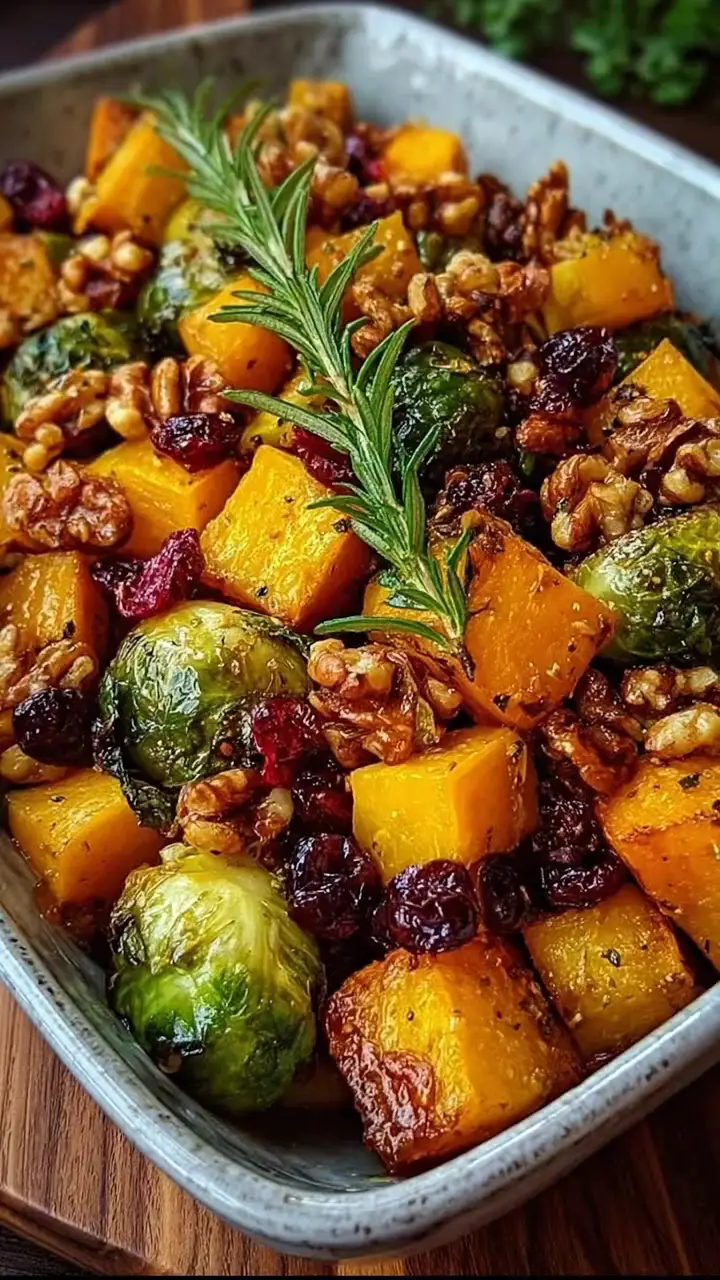
Roasted Brussels Sprouts & Butternut Squash with Maple Walnuts & Cranberries is a vibrant, nutrient-dense, and deeply flavorful side dish that effortlessly bridges seasonal elegance with rustic comfort. This harmonious medley brings together the earthy bitterness of Brussels sprouts, the velvety sweetness of roasted butternut squash, the rich crunch of maple-glazed walnuts, and the bright, tart pop of dried cranberries—creating a symphony of textures and tastes that elevates any meal, from weeknight dinners to holiday feasts. Whether served alongside roasted poultry, grilled meats, or as part of a plant-forward spread, this dish delivers warmth, complexity, and visual appeal in every bite.
The History
While Brussels sprouts and butternut squash have ancient agricultural roots—Brussels sprouts dating back to 13th-century Belgium (and named after the capital city where they were widely cultivated) and butternut squash originating in the early 20th century in Massachusetts—the modern fusion of these two vegetables in roasted preparations gained momentum during the late 20th and early 21st centuries. The rise of farm-to-table dining, seasonal cooking movements, and renewed interest in heirloom produce helped spotlight their complementary flavor profiles: the cruciferous depth of Brussels sprouts pairs remarkably well with the caramelized, nutty-sweet notes of winter squash. Meanwhile, maple syrup—a quintessential North American sweetener with Indigenous origins dating back centuries—found its way into savory roasting applications as chefs and home cooks sought natural, complex alternatives to refined sugar. Walnuts, long valued for their omega-3 richness and culinary versatility across Mediterranean, Middle Eastern, and North American cuisines, became a go-to garnish for textural contrast and toasted richness. Dried cranberries, native to North America and historically used by Indigenous peoples for food and medicine, entered mainstream kitchens in the 1950s with commercial dehydration techniques—and their tart-sweet intensity proved ideal for cutting through roasted richness. Together, these ingredients coalesced into a beloved contemporary classic: a celebration of regional bounty, cross-cultural culinary wisdom, and mindful, joyful eating.
Ingredients Breakdown
Every component in this dish serves a distinct sensory and nutritional purpose—understanding their roles deepens both appreciation and execution:
- Brussels Sprouts: Small, compact cabbage-family buds rich in glucosinolates (notably sulforaphane), vitamin C, fiber, and folate. Their slight bitterness balances sweetness and develops deep umami when roasted at high heat.
- Butternut Squash: A winter squash with dense, orange flesh high in beta-carotene (vitamin A precursor), potassium, magnesium, and dietary fiber. Its natural sugars caramelize beautifully, lending creamy sweetness and structural integrity.
- Walnuts: A tree nut packed with plant-based omega-3 fatty acids (ALA), polyphenols, magnesium, and protein. Toasting unlocks their warm, slightly bitter, buttery aroma—essential for contrast and mouthfeel.
- Maple Syrup: Pure, Grade A amber or dark maple syrup contains over 50 bioactive compounds—including quebecol and lignans—alongside manganese, zinc, and antioxidants. Its nuanced caramel-vanilla-woody notes enhance without overwhelming; its viscosity helps glaze and bind.
- Dried Cranberries: Concentrated tartness and chewy texture provide acidity and brightness. Opt for unsweetened or low-sugar varieties to avoid excess refined sugar; many brands now use apple juice concentrate or grape juice for natural sweetness.
- Olive Oil or Avocado Oil: High-smoke-point, heart-healthy fats that promote even browning, carry flavors, and support absorption of fat-soluble vitamins (A, E, K) from the vegetables.
- Aromatics & Seasonings: Freshly cracked black pepper adds piperine for enhanced nutrient absorption; flaky sea salt enhances all other flavors; optional fresh herbs (rosemary, thyme, or sage) contribute terpenes and aromatic complexity; a pinch of red pepper flakes introduces gentle heat and capsaicin.
Step-by-Step Recipe
- Preheat & Prep: Position oven racks in upper and lower thirds. Preheat oven to 425°F (220°C). Line two large, heavy-duty rimmed baking sheets with parchment paper (for easy cleanup and optimal browning—avoid foil unless lightly oiled, as it can cause steaming).
- Trim & Halve Brussels Sprouts: Remove any discolored or loose outer leaves. Trim stem ends flush. Cut each sprout in half lengthwise. For uniform roasting, discard any very small sprouts (<¾") or quarter larger ones (>1½”). Place in a large mixing bowl.
- Peel & Cube Butternut Squash: Use a sturdy Y-peeler to remove tough skin. Slice off top (stem end) and bottom. Stand upright and cut lengthwise into halves. Scoop out seeds and stringy pulp with a spoon. Cut flesh into ¾-inch cubes—uniformity is key for even roasting. Add to the same bowl as Brussels sprouts.
- Season the Vegetables: Drizzle with 3 tablespoons high-quality extra-virgin olive oil or avocado oil. Sprinkle with 1¼ teaspoons fine sea salt, ½ teaspoon freshly ground black pepper, and (optional) 1 teaspoon finely chopped fresh rosemary or thyme. Toss vigorously with clean hands or tongs until every piece glistens with oil and is evenly coated.
- Arrange for Roasting: Spread vegetables in a single, uncrowded layer on the prepared baking sheets—do not stack or overlap. Crowding causes steaming instead of roasting. If needed, use three sheets. Space sprouts cut-side down for maximum caramelization; scatter squash cubes evenly.
- First Roast Cycle: Place one sheet on the upper rack and one on the lower rack. Roast for 18 minutes. Rotate pans front-to-back and top-to-bottom halfway through for even heat distribution.
- Flip & Reassess: After 18 minutes, carefully flip Brussels sprouts (use a thin metal spatula to lift without breaking) and gently stir squash. Look for golden-brown edges and tender-crisp texture—sprouts should yield slightly when pierced with a fork but retain shape; squash should be fork-tender with caramelized corners.
- Second Roast Cycle: Return to oven for another 10–12 minutes, rotating again at the 5-minute mark. Total roasting time: 28–30 minutes. Watch closely near the end—sprouts can go from perfect to overly charred quickly.
- Prepare Maple Walnuts: While vegetables roast, combine 1 cup raw walnut halves, 2 tablespoons pure maple syrup, ¼ teaspoon fine sea salt, and (optional) ⅛ teaspoon ground cinnamon in a small nonstick skillet. Cook over medium-low heat, stirring constantly, for 4–6 minutes until syrup bubbles, thickens, and coats walnuts. Immediately spread onto parchment-lined plate or cooling rack to cool and crisp—do not let them clump.
- Add Cranberries & Finish: Transfer roasted vegetables to a large serving bowl. Gently fold in ⅔ cup unsweetened dried cranberries (or low-sugar variety). Top generously with cooled maple walnuts. Optional finish: drizzle with an additional ½–1 teaspoon maple syrup, a light sprinkle of flaky Maldon salt, and/or microgreens or chopped parsley.
Tips
- Selecting Produce: Choose firm, heavy-for-size Brussels sprouts with tightly closed, vivid green leaves—avoid yellowing, wilting, or soft spots. For butternut squash, look for matte (not shiny) beige skin, uniform shape, and no cracks or soft areas near stem or blossom end.
- Cutting Consistency: Use a sharp chef’s knife and stable cutting board. Halving sprouts vertically preserves core structure and prevents falling apart. Cubing squash uniformly ensures synchronized doneness—err on smaller rather than larger pieces if uncertain.
- Oven Calibration Matters: Many home ovens run hot or cold. Use an independent oven thermometer to verify accuracy—especially critical for caramelization without burning.
- Don’t Skip the Flip: Flipping sprouts mid-roast exposes the cut surface directly to heat, triggering Maillard reaction and deep browning. It also prevents sticking and promotes even crisping.
- Maple Syrup Timing: Never add maple syrup to vegetables before roasting—it burns easily at high temps. Always glaze walnuts separately and add both nuts and cranberries *after* roasting.
- Rest Before Serving: Let dish sit 3–5 minutes before serving. This allows residual heat to mellow sharpness, redistributes natural juices, and lets walnut crunch fully set.
- Make-Ahead Strategy: Roast vegetables up to 1 day ahead. Cool completely, store covered in fridge, then re-crisp on a parchment-lined sheet at 400°F for 8–10 minutes before adding walnuts and cranberries.
- Equipment Upgrades: A heavy-gauge stainless steel or nonstick rimmed baking sheet promotes better heat conduction than thin aluminum. A silicone baking mat offers excellent nonstick performance and even browning—but avoid stacking mats.
- Taste & Adjust: Before serving, taste a sprout and a squash cube. Adjust final seasoning with a pinch more salt or a squeeze of lemon juice if needed—the acidity brightens the entire dish.
- Leftover Creativity: Blend cooled leftovers with vegetable broth and roasted garlic for a silky autumnal soup; toss with cooked farro, arugula, and goat cheese for a hearty grain bowl; or pulse into a savory veggie pâté with tahini and lemon zest.
Variations and Customizations
This recipe is inherently adaptable—here are thoughtful, tested variations that preserve balance while accommodating preferences, seasons, and pantry availability:
- Vegan & Refined-Sugar-Free: Use certified organic maple syrup (naturally vegan) and unsweetened cranberries. Confirm walnuts are not processed on dairy/egg lines if severe allergy concerns exist.
- Nut-Free Option: Replace walnuts with roasted pepitas (pumpkin seeds) or sunflower seeds—toss with maple syrup and salt same as walnuts. Add 1 tsp smoked paprika for depth.
- Herb-Forward Version: Stir in 2 tbsp finely chopped fresh sage or rosemary *after* roasting, plus 1 tsp lemon zest. Serve with lemon wedges on the side.
- Spiced & Warm: Add ½ tsp ground cumin, ¼ tsp ground ginger, and a pinch of cardamom to the vegetable oil mixture before roasting. Finish with crumbled feta or goat cheese (if not vegan).
- Protein-Enhanced: Fold in ½ cup cooked, cooled lentils (French Puy or black beluga) or crispy baked tofu cubes after roasting. Or top with shaved Parmesan or aged Gouda.
- Low-Carb/Keto Adaptation: Reduce butternut squash to 1 cup (½-inch dice) and increase Brussels sprouts to 2 lbs. Replace maple syrup with 1 tbsp sugar-free maple-flavored syrup (e.g., Lakanto) + 1 tsp erythritol for walnut glaze. Use unsweetened cranberries only.
- Winter Citrus Twist: Add segments of 1 blood orange or Cara Cara orange (membrane removed) just before serving. Garnish with orange zest.
- Smoky Depth: Add ½ tsp smoked sea salt to vegetable seasoning, or finish with a light mist of liquid smoke (½ drop only—use sparingly).
- Gluten-Free & Allergen-Safe: Naturally GF—just verify maple syrup and cranberries are certified gluten-free if required (some processing facilities handle wheat). Use certified GF tamari instead of soy sauce if adding umami boosters.
- Sheet-Pan Simplified: Roast everything on one large sheet—place sprouts and squash in separate zones. Add walnuts to cooler edge of pan for last 5 minutes, tossing once. Less browning, but fewer dishes.
Health Considerations and Nutritional Value
This dish exemplifies functional, whole-food nutrition—each ingredient contributes synergistic phytonutrients, fiber, and healthy fats. A standard serving (1 cup, approx. 180g) provides approximately:
- Calories: ~220–250 kcal (varies by oil and maple用量)
- Fiber: 7–9 g (30–35% DV)—supports gut microbiome diversity, slows glucose absorption, and promotes satiety.
- Vitamin A (as beta-carotene): >300% DV—critical for immune function, vision, and epithelial tissue integrity.
- Vitamin C: ~120% DV—enhances iron absorption from plant foods, regenerates vitamin E, and supports collagen synthesis.
- Omega-3 ALA: ~2.5 g (150% DV for women, 100% for men)—linked to reduced inflammation and improved endothelial function.
- Polyphenols & Antioxidants: Sulforaphane (Brussels), quebecol (maple), proanthocyanidins (cranberries), and ellagic acid (walnuts) work in concert to mitigate oxidative stress and support cellular repair.
Dietary Notes: Naturally vegetarian, vegan (with certified ingredients), gluten-free, soy-free, and nut-free adaptable. Low glycemic impact when portion-controlled—ideal for metabolic health. Those with IBS may benefit from starting with smaller servings (½ cup) due to FODMAP content in Brussels sprouts and walnuts; soaking sprouts in salt water 10 minutes pre-roast may reduce raffinose. Individuals on blood-thinning medication should consult providers regarding consistent vitamin K intake (Brussels sprouts are high in K); however, moderate, regular consumption is generally preferred over erratic intake.
Ingredients
- 1½ lbs (680g) fresh Brussels sprouts, trimmed and halved lengthwise
- 1½ lbs (680g) butternut squash, peeled, seeded, and cut into ¾-inch cubes
- 3 tbsp extra-virgin olive oil or avocado oil
- 1¼ tsp fine sea salt (plus more to taste)
- ½ tsp freshly ground black pepper
- 1 cup raw walnut halves (or pieces)
- 2 tbsp pure maple syrup (Grade A amber or dark)
- ¼ tsp fine sea salt (for walnuts)
- ⅔ cup unsweetened dried cranberries (or low-sugar variety)
- (Optional) 1 tsp finely chopped fresh rosemary or thyme
- (Optional) Flaky sea salt (e.g., Maldon) and lemon wedges for serving
Directions
- Preheat oven to 425°F (220°C). Line two large rimmed baking sheets with parchment paper.
- In a large bowl, combine Brussels sprouts and butternut squash. Drizzle with 3 tbsp oil, 1¼ tsp salt, ½ tsp pepper, and (if using) herbs. Toss thoroughly until evenly coated.
- Spread vegetables in a single layer on prepared sheets—no overlapping. Roast on upper and lower oven racks for 18 minutes.
- Rotate pans front-to-back and top-to-bottom. Flip sprouts and stir squash. Return to oven for 10–12 minutes more, until sprouts are deeply golden and tender-crisp, and squash is caramelized and fork-tender.
- Meanwhile, prepare maple walnuts: In a small nonstick skillet over medium-low heat, combine walnuts, 2 tbsp maple syrup, and ¼ tsp salt. Stir constantly 4–6 minutes until syrup thickens and coats nuts. Immediately spread on parchment to cool and crisp.
- Transfer roasted vegetables to a large serving bowl. Gently fold in cranberries. Top with cooled maple walnuts.
- Finish with a light drizzle of maple syrup (½–1 tsp), flaky salt, and/or fresh herbs if desired. Serve warm.
FAQ
- Can I roast Brussels sprouts and butternut squash together?
- Yes—this recipe is specifically designed for concurrent roasting. Their similar density and roasting time (28–30 mins at 425°F) make them ideal partners. Just ensure uniform sizing and avoid overcrowding.
- Why do my Brussels sprouts taste bitter?
- Bitterness is natural but can be minimized: use fresh, small-to-medium sprouts; roast until deeply caramelized (bitter compounds break down with heat); avoid undercooking; and balance with sweet (squash, maple) and acidic (cranberries, lemon) elements.
- Can I make this ahead of time?
- Absolutely. Roast vegetables up to 24 hours ahead, cool completely, refrigerate covered, then re-crisp at 400°F for 8–10 minutes before adding cranberries and walnuts. Maple walnuts keep 1 week airtight at room temp.
- What’s the best maple syrup to use?
- Use 100% pure maple syrup—not pancake syrup (which is mostly corn syrup). Darker grades (Grade A Dark or Grade B) offer stronger, molasses-like flavor; Amber provides balanced sweetness. Organic options minimize pesticide residue.
- Can I freeze this dish?
- Not recommended. Freezing degrades the texture of roasted vegetables—Brussels sprouts become mushy and squash watery. However, raw, peeled, cubed squash freezes beautifully for future use.
- Are dried cranberries healthy?
- Unsweetened or low-sugar varieties retain antioxidants (proanthocyanidins) and fiber. Avoid brands with added sugar, apple juice concentrate, or sunflower oil. Check labels: “unsweetened” means no added sugars.
- How do I prevent walnuts from burning?
- Cook over medium-low heat, stir constantly, and remove from heat the moment syrup turns glossy and coats nuts. They continue cooking on the hot pan—spreading immediately stops carryover cooking.
- Can I air-fry this?
- Yes—with adjustments: Roast sprouts and squash separately in batches (air fryers lack space for even layering). Cook sprouts at 400°F for 14–16 min, shaking basket every 5 min. Squash at 390°F for 18–20 min. Combine after roasting.
- What wine or beverage pairs well?
- A dry Riesling or Gewürztraminer complements the dish’s sweet-savory profile. For non-alcoholic options: sparkling apple cider, chilled hibiscus tea, or infused water with orange and rosemary.
- Is this suitable for Thanksgiving or holiday menus?
- Highly recommended—it’s visually stunning, deeply flavorful, nutritionally robust, and holds well at warm serving temperature. Often becomes a requested annual tradition!
Summary
Roasted Brussels Sprouts & Butternut Squash with Maple Walnuts & Cranberries is a masterclass in seasonal balance—melding earthy, sweet, tart, and crunchy elements into a nourishing, restaurant-worthy side dish that celebrates autumn’s abundance with sophistication and soul.
With customizable variations, make-ahead flexibility, and exceptional nutritional synergy, it’s not just a recipe—it’s a versatile, joyful ritual that transforms humble vegetables into a centerpiece of wellness, flavor, and shared celebration.