Introduction
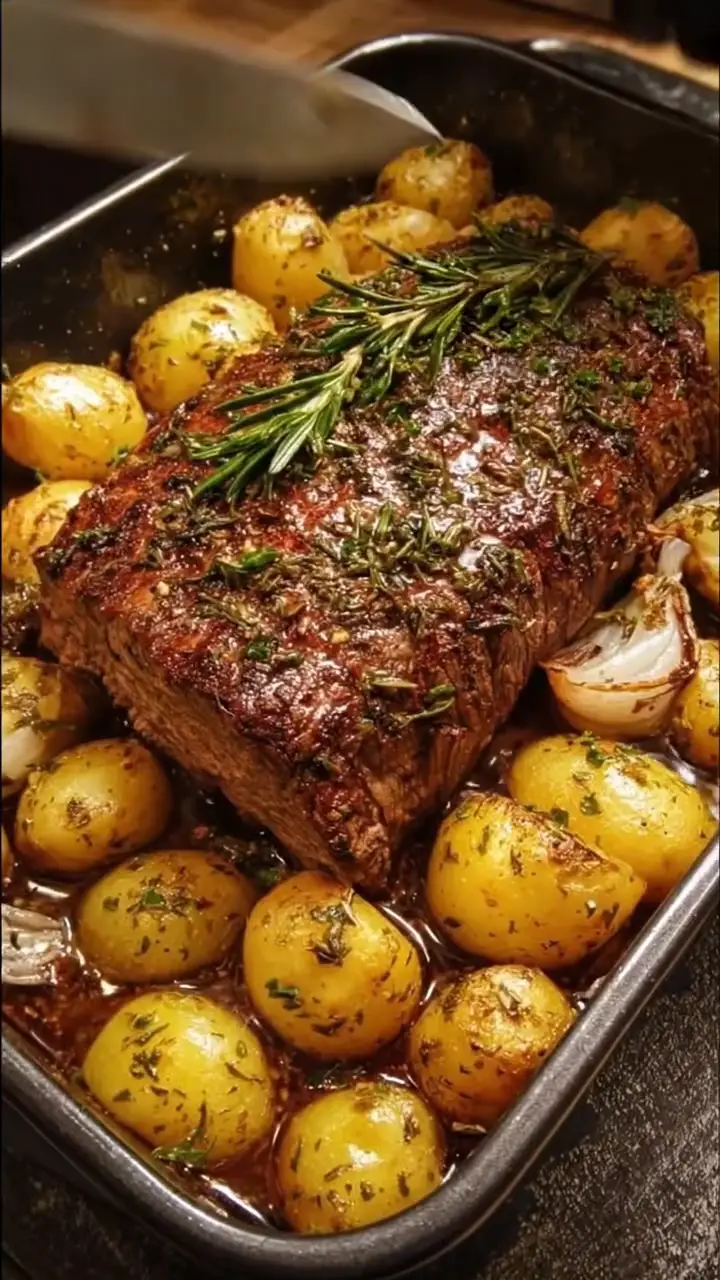
Roast Flank Steak with Potatoes is a rustic, deeply flavorful, and satisfying one-pan meal that transforms an often-overlooked cut of beef into a tender, savory centerpiece. While flank steak is traditionally grilled or marinated for quick cooking due to its lean, fibrous nature, roasting it low and slow—especially when paired with hearty root vegetables like potatoes—yields remarkable tenderness, rich caramelization, and layered umami depth. This dish bridges the gap between traditional Sunday roasts and modern, time-conscious home cooking: it’s elegant enough for guests yet humble and comforting for weeknight family dinners. With its golden-crisp potatoes soaking up savory beef drippings and the steak sliced thinly against the grain to maximize tenderness, this recipe delivers restaurant-quality results using accessible ingredients and straightforward techniques.
The History
Flank steak, derived from the abdominal muscles of the cow, has long been cherished in global cuisines—notably in Mexican carne asada, Korean bulgogi, and Middle Eastern shish taouk—where marinades and high-heat methods tenderize its dense fibers. In contrast, roast preparations for flank steak are relatively recent innovations rooted in the broader evolution of “nose-to-tail” and “whole-animal” cooking philosophies that gained momentum in the late 20th and early 21st centuries. Chefs and home cooks alike began re-examining underutilized cuts, applying slow-roasting, sous-vide, and braising techniques previously reserved for chuck or brisket. The pairing with potatoes traces back even further—to medieval European hearth cooking, where root vegetables were roasted alongside meats to absorb juices and stretch meals. The modern Roast Flank Steak with Potatoes emerged organically from this confluence: a practical, economical response to rising beef prices, growing interest in sustainable meat consumption, and the desire for hands-off, oven-based meals that require minimal supervision yet deliver maximum flavor and texture contrast.
Ingredients Breakdown
Every component in this dish plays a deliberate role in building complexity, moisture balance, textural harmony, and nutritional synergy:
- Flank Steak (1.5–2 lbs): A lean, flavorful cut with pronounced muscle grain; its collagen content responds beautifully to slow roasting when cooked to medium-rare and rested properly. Look for deep ruby-red color, fine marbling (not heavy streaks), and uniform thickness for even cooking.
- Yukon Gold or Russet Potatoes (1.5 lbs, scrubbed and cut into 1.5-inch chunks): Yukons offer buttery creaminess and crisp edges; Russets yield fluffier interiors and shatteringly crisp exteriors. Both hold shape well during roasting without disintegrating.
- Extra-Virgin Olive Oil (¼ cup): Adds fruitiness and richness while aiding in browning and preventing sticking. High smoke point varieties are ideal for roasting.
- Fresh Rosemary & Thyme (2 tbsp chopped rosemary + 1 tbsp fresh thyme leaves): Earthy, piney rosemary stands up to beef’s intensity, while thyme adds subtle floral-anise nuance and aromatic lift.
- Garlic (6 cloves, smashed and peeled): Slow-roasting mellows garlic’s pungency into sweet, nutty depth—infusing both steak and potatoes.
- Yellow Onion (1 large, thickly sliced): Provides natural sugars for caramelization and forms a flavorful base layer beneath the steak.
- Beef Broth or Bone Broth (¾ cup, low-sodium): Adds moisture, enhances savory notes (via glutamates), and creates a light pan jus without overpowering. Homemade bone broth contributes collagen for mouthfeel.
- Tomato Paste (1 tbsp): A secret umami booster—its concentrated sugars and glutamates deepen color, enrich browning (Maillard reaction), and add subtle acidity and body.
- Worcestershire Sauce (1½ tsp): Fermented anchovy, tamarind, and vinegar lend complex savoriness and brightness that balances the steak’s richness.
- Smoked Paprika (1 tsp, sweet or mild): Adds warmth, subtle smokiness, and vibrant red hue—complementing but not competing with the beef’s natural flavor.
- Sea Salt (1½ tsp, plus more to taste) & Freshly Ground Black Pepper (1 tsp): Coarse sea salt ensures even seasoning penetration; freshly cracked pepper provides volatile aromatic oils that bloom during roasting.
- Red Wine Vinegar (1 tsp, added at the end): A bright, acidic finish that cuts through fat and lifts the entire dish—added after roasting to preserve its sharp, clean tang.
Optional enhancements include halved baby carrots, quartered shallots, or diced fennel bulb for added vegetable variety and aromatic dimension.
Step-by-Step Recipe
- Prep & Marinate (30 minutes–24 hours): Pat flank steak *very* dry with paper towels. Rub evenly with 1 tsp salt, ½ tsp pepper, smoked paprika, and tomato paste. Place in a shallow dish, cover, and refrigerate for at least 30 minutes (optimal: 4–12 hours). This allows surface drying for better sear and gentle enzymatic tenderizing from the tomato paste’s natural acids.
- Preheat & Prep Pan (15 minutes): Position oven rack in lower-middle position. Preheat oven to 325°F (163°C)—a low-and-slow temperature crucial for tenderizing without drying. Select a heavy-duty, oven-safe roasting pan or Dutch oven (minimum 14″ x 10″) with high sides. Toss potatoes, onion slices, garlic cloves, rosemary, thyme, remaining ½ tsp salt, and ¼ tsp pepper with olive oil until evenly coated. Spread in an even layer across the pan.
- Sear the Steak (4–5 minutes per side): Heat a large stainless steel or cast-iron skillet over medium-high heat until shimmering. Add 1 tsp olive oil. Place steak in hot pan and sear undisturbed for 4–5 minutes until deeply browned and crust forms. Flip and sear second side for same duration. Resist moving or pressing—this builds essential fond (caramelized bits) that later flavors the jus.
- Assemble & Roast (1 hour 15 minutes–1 hour 35 minutes): Carefully transfer seared steak onto the bed of vegetables. Pour beef broth and Worcestershire sauce evenly over steak and veggies. Cover pan *tightly* with heavy-duty aluminum foil or a lid—trapping steam to gently braise the steak while roasting. Place in preheated oven. Roast for 75 minutes, then carefully remove foil and continue roasting uncovered for 15–20 minutes to re-crisp potato edges and reduce pan liquids slightly.
- Rest & Finish (20 minutes): Remove pan from oven. Transfer steak to a cutting board, tent loosely with foil, and rest for *full 20 minutes*. This allows muscle fibers to relax and reabsorb juices—critical for flank steak’s tenderness. Meanwhile, use a slotted spoon to transfer potatoes and onions to a serving platter. Skim excess fat from pan juices using a spoon or fat separator. Stir in red wine vinegar and adjust seasoning with salt and pepper. Spoon warm jus over potatoes.
- Slice & Serve: Using a *very sharp* chef’s knife, slice flank steak *thinly against the grain* at a 45-degree angle (look for parallel muscle lines and cut perpendicular to them). Arrange slices atop roasted potatoes. Drizzle with additional jus and garnish with extra fresh thyme or rosemary sprigs.
Tips
- Patience with Drying: Never skip thoroughly drying the steak before searing—it’s the single most important step for achieving a deep, flavorful crust. Moisture is the enemy of Maillard browning.
- Grain Awareness: Flank steak’s grain runs lengthwise. Always identify it *before* slicing—cutting with the grain yields tough, stringy bites; against the grain shortens muscle fibers for tenderness.
- Oven Thermometer Essential: Most home ovens run hot or cold. Use an independent oven thermometer to verify your 325°F setting—just 25°F variance can cause overcooking or insufficient tenderization.
- Potato Size Consistency: Cut all potato chunks to identical size (1.25–1.5 inches). Smaller pieces burn; larger ones remain undercooked. A serrated knife helps grip waxy skins.
- Don’t Skip the Foil Cover: Trapped steam during the initial roast phase gently breaks down connective tissue without boiling the meat—key for transforming flank into something fork-tender.
- Resting Is Non-Negotiable: Cutting too soon releases precious juices onto the board instead of back into the meat. Set a timer—the full 20-minute rest makes the difference between chewy and sublime.
- Reserve Juices Wisely: If pan liquid seems thin after roasting, return it to stovetop in the roasting pan over medium heat. Simmer 3–4 minutes until slightly reduced and glossy—do not boil vigorously, which can make it bitter.
- Use the Fond: After removing steak and veggies, deglaze the hot pan with 2 tbsp broth, scraping up all browned bits with a wooden spoon—these are pure flavor gold.
- Cold Pan Start for Garlic: Adding whole, smashed garlic cloves directly to the cold oil-potato mixture ensures gentle roasting rather than burning—a technique that yields sweet, mellow, spreadable garlic.
- Double-Duty Herbs: Reserve a few whole rosemary sprigs and thyme stems to tuck under the steak before roasting—they infuse aroma and can be discarded before serving.
Variations and Customizations
This versatile template adapts beautifully to seasonal produce, pantry staples, dietary preferences, and global flavor profiles:
- Mediterranean Style: Replace rosemary/thyme with 1 tsp dried oregano + ½ tsp lemon zest; add ½ cup kalamata olives and ¼ cup crumbled feta *after* roasting; finish with lemon juice instead of vinegar.
- Asian-Inspired: Swap Worcestershire for 1 tbsp tamari + 1 tsp grated fresh ginger + 1 tsp toasted sesame oil (added post-roast); garnish with scallions and sesame seeds; serve with steamed bok choy.
- Smoky Chipotle: Add 1–2 minced chipotle peppers in adobo + ½ tsp ground cumin to marinade; stir in 1 tbsp adobo sauce into pan juices before finishing.
- Herb-Crusted: Press a mixture of 2 tbsp chopped parsley, 1 tbsp Dijon mustard, and 1 tsp lemon zest onto steak before searing—creates a fragrant, textured crust.
- Vegetable-Forward: Add 1 cup diced parsnips, 1 cup Brussels sprouts (halved), and ½ cup pearl onions to the potato layer for added sweetness, bitterness, and crunch.
- Gluten-Free Adaptation: Ensure Worcestershire is GF-certified (many contain malt vinegar); substitute tamari for soy sauce if adding Asian elements.
- Keto/Low-Carb: Replace potatoes with 2 cups cubed rutabaga + 1 cup cauliflower florets; increase roasting time by 10–15 minutes and add 1 tbsp avocado oil for crispness.
- Wine-Braised: Substitute ½ cup dry red wine (Cabernet Sauvignon or Syrah) for half the beef broth; simmer pan juices 5 minutes post-roast to burn off alcohol and concentrate flavor.
- Instant Pot Hybrid: Sear steak and sauté veggies in IP on Sauté mode, then pressure cook on High for 35 minutes with ½ cup broth. Quick-release, then broil uncovered 5 minutes for crispiness.
- Leftover Reinvention: Thinly slice leftover steak and toss with arugula, shaved Parmesan, lemon vinaigrette, and roasted potato wedges for a hearty salad.
Health Considerations and Nutritional Value
A 6-ounce serving of Roast Flank Steak with Potatoes (including 1 cup potatoes, ½ cup onions, 2 tsp olive oil, and pan jus) provides approximately:
- Calories: ~480 kcal
- Protein: ~42 g (excellent complete protein source—rich in leucine for muscle synthesis, iron for oxygen transport, zinc for immunity, and B12 for nerve health)
- Fat: ~22 g (predominantly heart-healthy monounsaturated fats from olive oil; flank steak itself is ~7 g fat per 6 oz—lower in saturated fat than ribeye or sirloin)
- Carbohydrates: ~32 g (mostly complex carbs and fiber from potatoes and onions—Yukons provide ~3 g fiber per cup)
- Vitamins & Minerals: Exceptionally high in Vitamin B12 (120% DV), Selenium (65% DV), Zinc (50% DV), and Potassium (25% DV). Potatoes contribute Vitamin C (20% DV) and resistant starch (especially when cooled), supporting gut microbiome diversity.
Dietary Notes:
- Heart Health: Lean beef contains zero trans fat and less saturated fat than many popular cuts. Olive oil’s polyphenols and potassium from potatoes support healthy blood pressure.
- Iron Absorption: Pairing beef (heme iron) with vitamin C-rich ingredients (tomato paste, onions, optional lemon finish) significantly boosts non-heme iron absorption from plant components.
- Low-Sodium Option: Use no-salt-added broth and limit added salt to 1 tsp total—still delivers robust flavor via herbs, garlic, and umami boosters.
- Food Safety: Flank steak should reach a minimum internal temperature of 135°F (medium-rare) for optimal tenderness and safety. Use a calibrated instant-read thermometer inserted horizontally into the thickest part—avoiding fat or bone.
- Considerations: Those managing gout or kidney disease may moderate portion size due to purine content in beef. For lower histamine preparation, avoid extended marinating (>12 hours) and consume within 2 days of cooking.
Ingredients
- 1½–2 lb flank steak, trimmed of excess silver skin
- 1½ lbs Yukon Gold or Russet potatoes, scrubbed and cut into 1.5-inch chunks
- ¼ cup extra-virgin olive oil
- 2 tbsp fresh rosemary leaves, finely chopped
- 1 tbsp fresh thyme leaves
- 6 cloves garlic, smashed and peeled
- 1 large yellow onion, sliced ½-inch thick
- ¾ cup low-sodium beef broth or bone broth
- 1 tbsp tomato paste
- 1½ tsp Worcestershire sauce
- 1 tsp smoked paprika (sweet or mild)
- 1½ tsp coarse sea salt, divided
- 1 tsp freshly ground black pepper, divided
- 1 tsp red wine vinegar
Directions
- Pat flank steak extremely dry with paper towels. Rub all over with 1 tsp salt, ½ tsp pepper, smoked paprika, and tomato paste. Place in a shallow dish, cover, and refrigerate 30 minutes to 12 hours.
- Preheat oven to 325°F (163°C). In a large oven-safe roasting pan or Dutch oven, combine potatoes, onion slices, garlic, rosemary, thyme, remaining ½ tsp salt, and ¼ tsp pepper. Drizzle with olive oil and toss until evenly coated. Spread in an even layer.
- Heat a large stainless steel or cast-iron skillet over medium-high heat. Add 1 tsp olive oil. When shimmering, add steak and sear undisturbed 4–5 minutes per side until deeply browned. Transfer steak to prepared pan, placing it directly on top of the vegetables.
- Pour beef broth and Worcestershire sauce evenly over steak and vegetables. Cover pan *tightly* with heavy-duty foil or a lid. Roast in preheated oven for 75 minutes.
- Remove foil and continue roasting uncovered for 15–20 minutes, until potatoes are golden and crisp-edged and steak reaches 135°F internal temperature.
- Transfer steak to a cutting board, tent loosely with foil, and rest for 20 minutes. Meanwhile, use a slotted spoon to transfer potatoes and onions to a serving platter.
- Spoon excess fat from pan juices. Stir in red wine vinegar and adjust seasoning. Spoon warm jus over potatoes.
- Using a very sharp knife, slice steak thinly *against the grain* at a 45-degree angle. Arrange slices over potatoes and drizzle with additional jus. Garnish with fresh herbs.
FAQ
- Can I use a different cut of beef?
- Yes—but results vary. Skirt steak is thinner and cooks faster (reduce roasting time by 25–30%). Flat iron or hanger steak offer similar flavor but greater tenderness; reduce initial roast to 60 minutes. Avoid well-marbled cuts like ribeye—they’ll release too much fat and overwhelm the potatoes.
- Why roast instead of grill?
- Roasting at low temperature gently denatures collagen without evaporating moisture, yielding surprising tenderness in flank steak. Grilling excels for char and speed but risks overcooking this lean cut—especially with uneven thickness.
- My potatoes turned mushy. What went wrong?
- Likely causes: potatoes weren’t dried after washing, cut too small, or roasted uncovered the entire time. Always pat potatoes dry, cut uniformly, and cover for the first 75 minutes to create gentle steam that prevents drying out.
- Can I prepare this ahead of time?
- Absolutely. Marinate steak up to 24 hours ahead. Assemble the pan (without searing) and refrigerate covered for up to 12 hours—bring to room temperature 30 minutes before searing. Fully cooked dish reheats well: cover with foil and warm at 300°F for 15–20 minutes.
- Is the tomato paste necessary?
- Yes—it’s not just for flavor. Its natural enzymes and acids gently break down muscle proteins during marination, and its sugars accelerate caramelization during roasting. Omitting it reduces depth and crust development.
- What if I don’t have beef broth?
- Substitute with mushroom broth (for umami depth) or water + 1 tsp Better Than Bouillon Beef Base. Avoid chicken broth—it lacks the robust savoriness needed to complement flank steak.
- How do I store leftovers safely?
- Cool completely within 2 hours. Store steak and potatoes separately in airtight containers in the refrigerator for up to 4 days. Freeze cooked steak (sliced) for up to 3 months—potatoes freeze less well but can be repurposed into hash.
- Can I make this in a slow cooker?
- Not recommended—the lack of sear and high-moisture environment prevents potato crisping and dilutes flavor. However, you can sear steak and sauté veggies on stove, then transfer to slow cooker with broth and cook on Low 6–7 hours—finish under broiler for crispness.
- Why is resting so critical for flank steak?
- Flank steak’s tight muscle bundles contract tightly when hot. Resting allows residual heat to gently continue cooking while fibers relax and reabsorb expelled juices. Skipping rest = up to 30% juice loss and noticeably drier, tougher meat.
- What wine pairs best with this dish?
- A bold, fruit-forward red with moderate tannins: Zinfandel, Malbec, or a GSM blend (Grenache-Syrah-Mourvèdre). The wine’s acidity cuts the richness, while dark fruit complements the roasted vegetables and herb notes.
Summary
Roast Flank Steak with Potatoes redefines expectations for an economical, lean cut—transforming it into a tender, deeply savory, and visually stunning centerpiece through intelligent low-and-slow roasting, strategic marination, and harmonious vegetable pairing. With its crispy-edged potatoes bathed in herb-infused jus and impossibly tender, thinly sliced beef, this dish delivers restaurant-worthy satisfaction with pantry-staple simplicity and adaptable flair.