Introduction
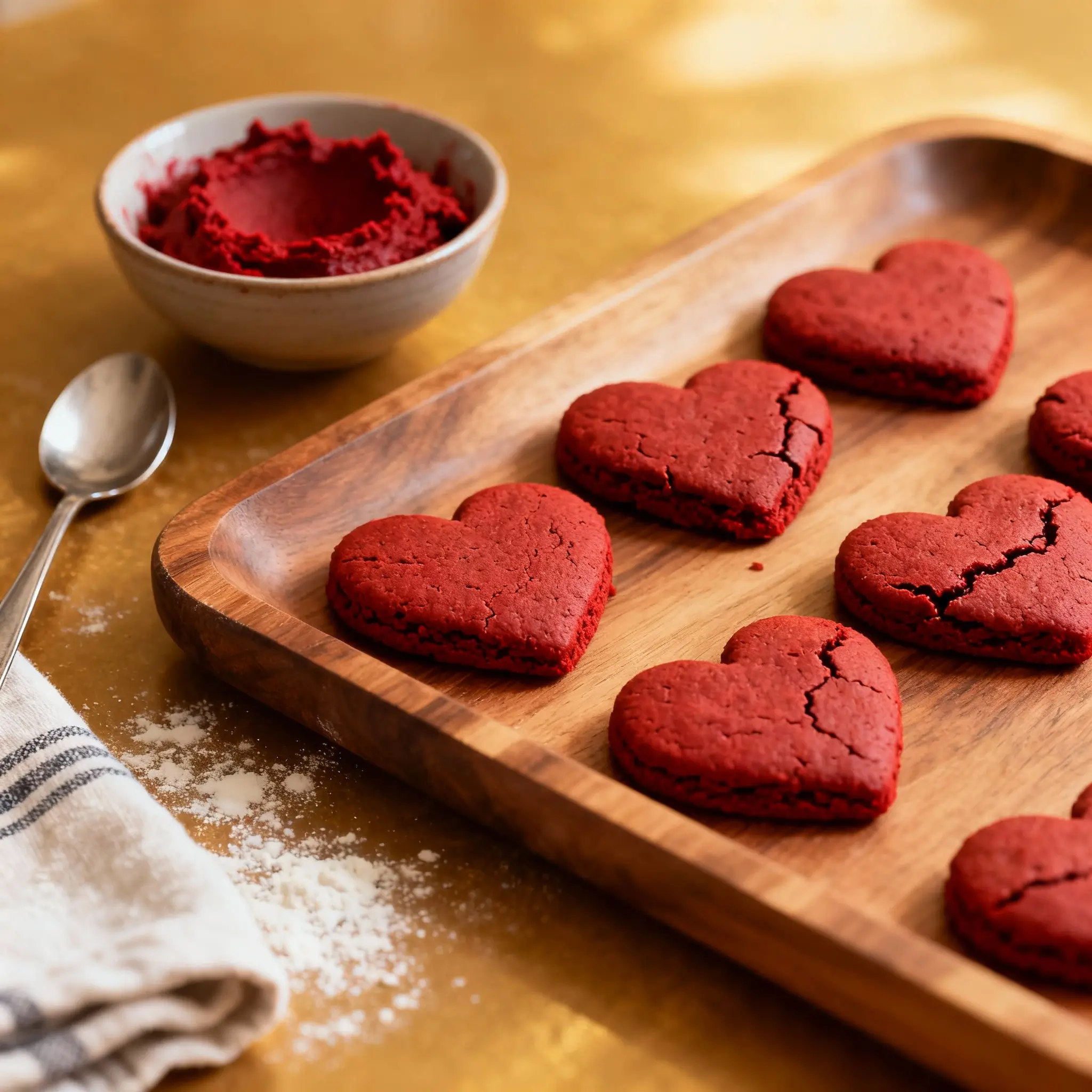
Red Velvet Heart Cookies are a stunning fusion of romance, nostalgia, and indulgent baking—perfect for Valentine’s Day, anniversaries, baby showers, or any occasion that calls for heartfelt sweetness. These soft, tender, cocoa-infused shortbread-style cookies boast the signature deep crimson hue of classic red velvet cake, enriched with buttermilk tang, a whisper of vinegar, and a luxurious cream cheese glaze that sets like satin. Shaped into delicate hearts and often adorned with edible gold dust, crushed freeze-dried strawberries, or white chocolate drizzle, they’re as visually captivating as they are delicious. More than just a cookie—they’re edible affection, crafted to evoke warmth, celebration, and artisanal charm in every bite.
The History
The origins of Red Velvet Heart Cookies trace back not to a single inventor, but to the beautiful evolution of two beloved American traditions: red velvet cake and heart-shaped holiday confections. Red velvet cake itself emerged in the early 20th century—its vibrant color initially derived from natural anthocyanin pigments in non-Dutched (natural) cocoa reacting with acidic ingredients like buttermilk and vinegar, later enhanced by food coloring for consistency and visual impact. By the 1940s, the Waldorf Astoria Hotel helped popularize the cake nationally, and its association with elegance and celebration grew steadily. Meanwhile, heart-shaped baked goods have long symbolized love—from Victorian-era sugar paste hearts stamped with romantic verses to mid-century Betty Crocker promotions encouraging “cookies for your sweetheart.” The convergence occurred in the late 1990s and early 2000s, as home bakers began adapting red velvet cake batter into drop cookies. However, true Red Velvet Heart Cookies—as a distinct, refined, structured shortbread–velvet hybrid—gained widespread traction around 2012–2015, buoyed by Pinterest aesthetics, food bloggers emphasizing texture contrast (chewy edges + melt-in-the-mouth centers), and the rise of premium cream cheese frostings formulated specifically for cookie glazes. Today, they’re a mainstay at boutique bakeries from Brooklyn to Austin and a beloved DIY project for bakers seeking both visual drama and nuanced flavor balance.
Ingredients Breakdown
Every ingredient in Red Velvet Heart Cookies serves a precise functional and sensory purpose—no element is arbitrary. Below is an in-depth analysis:
- All-Purpose Flour (2 ½ cups, spooned & leveled): Provides gluten structure for gentle chew without toughness. Spooning prevents overpacking—critical for tender cookies.
- Natural Unsweetened Cocoa Powder (¾ cup): Non-alkalized (natural) cocoa is essential—it contains the anthocyanins that react with acid to deepen red tones and contribute subtle fruitiness. Dutch-processed cocoa lacks this reactivity and yields duller color and muted flavor.
- Granulated Sugar (1 ¼ cups): Adds sweetness, aids in spreading control, and contributes to crisp edges via caramelization during baking.
- Packed Brown Sugar (¾ cup, light or dark): Introduces molasses notes, moisture retention (for chew), and acidity that enhances cocoa’s color reaction. Dark brown sugar adds deeper caramel complexity.
- Unsalted Butter (1 cup / 2 sticks, room temperature): Must be truly room temp (65–68°F)—cool enough to hold air when creamed, warm enough to emulsify smoothly. European-style butter (higher fat, ~82–84%) yields richer flavor and finer crumb.
- Large Eggs (2, room temperature): Bind structure, add richness, and assist leavening. Room-temp eggs incorporate more evenly and reduce risk of curdling.
- Buttermilk (¼ cup, full-fat, well-shaken): The primary acidulant—lowers pH to activate cocoa’s red pigments and tenderizes gluten. Full-fat ensures moisture; low-fat versions may dry out cookies.
- Distilled White Vinegar (1 tsp): A secondary acid that sharpens the red hue and brightens flavor without detectable tang—evaporates fully during baking.
- Red Food Coloring (1 tbsp liquid, or 1½ tsp gel/concentrated): Liquid provides consistent dispersion; gel offers deeper, truer red with less added moisture. Avoid “no-red” natural alternatives (beet powder, etc.) unless adjusted for pH sensitivity—they fade or turn brownish.
- Baking Soda (1 tsp): Reacts instantly with acids (buttermilk + vinegar) to produce carbon dioxide, creating lift and tenderness. Critical for the characteristic slight rise and airy crumb.
- Sea Salt (1 tsp fine, or ¾ tsp kosher): Balances sweetness, amplifies cocoa and vanilla notes, and controls yeast-like fermentation in dough if chilled.
- Vanilla Extract (2 tsp, pure, Madagascar bourbon preferred): Adds aromatic depth and rounds out the tangy-sweet profile. Imitation vanilla lacks nuance and can clash with cocoa.
- Cream Cheese Glaze Ingredients (optional but recommended): Full-fat brick-style cream cheese (4 oz, cold), powdered sugar (1 ½ cups, sifted), heavy cream (1–2 tbsp), pure vanilla (½ tsp), pinch of salt. Cold cream cheese prevents glaze from becoming runny; sifting sugar eliminates grittiness.
Step-by-Step Recipe
- Prepare Your Workspace: Line two large baking sheets with parchment paper (not silicone mats—they inhibit spread and browning). Preheat oven to 350°F (175°C). Position racks in upper and lower thirds. Weigh or meticulously measure all dry ingredients—accuracy is non-negotiable for color and texture.
- Cream Butter & Sugars: In a stand mixer fitted with paddle attachment, beat softened butter, granulated sugar, and brown sugar on medium speed for 3–4 minutes until pale, fluffy, and completely homogenous—scraping bowl twice. Over-creaming causes excess spread; under-creaming yields dense cookies.
- Add Eggs & Vanilla: Add eggs one at a time, beating on medium-low for 30 seconds after each addition until fully incorporated and glossy. Add vanilla and mix 15 seconds. Batter should look smooth, not curdled.
- Whisk Dry Ingredients: In a separate bowl, thoroughly whisk together flour, cocoa powder, baking soda, and salt. Sift twice to ensure no lumps and even cocoa distribution—this prevents streaking and guarantees uniform color.
- Alternate Wet & Dry: On low speed, add ⅓ of dry mixture → mix 15 sec. Add ½ buttermilk → mix 10 sec. Repeat (dry → wet → dry), ending with final third of dry mix. Mix only until *just* combined—do not overmix. Batter will be thick, slightly sticky, and deeply maroon.
- Incorporate Color & Acid: Drizzle in red food coloring and vinegar. Mix on low for 20–25 seconds until color is perfectly even and glossy. Pause to scrape paddle and bowl base—any unmixed streaks will bake as pale patches.
- Chill Dough (Non-Negotiable Step): Cover bowl tightly and refrigerate for *minimum 2 hours, ideally 4–24 hours*. This hydrates flour, firms butter, concentrates flavor, prevents overspreading, and deepens red color through acid-cocoa interaction. Do not skip—even 30 minutes is insufficient.
- Portion & Shape: Using a 1.5-tablespoon cookie scoop, portion chilled dough. Roll each into a smooth ball, then gently flatten between palms to ~½-inch thickness. Press into a heart shape using a lightly floured 3-inch heart-shaped cutter—or use a heart-shaped cookie stamp for embossed detail. Place 2 inches apart on prepared sheets.
- Bake Strategically: Bake 1 sheet at a time in center rack for 10–12 minutes. Cookies are done when edges are set and slightly firm to touch, centers look *just* set (no wet shine), and bottoms are lightly golden. Rotate sheet front-to-back at 7-minute mark for even baking. Cool on sheet 5 minutes—this finishes cooking and sets structure—then transfer to wire racks to cool completely (≈45 min) before glazing.
- Prepare Glaze: While cookies cool, beat cold cream cheese on medium until smooth (1 min). Gradually add sifted powdered sugar in 3 additions, beating 30 sec between. Add cream, vanilla, and salt; beat 1–2 min until glossy and pipeable (like thick yogurt). If too thick, add ½ tsp cream; if too thin, add 1 tbsp sugar.
- Glaze & Decorate: Using a small offset spatula or piping bag with #3 round tip, generously coat cooled cookies. Immediately garnish: sprinkle with flaky sea salt, edible rose petals, freeze-dried strawberry dust, white chocolate curls, or 22K gold leaf flakes. Let glaze set 1 hour at room temp before stacking or packaging.
Tips
- Color Consistency Tip: For deepest, most stable red, use high-quality gel food coloring (Wilton No-Taste Red, AmeriColor Super Red, or Chefmaster Soft Gel Paste). Liquid red often fades or turns pinkish during baking—gel holds intensity.
- Temperature Control is Everything: Butter must be cool-room temp—not greasy or melty. Eggs and buttermilk should be fridge-cold when added, then brought up gradually via mixing. Warm ingredients cause premature fat melting = flat cookies.
- No Substitutions for Buttermilk: Do not replace with milk + lemon/vinegar unless you age the mixture 10+ minutes to develop proper acidity and curd structure. Store-bought cultured buttermilk is ideal.
- Chill Twice for Perfection: After shaping hearts, chill cut cookies on baking sheets for 15 minutes before baking—this prevents distortion and maintains sharp edges.
- Oven Thermometer Required: Most ovens run hot or cold. An inexpensive oven thermometer ensures 350°F accuracy—±25°F variance causes underbaked centers or burnt edges.
- Cooling Surface Matters: Always cool on wire racks—not countertops or folded towels. Trapped steam makes bottoms soggy and interferes with glaze adhesion.
- Glaze Timing Precision: Never glaze warm cookies—the heat melts the glaze, causing it to pool and lose definition. Fully cooled = perfect sheen and clean lines.
- Storage for Freshness: Store undecorated cookies airtight at room temp up to 5 days. Glazed cookies last 3 days at room temp or 7 days refrigerated (bring to room temp 30 min before serving for best texture).
- Freezing Success: Freeze unbaked dough balls up to 3 months. Bake straight from freezer—add 1–2 minutes to bake time. Glaze after cooling.
- High-Altitude Adjustment (3,000+ ft): Reduce baking soda to ¾ tsp, increase flour by 1 tbsp, and bake at 360°F for 9–11 minutes.
Variations and Customizations
Red Velvet Heart Cookies offer remarkable versatility—elevating tradition while honoring their core identity. Here are chef-tested, crowd-approved adaptations:
- Dark Chocolate Swirl: Melt 4 oz 70% dark chocolate, cool to 90°F. After portioning dough, place ½ tsp chocolate in center of each ball before shaping into hearts. Gently fold edges to encase—creates molten core when baked.
- White Chocolate–Cranberry: Fold in ¾ cup dried unsweetened cranberries (soaked 10 min in orange juice, patted dry) and ½ cup white chocolate chips. Replace 1 tbsp cocoa with freeze-dried raspberry powder for berry brightness.
- Espresso Velvet: Add 1 tsp instant espresso powder to dry ingredients. Enhances cocoa depth without coffee flavor—ideal for sophisticated palates.
- Vegan Velvet Hearts: Substitute butter with vegan butter (Miyoko’s or Earth Balance), eggs with flax eggs (2 tbsp ground flax + 5 tbsp water), buttermilk with almond milk + 1 tsp vinegar, and use vegan cream cheese glaze. Note: Color may be slightly less vibrant.
- Gluten-Free Velvet: Use 1:1 GF flour blend with xanthan gum (King Arthur or Bob’s Red Mill). Add ½ tsp psyllium husk powder to improve elasticity and prevent crumbliness.
- Mini Heart Bites: Portion with 1-teaspoon scoop, bake 7–8 minutes. Perfect for favors, dessert tables, or portion control.
- Stuffed Heart Cookies: Flatten dough into 2-inch circles. Place 1 tsp cream cheese filling (cream cheese + powdered sugar + lemon zest) in center, fold edges up and seal. Reshape into heart—creates decadent surprise center.
- Spiced Velvet: Add ½ tsp ground cinnamon, ¼ tsp ground cardamom, and tiny pinch of black pepper to dry ingredients—warm, aromatic, and unexpected.
- Boozy Velvet: Replace 1 tbsp buttermilk with 1 tbsp bourbon or cherry brandy. Adds complex, grown-up nuance (alcohol bakes off completely).
- Matcha Velvet Hearts (Vibrant Green Twist): Omit cocoa and red coloring. Add 2 tbsp culinary-grade matcha + 1 tsp spirulina for electric green. Pair with yuzu glaze.
Health Considerations and Nutritional Value
While Red Velvet Heart Cookies are inherently indulgent, mindful preparation allows for thoughtful enjoyment without compromising joy. A standard 3-inch heart cookie (un-glazed, ~32g) contains approximately:
- Calories: 145 kcal
- Total Fat: 7.2 g (4.3 g saturated)
- Carbohydrates: 19.5 g (16.2 g sugars)
- Protein: 1.8 g
- Fiber: 0.9 g
- Sodium: 115 mg
Key Health Notes:
- Cocoa Benefits: Natural cocoa is rich in flavanols—antioxidants linked to improved endothelial function and mild blood pressure support. Choose high-flavanol, minimally processed cocoa when possible.
- Sugar Awareness: The recipe uses moderate sugar for structure and browning. For reduced sugar, decrease granulated by ¼ cup—but expect denser texture and less spread. Never reduce brown sugar below ½ cup—it’s vital for moisture.
- Butter vs. Oil: Butter provides superior flavor and texture. Substituting oil sacrifices crisp edges and creates greasier, cake-like cookies.
- Gluten Sensitivity: As noted in Variations, certified GF options exist—but cross-contamination risk remains for celiac individuals unless prepared in dedicated facilities.
- Dairy Considerations: Buttermilk and cream cheese provide calcium and probiotics (in raw/fermented forms), though pasteurization reduces live cultures. Lactose-intolerant individuals may tolerate small amounts due to low lactose content in aged cheeses—but vegan versions eliminate dairy entirely.
- Food Coloring Safety: FDA-approved red dyes (Red 40, Red 3) are rigorously tested. For sensitive individuals (especially children), opt for natural alternatives like beetroot powder—though color yield requires tripling the amount and pH adjustment with baking soda (consult food scientist resources for precise ratios).
- Portion Mindfulness: Their beauty encourages savoring—not scarfing. Serve 1–2 per person alongside herbal tea or sparkling water to enhance satisfaction with less volume.
- No Artificial Preservatives: This homemade version contains zero propyl gallate, TBHQ, or artificial flavors—making it cleaner than commercial counterparts, even if equally decadent.
Ingredients
Makes approx. 24–28 (3-inch) heart cookies
- 2 ½ cups (315g) all-purpose flour, spooned & leveled
- ¾ cup (65g) natural unsweetened cocoa powder (non-alkalized)
- 1 ¼ cups (250g) granulated sugar
- ¾ cup (150g) packed light or dark brown sugar
- 1 cup (227g / 2 sticks) unsalted butter, softened to 65–68°F
- 2 large eggs, cold
- ¼ cup (60ml) full-fat cultured buttermilk, well-shaken
- 1 tsp distilled white vinegar
- 1 tbsp (15ml) liquid red food coloring or 1½ tsp high-strength red gel food coloring
- 1 tsp baking soda
- 1 tsp fine sea salt (or ¾ tsp Diamond Crystal kosher salt)
- 2 tsp pure vanilla extract
Cream Cheese Glaze:
- 4 oz (113g) full-fat brick-style cream cheese, cold and cubed
- 1 ½ cups (180g) powdered sugar, sifted
- 1–2 tbsp (15–30ml) heavy cream or whole milk
- ½ tsp pure vanilla extract
- Pinch of fine sea salt
Optional Garnishes: Flaky sea salt, crushed freeze-dried strawberries, white chocolate shavings, edible rose petals, 22K gold leaf, red sanding sugar.
Directions
- Line two large baking sheets with parchment paper. Preheat oven to 350°F (175°C). Position racks in upper and lower thirds.
- In a stand mixer with paddle attachment, beat butter, granulated sugar, and brown sugar on medium speed for 3–4 minutes until pale, fluffy, and no graininess remains. Scrape bowl and paddle thoroughly.
- Add eggs one at a time, beating 30 seconds after each until fully incorporated and glossy. Add vanilla; mix 15 seconds.
- In a separate bowl, whisk together flour, cocoa powder, baking soda, and salt. Sift twice into a clean bowl.
- On low speed, add ⅓ dry mixture; mix 15 seconds. Add ½ buttermilk; mix 10 seconds. Repeat (dry → buttermilk → dry), ending with final dry portion. Mix only until *no dry streaks remain*—do not overmix.
- Add red food coloring and vinegar. Mix on low for 20–25 seconds until uniformly deep red and glossy. Scrape paddle and bowl base to ensure even color.
- Cover bowl tightly with plastic wrap. Refrigerate dough for minimum 2 hours, preferably 4–24 hours.
- Using a 1.5-tablespoon scoop, portion chilled dough. Roll each into smooth ball, then gently flatten and shape into 3-inch heart using floured cutter or stamp. Place 2 inches apart on prepared sheets.
- Chill shaped cookies on sheets for 15 minutes (optional but recommended for sharp edges).
- Bake one sheet at a time in center rack for 10–12 minutes—until edges are set, centers appear just-set (no wet shine), and bottoms are lightly golden. Rotate sheet front-to-back at 7 minutes.
- Cool cookies on sheet for 5 minutes, then transfer to wire racks. Cool completely (≈45 minutes) before glazing.
- For glaze: Beat cold cream cheese until smooth (1 minute). Gradually add powdered sugar in 3 batches, beating 30 seconds between. Add cream, vanilla, and salt; beat 1–2 minutes until glossy and pipeable.
- Glaze cooled cookies generously. Immediately garnish. Let glaze set 1 hour at room temperature before serving or storing.
FAQ
- Why did my cookies spread too much?
- Likely causes: butter too warm, insufficient chilling (dough or shaped cookies), expired baking soda, or over-creaming. Ensure butter is cool-room temp, chill dough ≥2 hours, and verify baking soda freshness (test in vinegar—if no vigorous fizz, replace).
- Can I make these ahead for Valentine’s Day?
- Absolutely! Bake cookies up to 5 days ahead and store airtight at room temperature. Glaze and decorate the day before or morning of. Unbaked dough keeps frozen 3 months—bake from frozen with +1–2 min bake time.
- My red color turned brown/pink—what went wrong?
- Brown: Too much baking soda (excess alkalinity neutralizes anthocyanins), Dutch-process cocoa used, or overbaking. Pink: Insufficient food coloring, too much buttermilk diluting pigment, or using liquid dye with weak concentration. Use gel + natural cocoa + precise baking soda.
- Can I use coconut oil instead of butter?
- Not recommended. Coconut oil has a lower melting point and different crystalline structure—it yields greasy, brittle, or overly soft cookies lacking richness and structure. Vegan butter is the only reliable substitute.
- How do I prevent cracked glaze?
- Cracking occurs when glaze dries too fast (low humidity) or is applied too thickly. Solution: Apply thin, even layer; avoid fans or AC drafts during setting; add ½ tsp light corn syrup to glaze for flexibility.
- Are these safe for nut allergies?
- Yes—this recipe contains no nuts. However, always verify labels on food coloring, cocoa, and powdered sugar, as some brands process on shared equipment. For severe allergy, choose certified nut-free brands.
- Can I add sprinkles before baking?
- Yes—but only jimmies or quins that withstand heat. Avoid nonpareils (they bleed) or metallic sprinkles (not oven-safe). Press gently onto shaped dough before chilling.
- Why does the recipe use both granulated and brown sugar?
- Granulated sugar promotes spread and crisp edges; brown sugar adds moisture, chew, molasses depth, and acidity for color development. Omitting either compromises texture and hue.
- My glaze is too runny—can I fix it?
- Yes! Chill glaze 15 minutes, then beat in 1–2 tbsp additional sifted powdered sugar. If too thick, add cream ½ tsp at a time—never water (it breaks emulsion).
- Can kids help make these?
- Yes—with supervision! Kids excel at scooping, shaping hearts, sprinkling garnishes, and stirring glaze. Assign age-appropriate tasks: ages 4–6 can press dough into cutters; ages 7–10 can measure dry ingredients; teens can operate mixer and glaze.
Summary
Red Velvet Heart Cookies are a masterclass in balanced indulgence—melding the nostalgic allure of red velvet cake with the timeless symbolism of the heart, achieved through precise chemistry (cocoa + acid + alkali), disciplined technique (chilling, temperature control), and artful presentation (luxurious cream cheese glaze and elegant garnishes). They’re not merely seasonal treats but edible heirlooms—crafted with intention, shared with love, and remembered for their vivid beauty, tender crumb, and unforgettable, velvety sweetness.
Whether baked for a first date, a milestone anniversary, or simply as a radiant act of self-care, each heart-shaped cookie carries the quiet power to say what words sometimes cannot: you are cherished, deeply and deliciously.