Introduction
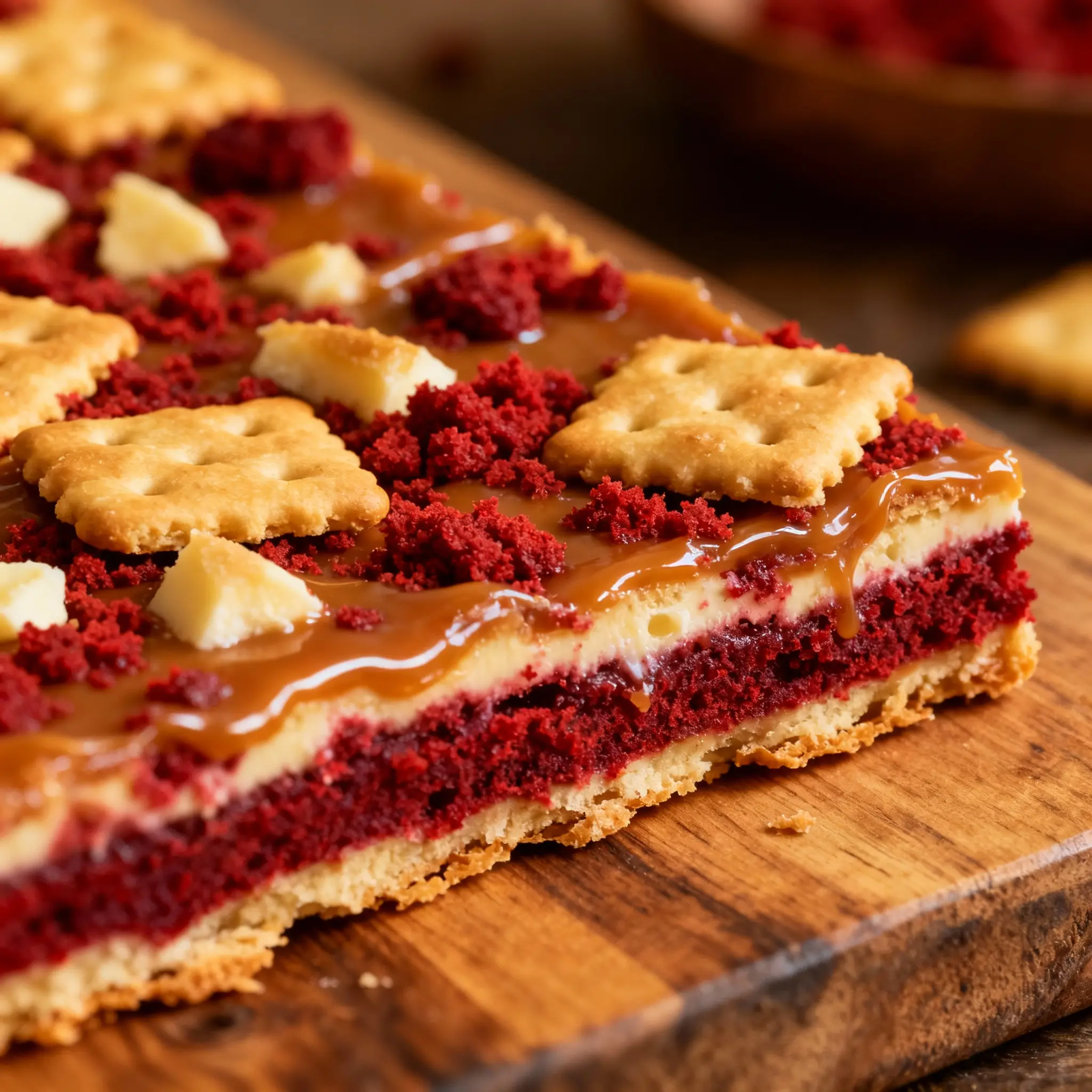
Red Velvet Cracker Toffee is a dazzling, modern twist on the classic holiday favorite—cracker toffee (also known as Christmas crack or buttercrunch). This vibrant confection marries the rich, buttery crunch of traditional cracker toffee with the unmistakable elegance and flavor profile of red velvet cake: cocoa-infused sweetness, subtle tang from buttermilk or vinegar, and a whisper of vanilla and cream cheese-inspired nuance. Visually stunning with its deep crimson hue and snowy dusting of white chocolate or powdered sugar, Red Velvet Cracker Toffee delivers a sophisticated sensory experience—crisp yet melt-in-your-mouth, sweet with balanced acidity, and luxuriously textured. It’s more than a snack—it’s a statement dessert that bridges nostalgia and innovation, perfect for festive platters, gourmet gift boxes, or as a conversation-starting addition to bridal showers, Valentine’s Day tables, or even Halloween “bloody” dessert spreads.
The History
Cracker toffee traces its roots to mid-20th-century American home kitchens, where resourceful bakers combined saltine crackers, brown sugar, and butter into a simple, addictive brittle-like treat—often baked in jelly-roll pans and topped with chocolate before being broken into shards. Its popularity surged during the 1970s and ’80s, earning affectionate monikers like “Christmas Crack” for its irresistible, habit-forming crunch. Meanwhile, red velvet cake—a Southern American icon since the early 1900s—evolved from a mahogany-hued cocoa cake chemically activated by acidic ingredients (like buttermilk and vinegar) and historically enhanced by natural cocoa’s reaction with non-alkalized baking soda. The modern red velvet renaissance began in the 1990s and 2000s, fueled by food media, cupcake culture, and the rise of “red velvet” as a standalone flavor identity—extending beyond cake into pancakes, milkshakes, and even savory applications. The fusion into Red Velvet Cracker Toffee emerged organically around 2012–2015, pioneered by innovative food bloggers and boutique confectioners seeking to elevate the humble cracker toffee with premium flavor layering, color storytelling, and experiential appeal. Its ascent coincided with the “gourmet snackification” trend, where artisanal reinterpretations of childhood treats gained traction on Pinterest, Instagram, and specialty food markets—making Red Velvet Cracker Toffee not just a recipe, but a cultural artifact of contemporary American dessert evolution.
Ingredients Breakdown
Every component in Red Velvet Cracker Toffee serves a precise functional and flavor purpose—no ingredient is arbitrary. Below is an in-depth analysis of each element:
- Saltine Crackers (or Premium Butter Crackers): Provide structural integrity and salty contrast. Their thin, uniform shape ensures even caramelization and clean breakage. High-quality, low-sodium varieties allow better control over overall salt balance.
- Unsalted Butter: The backbone of the toffee layer—clarified or European-style (82–84% fat) butter yields superior richness and higher smoke point, reducing scorch risk. Salted butter may be used—but adjust added sea salt accordingly.
- Packed Light Brown Sugar: Delivers molasses depth, moisture retention, and chewiness. Dark brown sugar intensifies caramel notes but may darken the red hue; light brown offers optimal balance and brightness.
- Granulated Sugar: Adds crispness and helps achieve the glassy, brittle texture. A small amount prevents excessive softness while supporting the Maillard reaction.
- Red Food Coloring (Gel-Based, Highly Concentrated): Critical for authentic red velvet appearance without diluting the syrup or introducing bitterness. Liquid coloring adds unwanted water; powder may clump. Gel ensures vivid, stable color at minimal volume (¼–½ tsp).
- Natural Cocoa Powder (Non-Alkalized/Unsweetened): Provides the signature red velvet cocoa base—not Dutch-process, which neutralizes acidity and dulls the color-reactive chemistry essential for vibrancy. Acts as both flavor enhancer and pH modulator.
- Distilled White Vinegar or Apple Cider Vinegar: Mimics the acid component of traditional red velvet, brightening flavor, enhancing cocoa’s red tones, and tenderizing the toffee matrix slightly for nuanced snap versus shatter.
- Real Vanilla Extract (Double-Strength or Madagascar Bourbon): Imparts warm, floral complexity that rounds out the sharpness of vinegar and cocoa—synthetic vanillin lacks depth and can taste medicinal under high heat.
- Fine Sea Salt (Flaky or Kosher): Applied post-bake for controlled salinity. Enhances sweetness perception, balances bitterness from cocoa, and creates a luxurious textural contrast against glossy chocolate.
- High-Quality White Chocolate (32–36% cocoa butter): Preferred over candy melts for superior mouthfeel, creamy finish, and subtle sweetness that complements—not competes with—the red velvet base. Couverture-grade ensures smooth tempering and glossy sheen.
- Optional Garnishes: Crushed freeze-dried strawberries (for tartness + visual pop), edible gold dust (for luxury occasions), miniature chocolate-covered cream cheese chips (for layered red velvet authenticity), or finely grated orange zest (to lift cocoa notes).
Step-by-Step Recipe
- Prep & Preheat: Line a large rimmed baking sheet (13″x18″ half-sheet pan) with parchment paper, extending 2 inches over two opposite edges for easy lifting. Lightly grease parchment with butter or nonstick spray. Position oven rack in center. Preheat oven to 400°F (200°C). Arrange 48–54 whole saltine crackers in a single, tightly packed layer—no gaps, no overlaps—covering the entire surface. Gently press crackers into parchment to prevent shifting.
- Make the Red Velvet Toffee Syrup: In a heavy-bottomed, light-colored saucepan (2–3 qt), combine 1 cup (227g) unsalted butter, 1 cup (200g) packed light brown sugar, ¼ cup (50g) granulated sugar, 2 tbsp (5g) natural unsweetened cocoa powder, and 1 tsp distilled white vinegar. Stir constantly over medium-low heat until butter fully melts and mixture begins to bubble gently—about 3–4 minutes. Increase heat to medium and bring to a full, rolling boil. Insert a candy thermometer. Boil—without stirring—to exactly 295°F (146°C), the “hard-crack” stage. This takes 8–12 minutes. Watch closely: temperature rises rapidly near the end. At 290°F, begin adding gel red food coloring, ¼ tsp at a time, whisking vigorously after each addition until fully dispersed. Total coloring: ½ tsp for deep crimson, ¼ tsp for rosy burgundy. Remove from heat immediately at 295°F.
- Pour & Spread: Working quickly but carefully, pour hot syrup evenly over cracker layer. Use a heat-resistant offset spatula or the back of a metal spoon to gently spread syrup into all corners—avoid dragging crackers. Tip pan slightly to pool excess syrup into thin areas if needed. Do not scrape bottom of pan—residual syrup will caramelize onto parchment.
- Bake for Caramelization: Place pan in preheated oven. Bake 8 minutes exactly—set timer. The syrup will bubble violently, then subside into a glossy, deep red surface. Do not open oven door before 7 minutes. At 8 minutes, remove pan—edges will be deeply amber, center slightly paler (normal).
- Cool Slightly & Add Chocolate: Let pan rest on wire rack for 2 minutes—just until surface stops bubbling but remains hot enough to melt chocolate (approx. 180°F). Meanwhile, finely chop 12 oz (340g) high-quality white chocolate. Sprinkle evenly over hot toffee. Wait 2–3 minutes for chocolate to soften, then spread smoothly with offset spatula. Optional: press in garnishes now (e.g., crushed strawberries or gold flakes).
- Chill & Set: Refrigerate uncovered for 45–60 minutes, until chocolate is firm to touch and toffee is completely cool. For best snap, chill overnight—texture improves with time as residual moisture migrates.
- Break & Store: Lift parchment to remove slab. Place on cutting board. Using a heavy chef’s knife or bench scraper, score lines lightly, then sharply tap handle to break into rustic shards (2–3 inches). Or use hands for organic pieces. Store in airtight container with parchment between layers at cool room temperature (60–68°F) for up to 2 weeks—or freeze for 3 months.
Tips
- Thermometer Is Non-Negotiable: Candy-making precision demands accuracy. Calibrate your thermometer in boiling water (should read 212°F at sea level) before starting. A variance of ±5°F alters texture dramatically—too low = sticky, chewy toffee; too high = bitter, grainy, or burnt.
- Light-Colored Pan = Visual Clarity: Use stainless steel or light enamel for syrup cooking. Dark pots hide color changes and make it hard to spot early caramelization or scorching.
- Vinegar Timing Matters: Add vinegar only after butter and sugars melt—introducing acid too early can cause premature crystallization. Whisk in last, just before boiling begins.
- Cracker Quality Impacts Texture: Avoid “thin” or “light” saltines—they’re too fragile and absorb butter unevenly. Opt for standard, sturdy saltines (like Keebler Zesta or Nabisco Premium) or upgraded butter crackers (e.g., Raincoast Crisps Sea Salt) for richer flavor and sturdier base.
- Humidity Is the Enemy: Make this on dry days (<60% RH). High humidity causes chocolate to bloom and toffee to soften or become tacky. If necessary, run AC or dehumidifier during prep and storage.
- White Chocolate Tempering Hack: For professional shine and snap, temper white chocolate separately (melt ⅔, cool to 82°F, recombine with reserved ⅓, warm to 86–88°F) before spreading. Untempered chocolate will still set—but may develop streaks or dullness.
- Rescue Undercooked Toffee: If syrup didn’t reach 295°F and toffee stays soft/chewy after chilling, re-bake at 325°F for 5–7 minutes, then re-chill. Overcooked? Grind into “red velvet toffee dust” for cake crumb toppings or ice cream sprinkles.
- Clean-Up Pro-Tip: Soak saucepan in hot, soapy water immediately after use—residual toffee hardens into impenetrable shell. For stubborn bits, simmer 1 cup water + 1 tbsp vinegar in pan for 10 minutes, then wipe clean.
Variations and Customizations
Red Velvet Cracker Toffee is a canvas for creativity—each variation honors the core identity while expanding its versatility:
- Black Tie Red Velvet: Swap white chocolate for dark chocolate (65–70% cacao) and sprinkle with edible black lava salt and crushed cocoa nibs for refined bitterness and contrast.
- Velvet & Vine: Infuse butter with 1 tsp dried hibiscus flowers (steep 10 min off heat, strain) for floral tartness and natural magenta hue—reducing need for artificial coloring.
- Maple Velvet Crunch: Replace ¼ cup brown sugar with Grade A dark maple syrup; reduce vinegar to ½ tsp. Top with candied pecans and maple sugar crystals.
- Boozy Velvet Brickle: Stir 1 tbsp high-proof vanilla vodka or cream sherry into hot syrup off-heat for aromatic lift and subtle warmth (alcohol evaporates during bake).
- Vegan Velvet Toffee: Use vegan butter (Miyoko’s or Earth Balance), coconut sugar (for deeper molasses tone), aquafaba-based “buttermilk” (1 tbsp lemon juice + ¾ cup soy milk), and dairy-free white chocolate (Pascha or Enjoy Life). Ensure crackers are egg-free.
- Gluten-Free Velvet Brittle: Substitute certified GF crackers (like Blue Diamond Nut-Thins or Mary’s Gone Crackers Super Seed) and verify all extracts/sugars are GF-certified. Texture may be slightly more delicate—bake 1 minute less.
- Miniature Velvet Bites: Press cracker layer into mini muffin tins (1 per cup), pour syrup, bake 6 minutes, top with mini chocolate chips. Perfect for party favors or wedding cookies.
- Spiced Velvet Snap: Add ¼ tsp ground cardamom + ⅛ tsp cayenne to syrup for warm, aromatic heat that enhances cocoa without overwhelming.
- Decadent Velvet Layer Cake Version: Use crushed Red Velvet Cracker Toffee as a crust for no-bake red velvet cheesecake—or fold shards into red velvet brownie batter before baking.
Health Considerations and Nutritional Value
While undeniably indulgent, understanding the nutritional composition empowers mindful enjoyment. Per standard 1-inch shard (approx. 28g):
- Calories: 145–160 kcal (primarily from sugars and fats)
- Total Fat: 8–9g (5–6g saturated; minimal trans fat if using natural butter)
- Carbohydrates: 18–20g (17–19g sugars; <1g fiber)
- Sodium: 120–180mg (moderate—largely from crackers and added salt)
- Protein: 0.8–1.2g (negligible, unless fortified with nut-based crackers)
Functional Notes:
- Sugar Content Awareness: Contains both sucrose (granulated) and sucrose+molasses (brown sugar)—a rapid-acting carbohydrate source. Those managing blood glucose should consume in strict portion control (1–2 pieces max) and pair with protein/fat (e.g., alongside almonds or Greek yogurt).
- Cocoa Benefits: Natural cocoa provides flavanols (antioxidants linked to vascular health) and trace minerals (magnesium, iron, zinc)—though levels are modest per serving due to small quantity used.
- Vinegar Contribution: Acetic acid may support glycemic response modulation and digestive enzyme activation—research is emerging, but culinary tradition affirms its balancing role.
- Allergen Alert: Contains dairy (butter, white chocolate), wheat (crackers), soy (lecithin in chocolate), and potentially tree nuts (if garnished). Always label clearly for guests.
- Not a Health Food—but Not Without Merit: When enjoyed intentionally—as part of a balanced diet, not daily fare—its real-food ingredients (butter, cocoa, vinegar) offer more nutritional integrity than ultra-processed candy bars laden with hydrogenated oils and artificial additives. Portion discipline and ingredient quality are key.
Ingredients
- 48–54 plain saltine crackers (standard size, ~200g)
- 1 cup (227g / 2 sticks) unsalted butter, cut into tablespoon pieces
- 1 cup (200g) packed light brown sugar
- ¼ cup (50g) granulated sugar
- 2 tablespoons (5g) natural unsweetened cocoa powder (non-alkalized)
- 1 teaspoon distilled white vinegar or apple cider vinegar
- ½ teaspoon pure vanilla extract
- ½ teaspoon concentrated red gel food coloring (e.g., Americolor Super Red or Chefmaster Red)
- 1 teaspoon flaky sea salt or kosher salt, for finishing
- 12 ounces (340g) high-quality white chocolate (32–36% cocoa butter), finely chopped
- Optional garnishes: 2 tbsp crushed freeze-dried strawberries, ¼ tsp edible gold dust, 1 tbsp miniature cream cheese chips
Directions
- Line a 13″x18″ rimmed baking sheet with parchment paper, extending over two opposite sides. Lightly grease parchment. Preheat oven to 400°F (200°C). Arrange crackers in a single, snug layer on parchment.
- In a heavy-bottomed 2–3 quart light-colored saucepan, combine butter, brown sugar, granulated sugar, cocoa powder, and vinegar. Melt over medium-low heat, stirring constantly, 3–4 minutes until smooth. Increase heat to medium; bring to a full rolling boil. Insert candy thermometer.
- Boil without stirring to exactly 295°F (146°C), 8–12 minutes. At 290°F, whisk in red gel coloring in two increments (¼ tsp each), then vanilla. Remove from heat immediately at 295°F.
- Pour hot syrup evenly over crackers. Spread gently with offset spatula to cover all surfaces. Bake 8 minutes—do not open oven early.
- Remove pan; let rest 2 minutes. Sprinkle white chocolate evenly over hot toffee. Wait 2–3 minutes, then spread smoothly. Press on optional garnishes.
- Refrigerate uncovered 45–60 minutes until fully set. For optimal texture, chill overnight.
- Lift parchment to remove slab. Break into rustic shards using knife or hands. Store airtight at cool room temperature up to 2 weeks.
FAQ
- Can I make this without a candy thermometer?
- No—this recipe requires precise temperature control. Substituting the cold-water test is unreliable for red velvet syrup due to cocoa and coloring interfering with crystal formation. A digital probe thermometer ($15–$25) is a worthwhile investment for consistent results.
- Why did my toffee burn or taste bitter?
- Most commonly: overheating past 300°F, using too high heat initially, or dark-colored cookware hiding early browning. Also, Dutch-process cocoa reacts differently under heat and may scorch faster. Always use medium (not medium-high) heat and stir constantly until boiling begins.
- My white chocolate seized or looked streaky—what went wrong?
- Moisture contamination (even steam from hot toffee) or overheating causes seizing. Ensure chocolate is completely dry, add gradually to warm (not boiling) surface, and avoid covering while cooling. Streaks indicate improper tempering—acceptable for home use but fixable with proper tempering technique.
- Can I use liquid red food coloring?
- Strongly discouraged. Liquid coloring introduces excess water, inhibiting proper caramelization, causing bubbling/foaming, and diluting flavor. Gel or powdered colorings are formulated for high-heat confectionery use.
- How do I prevent the crackers from getting soggy?
- Sogginess occurs when syrup isn’t hot enough (under 290°F) or is poured too slowly, allowing cooling before baking. Ensure syrup reaches full 295°F and pour immediately. Also, avoid humid environments and refrigerate only after full cooling.
- Is there a lower-sugar version?
- Yes—with caveats. Replace half the brown sugar with erythritol or allulose (both handle high heat well), but expect slightly softer texture and muted color. Avoid stevia or monk fruit blends with maltodextrin—they burn easily. Taste testing is essential.
- Can I double the batch?
- Not recommended in one pan. Doubling increases syrup depth, leading to uneven baking and inconsistent caramelization. Instead, make two separate batches using identical pans and ovens. Rotate pans halfway if baking simultaneously.
- Why does my toffee stick to the parchment?
- Usually due to insufficient greasing or using wax paper (not parchment). Also, removing from pan before fully chilled causes tearing. Always use silicone-treated parchment, grease lightly, and chill thoroughly before lifting.
- Can I ship this as a gift?
- Absolutely—layer shards between parchment in rigid tin or box with silica gel packs to absorb ambient moisture. Ship via 2-day express in insulated packaging during cool weather. Avoid summer shipping unless climate-controlled.
- What pairs best with Red Velvet Cracker Toffee?
- Contrasting textures and temperatures: chilled vanilla bean ice cream, sharp cheddar cheese cubes, espresso shots, sparkling rosé, or tart cranberry sorbet. For cocktails: bourbon sour or raspberry Moscow mule.
Summary
Red Velvet Cracker Toffee is a masterclass in modern confectionery—where the nostalgic crunch of holiday toffee meets the elegant, cocoa-kissed sophistication of red velvet through scientifically calibrated acidity, premium ingredients, and vivid visual storytelling. It’s a technically precise yet deeply rewarding recipe that transforms pantry staples into a showstopping, shareable, and endlessly customizable delicacy worthy of celebration year-round.
With its harmonious balance of sweet, salty, tangy, and rich—plus unparalleled textural contrast and eye-catching crimson allure—Red Velvet Cracker Toffee isn’t just a dessert; it’s an edible experience engineered for delight, memory-making, and joyful indulgence, one brilliant, buttery shard at a time.