Introduction
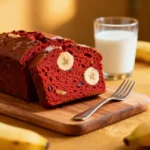
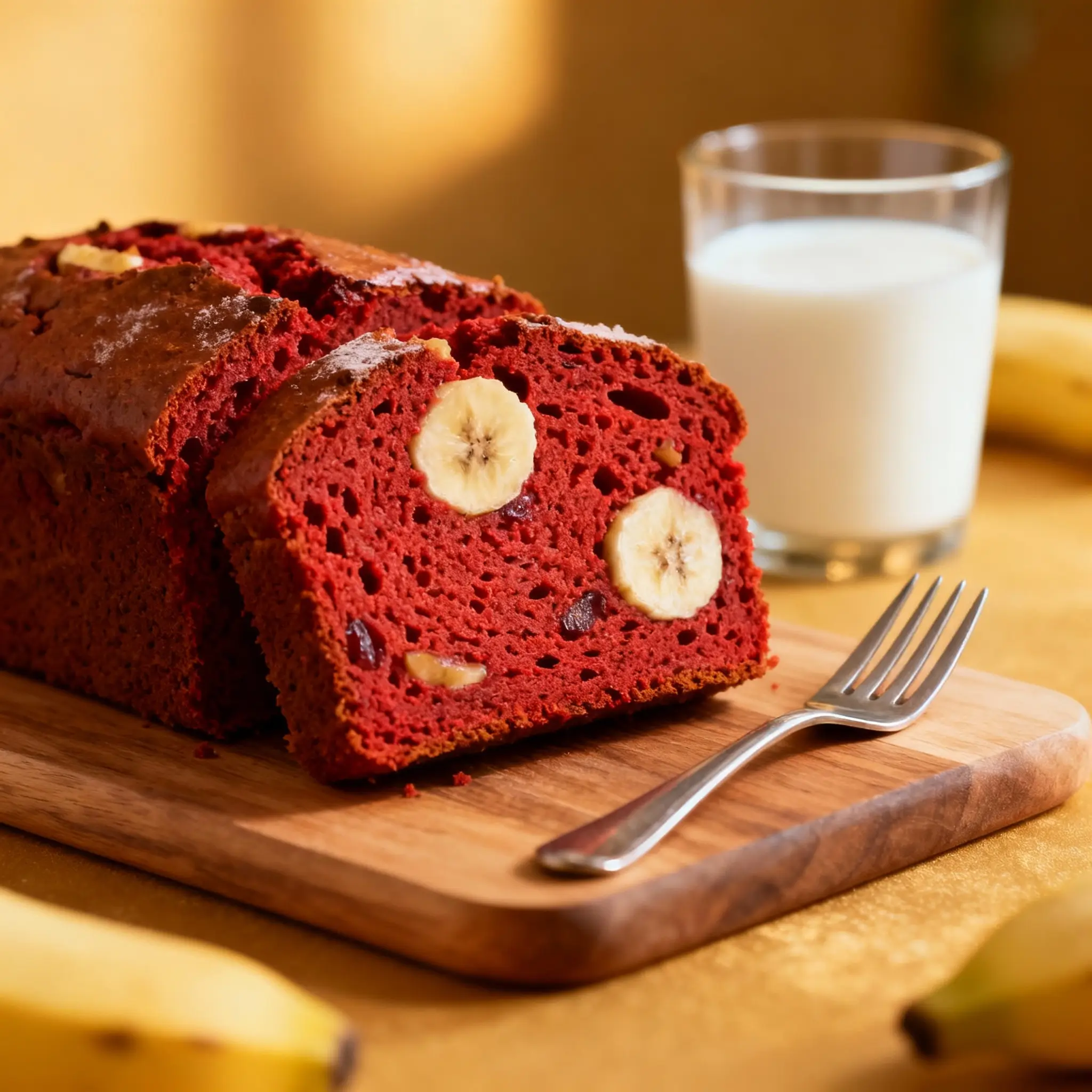
Red Velvet Banana Bread is a decadent, visually stunning twist on two beloved classics: the moist richness of banana bread and the elegant allure of red velvet cake. This hybrid treat marries the deep, caramelized sweetness of overripe bananas with the signature crimson hue, subtle cocoa undertones, and velvety crumb of traditional red velvet—elevated by buttermilk’s tang and cream cheese’s luxurious depth. Whether you’re baking for a holiday brunch, a birthday celebration, or simply indulging in weekend comfort, this loaf delivers drama on the plate and satisfaction in every bite. Its vibrant color—achieved thoughtfully without artificial dyes (when using natural alternatives)—makes it as photogenic as it is flavorful, turning an everyday quick bread into a showstopping centerpiece.
The History
The origins of Red Velvet Banana Bread are delightfully modern and grassroots—born not from a single inventor or historic cookbook, but from the creative convergence of two iconic American baked goods. Red velvet cake traces its roots to the early 20th century, possibly emerging from the chemical reaction between natural (non-Dutched) cocoa and acidic ingredients like vinegar or buttermilk, which yielded a reddish tint long before food coloring became standard. By the 1940s, the Waldorf Astoria popularized its version, cementing red velvet as a Southern and holiday staple. Meanwhile, banana bread rose to prominence during the Great Depression and WWII as a thrifty way to use bruised or overripe fruit, gaining national love through community cookbooks and Betty Crocker’s mid-century recipes. The fusion began organically in the 2000s—first in food blogs and Pinterest boards—as bakers experimented with “swirl loaves,” “marbled banana cakes,” and “red velvet muffins.” By the 2010s, Red Velvet Banana Bread had evolved into a full-fledged trend, appearing in gourmet bakeries from Brooklyn to Austin, often layered with cream cheese glaze or swirled with white chocolate. Its rise reflects broader culinary shifts toward nostalgic remixes, visual storytelling in baking, and ingredient-driven innovation—proving that tradition doesn’t have to be static to stay beloved.
Ingredients Breakdown
Every ingredient in Red Velvet Banana Bread plays a precise, synergistic role—no component is arbitrary. Let’s explore them in depth:
- Ripe Bananas (3 large, ~1 ¼ cups mashed): Provide natural sweetness, moisture, and dense tenderness. Overripeness is essential—brown-speckled skins indicate peak amylase enzyme activity, which breaks down starches into sugars, yielding deeper flavor and better browning. Freezing and thawing bananas before mashing intensifies their jammy texture and concentrates sweetness.
- Unsweetened Natural Cocoa Powder (¾ cup): Not Dutch-processed—this is critical. Natural cocoa is acidic and reacts with baking soda to produce carbon dioxide (lift) *and* interacts with anthocyanins in the cocoa (and any added beet powder) to deepen the red hue. It contributes earthy, slightly bitter notes that balance the sugar and echo classic red velvet’s complexity.
- Buttermilk (½ cup): Adds acidity for leavening activation, tenderness via protein breakdown, and a subtle tang that cuts through richness. Homemade buttermilk (1 tbsp lemon juice or vinegar + enough milk to equal ½ cup, rested 5 minutes) works perfectly—and enhances the red tone due to lower pH.
- White Vinegar (1 tsp): A double-duty powerhouse: boosts acidity for optimal cocoa-red reaction and activates baking soda for maximum rise and airy crumb structure. It also tenderizes gluten strands, ensuring no rubberiness.
- Red Food Coloring (2 tbsp liquid or 1 tbsp gel): While optional for natural versions, high-quality gel coloring (like AmeriColor Super Red) delivers intense, consistent color without thinning batter. Liquid coloring requires more volume, risking excess moisture—gel is preferred for professional results. For natural alternatives: 2 tbsp pure beetroot powder (not juice—too wet) or 3 tbsp concentrated beet juice (simmered down to syrup) can yield a lovely rosy-burgundy shade, though less vivid than gel.
- All-Purpose Flour (2 ¼ cups): Provides structure. Sifting is non-negotiable—it aerates flour, prevents clumping, and ensures even distribution of leaveners and cocoa. For gluten-free adaptation, a 1:1 GF blend with xanthan gum (like King Arthur or Bob’s Red Mill) works well when paired with extra psyllium husk (1 tsp) for elasticity.
- Granulated Sugar (1 ¼ cups): Fuels browning (Maillard reaction), tenderizes, and stabilizes air bubbles. A portion can be replaced with light brown sugar (¼ cup) for molasses depth and extra moisture—but avoid all brown sugar, as excess acidity may over-tenderize.
- Baking Soda (1 tsp) & Baking Powder (1 tsp): A dual-leavening system: soda reacts instantly with acids (vinegar, buttermilk, cocoa), while powder provides secondary lift during oven spring. This combo guarantees height, open crumb, and avoidance of metallic aftertaste from unreacted soda.
- Salt (1 tsp): Enhances all flavors, balances sweetness, and strengthens gluten just enough for cohesion without toughness.
- Eggs (3 large, room temperature): Emulsify fat and water, trap air for lift, and contribute protein for structure. Room temp ensures uniform mixing and prevents butter from seizing.
- Unsalted Butter (½ cup, melted & cooled): Adds richness, mouthfeel, and flakiness in the crumb. Melted (not hot) ensures easy incorporation; clarified butter can be used for higher smoke point and nuttier notes.
- Vanilla Extract (2 tsp pure): Rounds out flavor and adds aromatic warmth—imitation vanilla lacks complexity and can taste medicinal alongside cocoa.
- Cream Cheese (4 oz, full-fat, softened): Swirled into the batter for pockets of tangy, creamy contrast. Must be at true room temperature—cold cream cheese creates lumps; overheated becomes oily. Optional but highly recommended for signature red velvet authenticity.
Step-by-Step Recipe
- Preheat & Prep: Position oven rack in center. Preheat to 350°F (175°C). Grease a 9×5-inch loaf pan *thoroughly*, then line bottom with parchment paper (overhanging 2 inches on long sides for easy lift-out). Lightly flour the greased sides—or use a non-stick spray with flour (like Baker’s Joy).
- Mash Bananas: In a large bowl, mash bananas with a fork or potato masher until mostly smooth with small lumps. Stir in melted, cooled butter, granulated sugar, and vanilla. Whisk vigorously for 1 minute to begin emulsification—mixture should look glossy and slightly thickened.
- Combine Wet Acids: In a small bowl, whisk buttermilk and vinegar. Let sit 1 minute—small curds will form (this is cultured buttermilk, ideal for reaction).
- Mix Dry Ingredients: In a separate medium bowl, sift together flour, cocoa powder, baking soda, baking powder, and salt. Whisk 30 seconds to fully aerate and distribute leaveners evenly—critical for uniform rise.
- Alternate Incorporation: Add one-third of dry mix to banana mixture; stir with spatula until *just* combined (no dry streaks). Pour in half of buttermilk-vinegar mixture; fold gently. Repeat—dry, wet, dry—ending with final third of dry mix. Do *not* overmix; stop as soon as no flour remains. Batter will be thick, glossy, and deep maroon.
- Add Color & Cream Cheese Swirl: Stir in red food coloring (or natural alternative) until uniformly vibrant. Transfer ⅔ of batter to prepared pan. In a small bowl, beat softened cream cheese with 2 tbsp sugar and ½ tsp vanilla until smooth. Dollop cream cheese mixture over batter, then top with remaining batter. Using a butter knife or skewer, gently drag through layers in a figure-eight or zigzag motion—3–4 passes only—to create marbled swirls. Avoid over-swirling, which blends it completely.
- Bake with Precision: Place pan in center oven. Bake 60–75 minutes. At 45 minutes, tent loosely with foil to prevent over-browning. Done when a toothpick inserted 2 inches from end (not center swirl) comes out with *moist crumbs*—not wet batter, not clean. Internal temperature should read 205–210°F (96–99°C) on an instant-read thermometer. Rotate pan 180° halfway through for even baking.
- Cool Strategically: Let loaf cool *in pan* on a wire rack for 20 minutes exactly. Then, grip parchment overhangs and lift loaf onto rack. Remove parchment. Cool *completely* (3+ hours) before slicing—this allows starches to set and prevents gummy texture. Slicing warm releases steam and collapses structure.
Tips
- Ripe Banana Hack: Freeze overripe bananas in peel. Thaw overnight in fridge—liquid drains off, leaving ultra-concentrated, caramel-sweet mash. Pat dry with paper towel before measuring.
- Color Consistency: For deepest red, use white vinegar (not apple cider) and natural cocoa. Add coloring *after* dry/wet mixing—adding early can cause uneven dispersion or premature oxidation.
- No-Sink Swirl: Ensure cream cheese is *exactly* room temp (68–70°F). Cold = lumps; warm = oil separation. Chill swirled batter 15 minutes before baking to solidify cream cheese, preventing sinking.
- Moisture Lock: Brush warm loaf (after 20-min pan cool) with 1 tbsp simple syrup (equal parts sugar/water, boiled 1 min) for glossy sheen and shelf-life extension.
- Perfect Crumb: Use a digital scale for flour (1 cup = 120g). Scooping directly packs flour—up to 20% more—causing dryness. Spoon flour into cup, then level.
- Oven Thermometer Essential: Built-in oven thermostats vary ±25°F. An inaccurate temp causes underbake (gummy) or overbake (crumbly). Calibrate yearly.
- Altitude Adjustments: Above 3,000 ft: decrease sugar by 1 tbsp, increase liquid by 1 tbsp, raise oven temp 15–25°F, and reduce baking powder by ⅛ tsp.
- Storage Wisdom: Wrap *cooled* loaf tightly in beeswax wrap or parchment + foil. Keeps 4 days at room temp, 1 week refrigerated (slice before chilling for easy portioning), or 3 months frozen (wrap in plastic + foil, thaw overnight in fridge).
Variations and Customizations
This recipe is a canvas for creativity—here are 12 tested, crowd-pleasing adaptations:
- Gluten-Free Red Velvet Banana Bread: Substitute 2 ¼ cups certified GF 1:1 flour blend + 1 tsp xanthan gum + 1 tsp psyllium husk powder. Add 2 tbsp almond milk if batter seems thick.
- Vegan Version: Replace eggs with flax eggs (3 tbsp ground flax + 9 tbsp water, rested 10 min); butter with refined coconut oil (½ cup, melted); buttermilk with soy milk + vinegar; cream cheese swirl with vegan cream cheese (Tofutti) + maple syrup.
- Protein-Packed: Add ¼ cup unflavored whey or plant-based protein powder to dry mix; reduce flour by 2 tbsp. Boost with ½ cup chopped walnuts or pecans.
- Spiced Red Velvet: Add 1 tsp cinnamon, ¼ tsp cardamom, and ⅛ tsp clove to dry ingredients. Pairs beautifully with orange zest (1 tbsp).
- White Chocolate Swirl: Omit cream cheese. Melt ½ cup high-quality white chocolate; cool 5 min. Swirl same as cream cheese—creates ivory ribbons against red crumb.
- Black Cocoa Loaf: Replace ¼ cup natural cocoa with black cocoa (Hershey’s Special Dark) for intense, almost black-red color and espresso-like bitterness.
- Streusel-Topped: Before baking, sprinkle batter with streusel: ¼ cup flour, ¼ cup brown sugar, 2 tbsp cold butter, ½ tsp cinnamon, pinches of salt—rubbed to pea-sized crumbs.
- Mini Loaves: Divide batter among six 3×5-inch mini loaf pans. Bake 35–45 minutes. Perfect for gifts!
- Red Velvet Banana Muffins: Portion into lined muffin tins (fill ¾ full). Bake 22–28 minutes. Top with cream cheese glaze (4 oz cream cheese, 1 cup powdered sugar, 1 tsp vanilla, 1 tbsp milk).
- Boozy Twist: Add 2 tbsp bourbon or Grand Marnier to buttermilk mixture. Complements cocoa and banana beautifully.
- Double-Layer Cake: Double recipe; bake in two 8-inch round pans (30–35 min). Frost with ermine frosting (cooked flour-milk roux + butter + sugar) for authentic red velvet cake texture.
- Breakfast Loaf: Reduce sugar to ¾ cup, omit food coloring, add ½ cup old-fashioned oats and ¼ cup chia seeds. Serve toasted with Greek yogurt.
Health Considerations and Nutritional Value
A single 1-slice (100g) serving of Red Velvet Banana Bread (standard recipe, unfrosted) contains approximately:
- Calories: 285 kcal
- Total Fat: 11g (7g saturated, from butter/cream cheese)
- Carbohydrates: 44g (28g sugars—naturally occurring from bananas + added; 2g fiber)
- Protein: 4g
- Vitamins/Minerals: Excellent source of Vitamin B6 (20% DV) and manganese (30% DV) from bananas; iron (8% DV) and magnesium (12% DV) from cocoa; calcium (6% DV) from buttermilk.
Health Notes:
- Sugar Awareness: While bananas offer natural fructose, the added sugar pushes this into “occasional treat” territory. For reduced sugar: cut granulated sugar to ¾ cup, add 1 tsp stevia glycerite, and boost banana to 4 medium fruits.
- Heart Health: Cocoa’s flavanols support circulation—but processing matters. Choose natural, non-alkalized cocoa for maximum antioxidant retention.
- Digestibility: Buttermilk’s probiotics aid digestion; however, lactose-intolerant individuals may prefer lactose-free buttermilk or coconut milk + vinegar.
- Anti-Inflammatory Boost: Adding 2 tbsp ground flaxseed introduces omega-3s and lignans; 1 tsp cinnamon adds polyphenols and helps moderate blood sugar response.
- Not Low-Carb/Keto: With 44g net carbs per slice, it’s incompatible with strict low-carb diets. Almond flour substitutions drastically alter texture and require egg/leavener recalibration—best approached with keto-specific recipes.
Enjoy mindfully: pair a slice with Greek yogurt and berries for balanced macros, or savor as part of a festive meal where indulgence is intentional—not habitual.
Ingredients
- 3 large ripe bananas (about 1 ¼ cups mashed)
- ½ cup (1 stick / 113g) unsalted butter, melted and cooled
- 1 ¼ cups (250g) granulated sugar
- 2 tsp pure vanilla extract
- ½ cup (120ml) buttermilk
- 1 tsp white vinegar
- 2 ¼ cups (270g) all-purpose flour, spooned & leveled
- ¾ cup (65g) unsweetened natural cocoa powder
- 1 tsp baking soda
- 1 tsp baking powder
- 1 tsp fine sea salt
- 2 tbsp red gel food coloring (or 3 tbsp concentrated beet juice)
- 4 oz (113g) full-fat cream cheese, softened
- 2 tbsp (25g) granulated sugar (for cream cheese swirl)
- ½ tsp pure vanilla extract (for cream cheese swirl)
Directions
- Preheat oven to 350°F (175°C). Grease a 9×5-inch loaf pan and line bottom with parchment paper, leaving overhang on long sides.
- In a large bowl, mash bananas until mostly smooth. Whisk in melted butter, 1 ¼ cups sugar, and 2 tsp vanilla until glossy (~1 min).
- In a small bowl, combine buttermilk and vinegar; let sit 1 minute.
- In another bowl, sift together flour, cocoa, baking soda, baking powder, and salt.
- Add ⅓ of dry mix to banana mixture; stir until just incorporated. Add ½ of buttermilk mixture; fold gently. Repeat, ending with final ⅓ dry mix. Stir until *no dry streaks remain*.
- Stir in food coloring until uniformly red.
- In a small bowl, beat cream cheese, 2 tbsp sugar, and ½ tsp vanilla until smooth.
- Spread ⅔ of red batter into pan. Dollop cream cheese mixture over top. Cover with remaining batter. Swirl gently 3–4 times with knife.
- Bake 60–75 minutes, tenting with foil at 45 minutes. Loaf is done when toothpick in side (not center) has moist crumbs and internal temp reads 205–210°F.
- Cool in pan 20 minutes. Lift out using parchment. Cool completely on wire rack (3+ hours) before slicing.
FAQ
- Can I use Dutch-process cocoa?
- No—it’s alkalized and neutral pH, so it won’t react with vinegar/baking soda to enhance red color or lift. Natural cocoa is required for authentic results.
- Why did my loaf sink in the middle?
- Three likely causes: (1) Underbaking—check internal temp next time; (2) Opening oven too early (before 45 min); (3) Too much liquid—ensure bananas are well-drained and buttermilk measured precisely.
- Can I make this ahead and freeze?
- Absolutely. Cool completely, wrap tightly in plastic wrap + aluminum foil, and freeze up to 3 months. Thaw overnight in fridge, then bring to room temp before serving.
- My cream cheese swirl disappeared! What happened?
- Overmixing the swirl or using cream cheese that was too warm caused it to blend in. Chill swirled batter 15 minutes before baking, and use true room-temp (not soft) cream cheese.
- Is there a way to make it less sweet?
- Yes—reduce sugar to 1 cup, add ¼ cup unsweetened applesauce for moisture, and boost banana to 4 medium. Flavor remains rich, but perceived sweetness drops significantly.
- Can I use avocado oil instead of butter?
- You can, but it changes flavor profile and texture. Avocado oil yields a more delicate, less rich crumb. For best red velvet character, stick with butter—or try browned butter for nutty depth.
- What’s the best way to store leftovers?
- At room temperature: wrap tightly in beeswax wrap or parchment + foil. Lasts 4 days. For longer freshness, refrigerate (up to 1 week) or freeze (3 months). Never store cut-side exposed—it dries out fast.
- Can I add nuts or chocolate chips?
- Yes! Fold in ½ cup chopped walnuts, pecans, or dark chocolate chips *after* swirling. Toast nuts first for enhanced flavor and crunch.
- Why does my red color fade after baking?
- Natural cocoa + acid creates a temporary red that oxidizes to burgundy during cooling. Gel coloring holds brightest. To preserve vibrancy: avoid overbaking, cool in draft-free area, and store wrapped in dark container.
- Can I bake this as cupcakes?
- Yes! Fill liners ⅔ full. Bake at 350°F for 22–28 minutes. Yield: 18–20 cupcakes. Top with cream cheese frosting or a dusting of cocoa.
Summary
Red Velvet Banana Bread is a masterful fusion of nostalgic comfort and elegant flair—leveraging the deep sweetness of overripe bananas, the vibrant chemistry of natural cocoa and acid, and the luxurious tang of cream cheese swirls to create a loaf that’s as unforgettable in flavor as it is in appearance.
Baked with precision, customized to dietary needs, and rooted in the joyful evolution of American baking traditions, it’s more than dessert—it’s edible celebration, science, and soul, all swirled into one stunning, sliceable masterpiece.