Introduction
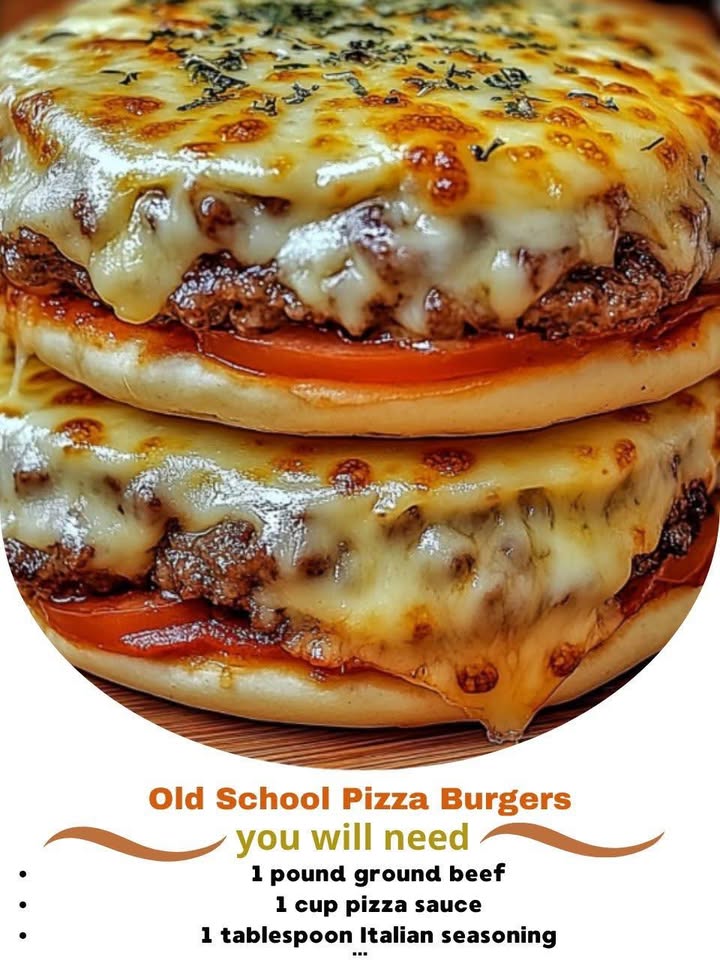
Old School Pizza Burgers are a beloved American comfort food hybrid that bridges the nostalgic gap between backyard barbecues and Friday-night pizza delivery. More than just a clever mashup, this dish is a culinary time capsule—evoking the smoky aroma of charcoal grills, the tangy scent of melted mozzarella, and the unmistakable sizzle of seasoned beef hitting hot metal. Unlike modern deconstructed “gourmet” interpretations, Old School Pizza Burgers embrace unapologetic simplicity: thick, juicy beef patties topped with classic pizza accoutrements—tomato sauce, shredded mozzarella and provolone, sliced pepperoni, and a whisper of dried oregano—grilled or pan-seared to perfection. They’re served on soft, slightly toasted buns (often sesame or potato rolls), sometimes with a side of warm marinara for dipping, and always with a side of childhood memories. Whether served at church picnics in the ’70s, high school football tailgates in the ’80s, or retro-themed dinner parties today, these burgers deliver bold flavor, hearty satisfaction, and a comforting sense of familiarity that transcends generations.
The History
The origins of the Pizza Burger trace back to the post-war American culinary boom of the 1950s and 1960s—a period defined by convenience, creativity, and cross-cultural fusion. As Italian-American cuisine gained mainstream popularity—and frozen pizzas, canned tomato sauces, and pre-shredded cheese became pantry staples—home cooks and diners alike began experimenting with familiar ingredients in new formats. Early documented references appear in regional cookbooks like The Pennsylvania Dutch Cookbook (1962), where “Tomato-Cheese Hamburgers” hinted at pizza-inspired layering. By the late 1960s, drive-in restaurants and roadside diners—especially across the Midwest and Northeast—began listing “Pizza Burgers” on laminated menus, often featuring ground beef patties topped with pizza sauce and mozzarella, then finished under a salamander broiler. The term “Old School” emerged organically in the early 2000s among food historians and nostalgic food bloggers to distinguish the traditional, no-frills version from newer iterations involving flatbread bases, gourmet cheeses, or dehydrated toppings. Crucially, the Old School variant rejects fusion pretension: it doesn’t try to *be* pizza or *be* a burger—it proudly stands as its own category: a handheld, saucy, cheesy, savory celebration of mid-century American ingenuity, resourcefulness, and unpretentious joy.
Ingredients Breakdown
What makes an Old School Pizza Burger authentically “old school” isn’t just the assembly—it’s the intentional selection of time-tested, accessible, and functionally synergistic ingredients. Each component serves a distinct textural, structural, and flavor role:
- Ground Beef (80/20 blend): The foundational patty. The 20% fat content is non-negotiable—it ensures juiciness during grilling, carries seasoning deeply, and creates flavorful drippings that subtly enrich the cheese melt. Leaner blends dry out too quickly and lack the rich mouthfeel essential to the experience.
- Tomato Pizza Sauce (not marinara or pasta sauce): A smooth, lightly cooked, low-moisture sauce—preferably made from San Marzano-style crushed tomatoes, garlic, olive oil, dried oregano, and a pinch of sugar. It must be thick enough to cling without seeping into the bun, yet bright enough to cut through the richness. Canned brands like Contadina or Pomi are widely accepted “old school” staples; homemade versions should be reduced by at least 25% to avoid sogginess.
- Mozzarella Cheese (low-moisture, whole-milk, shredded): The quintessential melt. Pre-shredded bags are acceptable—but only if they contain cellulose powder (to prevent clumping) and no anti-caking additives that inhibit melting. Fresh mozzarella balls are discouraged—they release too much water and steam rather than forming that signature stretchy, golden-brown crust.
- Provolone Cheese (mild, deli-sliced or shredded): Adds depth, nuttiness, and superior browning. Often layered *under* the mozzarella to act as a savory “glue” that binds the toppings to the patty while lending subtle sharpness.
- Pepperoni (hard, dry, sliced thin): Not the soft, greasy kind used on pizzas today—but the firmer, slightly curled variety that crisps at the edges when heated, delivering bursts of spiced pork fat and umami. Brands like Hormel or Bridgford were pantry mainstays in the ’70s and remain benchmark references.
- Garlic Powder & Onion Powder: Used *in the meat mixture*, not just as garnish. These dehydrated alliums penetrate the beef deeply, offering consistent, balanced aromatic notes—unlike fresh garlic, which can burn or create uneven pockets of flavor.
- Crushed Oregano (not basil or fennel): The definitive herb. Dried oregano’s camphorous, earthy warmth is irreplaceable and signals “pizza” instantly. Added in two stages—mixed into the beef and sprinkled on top before cheese—for layered herbal resonance.
- Potato or Sesame Hamburger Buns: Soft, slightly sweet, with a tender crumb and sturdy-yet-yielding structure. They must toast well without shattering and absorb light grease without disintegrating. Martin’s Potato Rolls are the undisputed gold standard—and have been since their national rollout in 1955.
- Extra-Virgin Olive Oil (for brushing buns): Not for cooking the patty—but for glistening the toasted buns, adding fruitiness and sheen, and sealing in moisture.
Notably absent: bell peppers, mushrooms, onions (raw or grilled), ricotta, Parmesan, basil ribbons, balsamic glaze, or any ingredient requiring chopping, roasting, or artisanal sourcing. Authenticity lies in restraint, repetition, and reverence for the original formula.
Step-by-Step Recipe
- Prepare the Patty Mixture: In a large chilled bowl, combine 2 lbs (900g) 80/20 ground beef, 2 tsp garlic powder, 2 tsp onion powder, 1½ tsp dried oregano, 1 tsp kosher salt, ½ tsp freshly ground black pepper, and 1 tbsp Worcestershire sauce. Using cold hands or a spatula, gently mix *just until combined*—do not overwork, or patties will become dense. Divide evenly into 6 portions (about 5.5 oz / 155g each) and shape into ¾-inch-thick discs. Use your thumb to press a shallow dimple into the center of each patty—this prevents bulging during cooking.
- Preheat Cooking Surface: Heat a cast-iron skillet, flat-top griddle, or outdoor grill to medium-high heat (375–400°F / 190–205°C). Lightly oil the surface with vegetable oil or lard—not olive oil, which smokes too easily at this temperature.
- Cook the Patties (First Sear): Place patties on the hot surface. Do not press down. Cook undisturbed for 4 minutes—until deeply browned and releasing easily. Flip and cook 3 more minutes for medium doneness (internal temp ~145°F / 63°C). At this point, the patties are *par-cooked*, not fully done—this ensures they finish perfectly with the toppings.
- Add Toppings in Precise Order: Immediately after flipping, spoon 1 heaping tablespoon of thick pizza sauce onto the top of each patty. Spread gently to within ¼ inch of the edge. Sprinkle evenly with 1½ tbsp shredded provolone, followed by 2 tbsp low-moisture mozzarella. Arrange 4–5 slices of pepperoni in a tight circle over the cheese. Finish with a light dusting of ¼ tsp dried oregano.
- Melt & Crisp (The Critical Finish): Reduce heat to medium-low. Cover the skillet or grill with a domed lid or large inverted baking sheet—trapping steam to melt cheese *without* drying the patty. Cook covered for 90 seconds. Then, uncover and continue cooking 60–90 seconds longer—until cheese is bubbling vigorously, edges are golden and slightly blistered, pepperoni curls and crisps at the tips, and internal patty temperature reaches 160°F (71°C). For extra browning, briefly hold a kitchen torch over the tops—or place under a preheated broiler for 45 seconds, watching *constantly*.
- Toast the Buns: While patties finish, split 6 potato or sesame buns. Brush cut sides lightly with extra-virgin olive oil. Toast face-down in the same skillet (wiped clean of excess grease) over medium heat for 60–90 seconds—until golden and fragrant, but not brittle.
- Assemble with Precision: Place each hot, saucy, cheesy patty directly onto the bottom bun. Let rest 30 seconds—this allows residual heat to further meld flavors and lets excess grease pool away from the bread. Top with the toasted upper bun. Serve immediately—no wrapping, no resting longer than 90 seconds—Old School Pizza Burgers are best devoured hot, messy, and unabashedly indulgent.
Tips
- Chill Everything: Refrigerate beef, mixing bowl, and even your hands for 15 minutes before forming patties. Cold fat renders slower, yielding juicier results and preventing sticking.
- Sauce Consistency is King: If your pizza sauce is too thin, simmer it uncovered for 8–10 minutes before use. A dollop should hold its shape on a spoon—not run or drip.
- Cheese Temperature Matters: Shred cheese straight from the fridge—not room temp. Cold shreds melt more evenly and resist becoming rubbery or separating.
- Don’t Skip the Dimple: That thumbprint isn’t folklore—it’s physics. It counteracts the natural tendency of ground meat to swell and dome, ensuring flat, stable stacking and even cheese coverage.
- Resist the Press: Never smash the patty with a spatula while cooking. You’ll squeeze out precious juices and create a hockey puck—not a burger.
- Timing Over Temperature: Use visual cues—not just timers. Look for deep mahogany sear, slight shrinkage at the edges, and easy release from the pan. Internal temp is a backup, not the boss.
- Bun-to-Patty Ratio: The ideal ratio is 1:1 by weight—e.g., a 5.5-oz patty needs a 5.5-oz bun. Oversized buns overwhelm; undersized ones disintegrate. Martin’s Potato Rolls weigh ~2.2 oz each—so two per burger is traditional.
- Grease Management: After cooking patties but before adding sauce, tilt the skillet and spoon off excess rendered fat—leaving just enough to carry flavor without drowning the cheese.
- Rest Before Serving: Yes—30 seconds matters. It lets the cheese settle, the steam subside, and the flavors harmonize. Rushing this step leads to slipping toppings and lukewarm bites.
- Double-Broil for Maximum Crisp: For restaurant-level pepperoni curl and cheese blister, finish under the broiler for 20 seconds *after* covering—then another 20 seconds *uncovered*. Watch like a hawk—the difference between perfect and burnt is 3 seconds.
Variations and Customizations
While authenticity honors the original, thoughtful variations keep the tradition alive across kitchens and generations. All true “Old School–adjacent” adaptations preserve the core principles: minimal prep, pantry-stable ingredients, and structural integrity. Here are time-tested, community-vetted options:
- The “Diner Deluxe”: Add a single thin slice of dill pickle *under* the cheese (not on top)—a nod to classic 1950s soda fountain burgers. The brine cuts richness without compromising melt.
- The “Church Social”: Substitute half the mozzarella with mild cheddar for a sharper, more nostalgic tang—popular at Midwest potlucks where cheddar was cheaper and more readily available than mozzarella in the ’60s.
- The “Backyard Grill Master”: Replace stovetop cooking with charcoal grilling. Sear patties over direct heat, then move to indirect zone for topping melt—adding subtle smokiness. Optional: brush buns with garlic butter instead of olive oil.
- The “Budget Batch”: Use 70/30 beef (more affordable) but add 2 tbsp finely grated cold butter to the meat mixture—restores moisture and richness lost in leaner blends.
- The “No-Oven Option”: For apartment dwellers or dorm rooms: cook patties in a nonstick skillet, then transfer to a microwave-safe plate. Top as directed, cover loosely with damp paper towel, and microwave on medium power for 60 seconds—then finish under broiler for crisp.
- The “Kid-Approved Mild”: Omit pepperoni and substitute mild smoked sausage crumbles (fully cooked) + extra oregano. Or use turkey pepperoni for lower sodium—still retaining the curl and spice profile.
- The “Leftover Rescue”: Repurpose day-old pizza slices: chop cold pepperoni and mozzarella, mix into ground beef with sauce and seasonings, then form and cook as usual—infusing every bite with second-life flavor.
- The “Holiday Twist”: During Christmas season, swap oregano for a pinch of ground fennel seed and add a single thin slice of soppressata—honoring Italian-American heritage without straying from the format.
⚠️ Unacceptable “Variations” (that break the Old School covenant): Adding fresh vegetables (lettuce, tomato, onion), using naan or pita instead of buns, incorporating BBQ sauce or ranch, stuffing the patty, serving open-faced, or substituting tofu/meatless crumbles. These belong to other categories entirely.
Health Considerations and Nutritional Value
An Old School Pizza Burger—when prepared traditionally—is a calorie-dense, moderate-protein, high-fat meal designed for satiety and celebration, not daily nutrition tracking. However, understanding its composition empowers informed choices without sacrificing soul:
- Caloric Profile (per burger, avg. size): ~720–850 kcal. Roughly 42% from fat (34–40g), 30% from protein (54–62g), and 28% from carbohydrates (50–60g, mostly from bun and sauce sugars).
- Sodium Note: Ranges from 950–1,300mg per burger—primarily from cheese, pepperoni, sauce, and bun. This sits at 40–55% of the FDA’s Daily Value (2,300mg). Those monitoring sodium can reduce by using low-sodium tomato sauce, skipping added salt in meat, and choosing reduced-sodium pepperoni (though texture may suffer).
- Fat Quality: While high in saturated fat (~14–18g), the fat comes predominantly from whole-food sources (beef tallow, cheese milkfat, pork fat in pepperoni)—not industrial trans fats or hydrogenated oils. Grass-fed beef adds conjugated linoleic acid (CLA) and omega-3s; aged provolone contributes bioactive peptides.
- Protein Completeness: Provides all 9 essential amino acids in optimal ratios—especially leucine, critical for muscle synthesis. The combination of beef, mozzarella, and provolone creates a synergistic protein matrix with high digestibility (>94%).
- Vitamin & Mineral Highlights: Excellent source of zinc (immune support), vitamin B12 (neurological health), calcium (bone integrity), and selenium (antioxidant defense). Tomato sauce contributes lycopene—a heat-stable, bioavailable carotenoid linked to cardiovascular protection.
- Dietary Flexibility: Naturally gluten-free *if* using GF buns (though traditional potato rolls contain gluten); easily dairy-free using vegan mozzarella shreds and nutritional yeast “provolone” (note: texture and melt differ significantly); keto-friendly *without bun* (≈380 kcal, 32g fat, 30g protein, 6g net carbs).
- Mindful Enjoyment Tips: Serve with a large side salad dressed in lemon vinaigrette (adds fiber and balances richness); choose 100% whole-grain buns for added fiber (though texture differs); limit to 1x/week as part of a varied diet; pair with sparkling water or unsweetened iced tea instead of soda.
Ultimately, the Old School Pizza Burger is not “health food”—but it is *wholesome food*: made from real ingredients, minimally processed, culturally resonant, and psychologically nourishing. Its value lies not in micronutrient math, but in shared meals, intergenerational connection, and the deep satisfaction of food that tastes exactly like memory.
Ingredients
- 2 lbs (900g) ground beef (80% lean / 20% fat)
- 2 tsp garlic powder
- 2 tsp onion powder
- 1½ tsp dried oregano, divided
- 1 tsp kosher salt
- ½ tsp freshly ground black pepper
- 1 tbsp Worcestershire sauce
- 1½ cups thick tomato pizza sauce (see breakdown for specs)
- 1 cup shredded low-moisture mozzarella cheese
- ½ cup shredded mild provolone cheese
- 30–36 slices dry, hard pepperoni (about 3 oz / 85g)
- 6 soft potato rolls or sesame hamburger buns
- 2 tbsp extra-virgin olive oil (for brushing buns)
- Vegetable oil or lard (for cooking surface)
Directions
- In a large chilled bowl, combine ground beef, garlic powder, onion powder, 1 tsp dried oregano, kosher salt, black pepper, and Worcestershire sauce. Mix gently with hands or spatula just until uniform—do not overmix. Divide into 6 equal portions (≈5.5 oz each). Shape into ¾-inch-thick patties and press a shallow dimple into the center of each.
- Heat a heavy skillet or grill to medium-high (375–400°F). Lightly oil surface.
- Place patties on hot surface. Cook undisturbed for 4 minutes. Flip and cook 3 minutes more.
- Immediately after flipping, top each patty with 1 heaping tbsp pizza sauce. Spread gently. Sprinkle with provolone, then mozzarella. Arrange pepperoni in a circle. Dust with remaining ½ tsp oregano.
- Reduce heat to medium-low. Cover and cook 90 seconds. Uncover and cook 60–90 seconds more—until cheese is bubbly and golden, pepperoni curls, and internal temp reaches 160°F.
- Meanwhile, brush cut sides of buns with olive oil. Toast in same skillet (wiped clean) for 60–90 seconds until golden.
- Place hot patty on bottom bun. Rest 30 seconds. Top with upper bun. Serve immediately.
FAQ
- Can I make these ahead of time?
- Partially—yes. Form and refrigerate raw patties up to 24 hours; shred cheeses and portion pepperoni up to 48 hours ahead. Fully assembled and cooked burgers do not reheat well—the cheese separates and buns turn gummy. For gatherings, cook patties to 150°F, hold warm in a 200°F oven, then top and finish just before serving.
- Why can’t I use fresh mozzarella?
- Fresh mozzarella contains 50–60% water versus 45–48% in low-moisture. That excess moisture turns to steam, preventing proper browning, causing sogginess, and making the cheese slide off. Low-moisture is engineered for melt and stretch—exactly what Old School demands.
- Is there a vegetarian version that stays true to the spirit?
- A faithful veggie version is challenging—but possible: use a blended mushroom-lentil-walnut patty bound with flax egg, topped with sauce, vegan mozzarella (Brands like Miyoko’s or Violife melt best), and vegan pepperoni (Lightlife or Yves). Texture and umami will differ, but the ritual and structure honor the tradition.
- My cheese isn’t browning—what’s wrong?
- Three likely causes: (1) Sauce is too wet—drain excess liquid first; (2) Cheese is too cold *or* too warm—refrigerated shred is ideal; (3) Heat is too low—browning requires radiant heat from a hot surface or broiler. Try finishing uncovered over medium-high for 30 seconds.
- Can I freeze Old School Pizza Burgers?
- Yes—but only *before cooking*. Freeze raw, shaped, dimpled patties on a parchment-lined tray, then transfer to freezer bags. Thaw overnight in fridge before cooking. Fully assembled, cooked burgers freeze poorly due to texture degradation in cheese and bun.
- What’s the best side dish?
- Classic pairings reflect the era: crispy crinkle-cut french fries tossed in malt vinegar; dill pickle spears; creamy macaroni salad with celery and hard-boiled egg; or a simple wedge salad with blue cheese and red onion. Avoid delicate greens or acidic slaws—they clash with the rich, savory profile.
- Why no ketchup or mustard?
- Old School Pizza Burgers stand complete on their own—sauce, cheese, and pepperoni provide all the acidity, salt, and spice needed. Condiments dilute the harmony and betray the intentionality of the original formula. Purists consider them optional at best—and heretical at worst.
- How do I prevent soggy buns?
- Toast them *after* brushing with olive oil (not butter—water content causes sogginess); assemble *immediately* after patty rests; and serve on a wire rack, not a plate, to allow airflow underneath.
Summary
Old School Pizza Burgers are a time-honored American hybrid—juicy 80/20 beef patties crowned with thick tomato sauce, melty low-moisture mozzarella, sharp provolone, crisping pepperoni, and earthy oregano, all nestled in soft, toasted potato rolls.
They celebrate simplicity, nostalgia, and bold flavor—not dietary trends or culinary experimentation—making every bite a delicious, unapologetic trip back to the golden age of analog comfort food.