Introduction
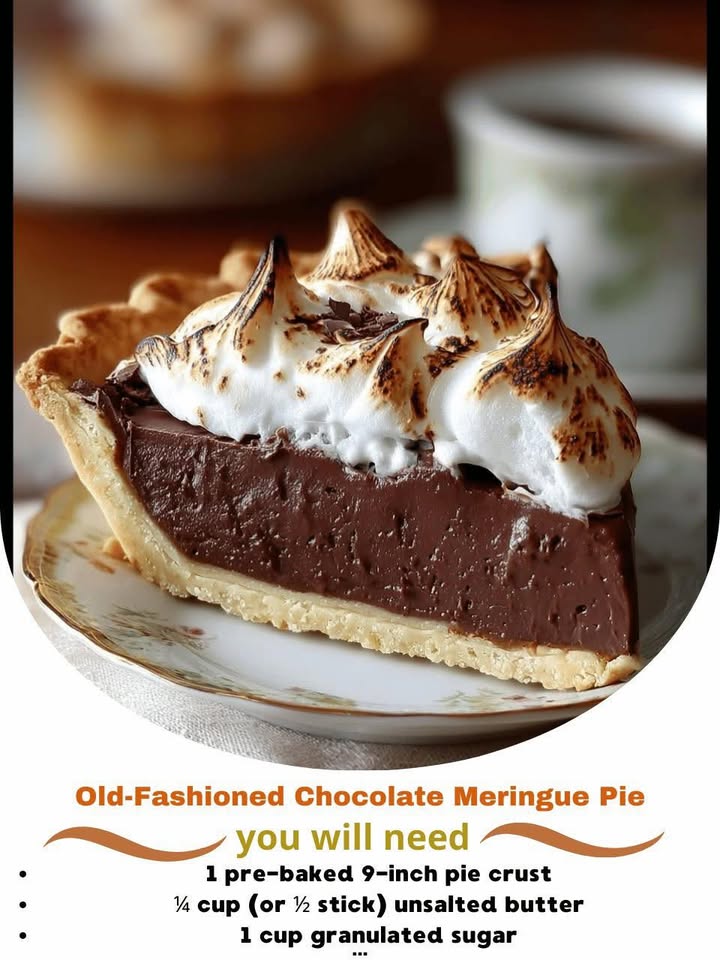
The Old-Fashioned Chocolate Meringue Pie is a cherished American classic—a luscious, nostalgic dessert that embodies the very soul of mid-century home baking. With its rich, velvety chocolate filling nestled in a tender, buttery crust and crowned with a cloud-like, toasted meringue, this pie strikes the perfect balance between decadence and delicacy. It’s more than just a dessert—it’s a memory evoked: Sunday suppers, church potlucks, holiday tables draped in lace cloths, and the comforting aroma of cocoa and vanilla wafting from a warm kitchen. Unlike modern shortcuts or no-bake variations, the true old-fashioned version relies on time-honored techniques—tempered custards, hand-whisked meringues, and slow oven-toasting—that reward patience with unforgettable texture and depth.
The History
Tracing its roots to the late 19th and early 20th centuries, the Chocolate Meringue Pie emerged alongside the broader rise of “pie culture” in the United States—a culinary tradition shaped by resourcefulness, seasonal abundance, and evolving pantry staples. While chocolate pie recipes appeared as early as the 1870s (often thickened with flour or cornstarch and served without meringue), the marriage of chocolate custard and billowy meringue gained widespread popularity in the 1930s–1950s, buoyed by innovations like reliable refrigeration, standardized oven temperatures, and the mass availability of granulated sugar, cocoa powder, and fresh eggs. Notably, the 1944 edition of The Joy of Cooking included a “Chocolate Cream Pie with Meringue” that closely mirrors today’s canonical version—calling for a cooked stovetop custard enriched with egg yolks and thickened with cornstarch, then topped with a Swiss or French meringue. The pie became a staple in community cookbooks—especially those published by women’s auxiliaries, churches, and extension services—where it was praised for its impressive appearance, crowd-pleasing flavor, and ability to stretch modest ingredients into something celebratory. Its enduring appeal lies not only in taste but in symbolism: the glossy meringue represents care and craftsmanship; the deep chocolate center, warmth and comfort; and the flaky crust, the grounding presence of tradition itself.
Ingredients Breakdown
Every element of this pie plays a distinct and indispensable role—no ingredient is merely filler. Understanding their functions elevates both technique and outcome:
- Graham Cracker Crust (or Traditional Pastry): While graham cracker crusts became popular post-WWII for their ease and sweetness, many vintage recipes specify a flaky all-butter shortcrust, blind-baked until golden. The crust provides structural integrity, textural contrast (crisp vs. creamy), and subtle caramelized notes that deepen the chocolate’s complexity. Butter contributes richness and flakiness; brown sugar (in graham versions) adds molasses undertones; cinnamon (a frequent addition in 1940s recipes) offers quiet warmth.
- Unsweetened Cocoa Powder: Not Dutch-process—natural unsweetened cocoa is essential for its higher acidity, which reacts with baking soda (if used) and balances the sweetness of the meringue. Vintage recipes almost exclusively used natural cocoa, lending a bright, slightly astringent chocolate character that prevents cloyingness.
- Cornstarch: The traditional thickener—not flour or instant pudding mix. Cornstarch yields a translucent, satiny, non-grainy custard that holds its shape when sliced yet melts luxuriously on the tongue. Its neutral flavor doesn’t compete with chocolate, and it stabilizes the filling during baking and cooling.
- Egg Yolks: Pure emulsifiers and enrichers. They lend unctuous body, sheen, and a custardy silkiness impossible to replicate with starch alone. Older recipes often use 4–6 yolks (reserving whites for meringue), maximizing richness without heaviness.
- Granulated Sugar (for Filling & Meringue): Refined cane sugar isn’t just sweetener—it affects viscosity, tenderness, and browning. For the filling, it dissolves into the hot milk mixture to create a smooth syrup base; for the meringue, it stabilizes foam structure and enables gentle browning.
- Fresh, Room-Temperature Egg Whites: Critical for volume and stability. Cold whites whip slower and less voluminously; aged whites (1–2 days old) actually yield firmer, drier foams ideal for piping and browning. Vintage bakers knew this intuitively—eggs were rarely refrigerated year-round before the 1950s.
- Cream of Tartar: A trace acid that strengthens egg white proteins, increases foam volume by up to 30%, and prevents weeping. Though some 1940s recipes omit it (relying instead on copper bowls or vinegar), its inclusion is now considered best practice for foolproof meringue.
- Pure Vanilla Extract & Salt: Not optional accents—they’re flavor amplifiers. Real vanilla (not imitation) adds floral, woody depth that harmonizes with cocoa’s bitterness; sea salt or kosher salt heightens sweetness perception and rounds out tannic notes.
Step-by-Step Recipe
Makes one 9-inch pie (8–10 servings)
- Prepare the Crust: Preheat oven to 375°F (190°C). For a graham crust: Pulse 1 ½ cups (150g) finely crushed graham crackers, 2 tbsp granulated sugar, and 6 tbsp (85g) melted unsalted butter in a food processor until moistened. Press firmly into a 9-inch pie plate, covering bottom and up the sides evenly. Bake 8–10 minutes until fragrant and lightly golden. Cool completely on a wire rack. (For pastry crust: Roll out chilled all-butter dough, fit into plate, trim, flute edges, prick base, line with parchment and pie weights, and blind-bake at 400°F for 15 min; remove weights, bake 5–7 min more until dry and pale gold. Cool fully.)
- Make the Chocolate Filling: In a heavy-bottomed 2-qt saucepan, whisk together ¾ cup (75g) natural unsweetened cocoa powder, ⅔ cup (135g) granulated sugar, ¼ cup (30g) cornstarch, ¼ tsp fine sea salt, and ¼ tsp baking soda (optional, enhances browning and balances acidity). Gradually whisk in 2 cups (480ml) whole milk until smooth and lump-free. Stir in 4 large egg yolks (reserve whites), then place over medium-low heat. Cook, whisking constantly and scraping the bottom and corners, until mixture thickens noticeably and begins to bubble gently around the edges—about 8–12 minutes. Do not rush; undercooked starch yields runny filling. Once thickened to a pudding-like consistency that coats the back of a spoon (220°F/104°C on an instant-read thermometer), immediately remove from heat. Whisk in 2 tbsp (28g) unsalted butter and 1 ½ tsp pure vanilla extract until fully incorporated and glossy. Pour hot filling into cooled crust. Smooth surface with an offset spatula. Set aside while preparing meringue—do not cover or refrigerate yet.
- Prepare the Meringue: Ensure bowl and beaters are impeccably clean and grease-free (a drop of fat will prevent whipping). Place 4 large egg whites (about ½ cup/120ml) in a heatproof bowl. Add ¼ tsp cream of tartar and ½ cup (100g) granulated sugar. Set bowl over a saucepan of barely simmering water (double boiler), ensuring water does not touch the bowl. Whisk constantly with a hand whisk until sugar dissolves completely and mixture reaches 160°F (71°C)—about 3–5 minutes. Transfer to a stand mixer fitted with the whisk attachment. Beat on medium-high speed until stiff, glossy peaks form and bowl feels cool to the touch—approximately 5–7 minutes. Optional but recommended: Add ½ tsp vanilla extract during last 30 seconds for aromatic lift.
- Top & Bake: Immediately spread meringue over warm filling, ensuring it touches the crust edge all the way around to seal and prevent shrinkage. Use a spatula or spoon to create elegant swirls or peaks. For classic presentation, pipe with a star tip. Place pie on middle oven rack. Reduce oven temperature to 350°F (175°C). Bake 12–15 minutes, rotating halfway, until meringue is evenly golden brown—not just tan, but rich amber—with delicate crispness on the peaks. Avoid overbaking, which causes beading or weeping.
- Cool & Set: Remove pie from oven and place on a wire rack. Let cool at room temperature for at least 2 hours—this gradual cooling sets the custard and allows meringue to stabilize. Only then refrigerate uncovered for at least 4 more hours (preferably overnight) to fully chill and firm. This step is non-negotiable for clean slices and optimal texture.
Tips
- Prevent Weeping (Liquid Beads on Meringue): Ensure meringue is spread over warm (not hot, not cold) filling—the residual heat helps cook the bottom layer of meringue, forming a moisture barrier. Always seal meringue to the crust edge. Avoid high humidity days if possible; if unavoidable, add 1 tsp cornstarch to meringue sugar before cooking.
- Avoid Curdling or Graininess in Filling: Temper yolks properly—never add them directly to boiling milk. Whisk yolks with a few tablespoons of warm milk first, then incorporate back into pan. Cook over low-medium heat and stir constantly—scraping corners prevents scorching and starch clumping.
- Maximize Meringue Volume & Stability: Use aged egg whites (separated 1–2 days ahead, covered and refrigerated). Bring to room temperature before whipping. Add sugar gradually—not all at once—to allow full dissolution and protein reinforcement. Stop beating as soon as stiff peaks hold; overbeating creates dry, crumbly meringue.
- Crust Perfection: Chill graham crust before baking to prevent bubbling. For pastry crust, freeze for 15 minutes before blind-baking to minimize shrinkage. Brush cooled crust with beaten egg white and rebake 2 minutes to create a moisture-resistant barrier against soggy bottoms.
- Slicing Success: Use a long, thin-bladed knife dipped in hot water and wiped dry between each cut. Serve with a metal spatula to lift slices cleanly. If meringue softens slightly after refrigeration, refresh under a broiler for 30–60 seconds before serving.
- Timing Mastery: This is a same-day pie—but not a rushed one. Allow 45 minutes prep, 25 minutes active cooking/baking, and minimum 6 hours total cooling/chilling. Plan accordingly: make crust evening before; fill and meringue the next morning; serve by afternoon.
Variations and Customizations
While reverence for tradition is central, thoughtful adaptations honor the spirit of home baking—resourceful, personal, and joyful:
- Dark Chocolate Intensity: Replace 2 tbsp cocoa with 2 oz (55g) finely chopped bittersweet chocolate (60–70% cacao), added off-heat after removing custard from stove. Stir until melted and smooth for deeper, more complex chocolate notes.
- Spiced Warmth: Add ¼ tsp ground cinnamon, ⅛ tsp ground nutmeg, and a pinch of cayenne to the dry cocoa mixture for a subtle, nostalgic “Mexican chocolate” nuance.
- Boozy Elegance: Stir 1 tbsp bourbon, dark rum, or Grand Marnier into the warm filling just before pouring into crust. Reduces alcohol while enhancing aroma and roundness.
- Nutty Crunch: Fold ½ cup toasted pecans or walnuts into the filling just before pouring—or sprinkle ¼ cup over meringue in last 2 minutes of baking for caramelized texture.
- Coconut-Chocolate Fusion: Substitute ½ cup coconut milk for part of the dairy milk; toast ½ cup shredded unsweetened coconut and fold into meringue before baking.
- Gluten-Free Adaptation: Use certified GF graham crackers (or almond flour + cocoa crust); ensure cornstarch is GF-certified (most are). No other changes needed.
- Vegan Alternative (Honoring Spirit, Not Letter): While not “old-fashioned,” a respectful homage uses silken tofu blended with aquafaba meringue (3 tbsp aquafaba + ¼ tsp cream of tartar + ½ cup sugar, cooked to 160°F), cocoa, coconut milk, and agar-agar. Best served same-day.
- Mini Individual Pies: Bake in six 4-inch tart pans with removable bottoms. Reduce crust bake time by 2 minutes; fill and meringue as directed; bake meringue 8–10 minutes. Perfect for gatherings or portion control.
Health Considerations and Nutritional Value
An honest appraisal acknowledges both nourishment and indulgence. Per standard slice (1/8 of pie, approx. 220g), this recipe delivers approximately:
- Calories: 340–380 kcal (varies by crust type—graham adds ~25 kcal more than pastry)
- Total Fat: 16–18g (mostly unsaturated from cocoa butter and dairy; saturated fat ~9g—moderate for occasional dessert)
- Carbohydrates: 48–52g (including 36–40g sugars—primarily added; natural sugars from milk ~6g)
- Protein: 6–7g (from egg yolks, whites, and milk—high-quality, complete protein)
- Fiber: 2–3g (cocoa provides flavonoid-rich soluble fiber; graham crust adds 1g more than pastry)
- Key Micronutrients: Significant manganese (from cocoa), selenium (egg yolks), calcium (milk), and magnesium (cocoa). Natural cocoa is also rich in antioxidant flavanols linked to cardiovascular and cognitive support—though heat and sugar reduce bioavailability.
Dietary Notes: Contains gluten (unless GF crust used), dairy, and eggs. Not suitable for strict vegans or those with egg allergies. For reduced sugar: decrease filling sugar to ½ cup (100g) and add 1 tbsp maple syrup for moisture—meringue must remain full-sugar for stability. Lower-fat versions compromise texture significantly; whole milk and butter are integral to mouthfeel and flavor release. Enjoy mindfully: one slice satisfies deeply due to richness and satiety from fat/protein—portion discipline is built into the experience.
Ingredients
For the Crust:
• 1 ½ cups (150g) graham cracker crumbs (about 12 full sheets) OR 1 ¼ cups (155g) all-purpose flour (for pastry)
• 2 tbsp (25g) granulated sugar
• 6 tbsp (85g) unsalted butter, melted (graham) OR ½ cup (115g) cold unsalted butter, cubed (pastry)
• ¼ tsp fine sea salt
• 1–2 tbsp ice water (pastry only)
For the Chocolate Filling:
• ¾ cup (75g) natural unsweetened cocoa powder (not Dutch-process)
• ⅔ cup (135g) granulated sugar
• ¼ cup (30g) cornstarch
• ¼ tsp fine sea salt
• ¼ tsp baking soda (optional, but recommended)
• 2 cups (480ml) whole milk
• 4 large egg yolks, room temperature
• 2 tbsp (28g) unsalted butter, cubed
• 1 ½ tsp pure vanilla extract
For the Meringue:
• 4 large egg whites, room temperature (aged 1–2 days preferred)
• ¼ tsp cream of tartar
• ½ cup (100g) granulated sugar
• ½ tsp pure vanilla extract (optional, but recommended)
Directions
- Make the Crust: Preheat oven to 375°F (190°C). For graham crust: In a medium bowl, combine graham crumbs, sugar, salt, and melted butter; stir until evenly moistened. Press mixture firmly into a 9-inch pie plate, covering bottom and sides evenly. Bake 8–10 minutes until fragrant and set. Cool completely on a wire rack. For pastry crust: In a food processor, pulse flour and salt; add cold butter and pulse until pea-sized crumbs form. Sprinkle with 1–2 tbsp ice water and pulse until dough just comes together. Flatten into disc, wrap in plastic, chill 1 hour. Roll out on floured surface to 12-inch circle; transfer to pie plate; trim, flute edges. Line with parchment, fill with pie weights, and bake 15 min. Remove weights, bake 5–7 min more until dry and pale gold. Cool completely.
- Prepare Filling: In a heavy-bottomed 2-qt saucepan, whisk cocoa, sugar, cornstarch, salt, and baking soda (if using) until combined. Gradually whisk in milk until smooth. Whisk in egg yolks. Place over medium-low heat. Cook, whisking constantly and scraping bottom, until mixture thickens and bubbles gently at edges—8–12 min. When it coats the back of a spoon and reaches 220°F (104°C), remove from heat. Whisk in butter and vanilla until smooth. Pour into cooled crust. Smooth top. Let stand, uncovered, 15 minutes.
- Make Meringue: In a heatproof bowl, combine egg whites, cream of tartar, and sugar. Set over simmering water (water not touching bowl). Whisk constantly until mixture reaches 160°F (71°C) and sugar fully dissolves—3–5 min. Transfer to stand mixer. Beat on medium-high until stiff, glossy peaks form and bowl feels cool—5–7 min. Beat in vanilla, if using.
- Top & Bake: Spread meringue over warm filling, sealing to crust edge. Create swirls or peaks. Bake at 350°F (175°C) for 12–15 minutes, rotating halfway, until golden brown. Cool on wire rack 2 hours at room temperature.
- Chill & Serve: Refrigerate uncovered at least 4 hours (overnight preferred). Slice with hot, dry knife. Store leftovers covered in refrigerator up to 3 days. Meringue may soften slightly but remains flavorful.
FAQ
- Can I make this pie ahead of time?
- Yes—and it’s highly recommended. The pie tastes best after chilling overnight. Prepare crust one day, filling and meringue the next morning, and refrigerate until serving. Do not freeze; meringue weeps upon thawing.
- Why does my meringue weep or shrink?
- Weeping is usually caused by undercooking the meringue base (not spreading over warm filling), high humidity, or undissolved sugar. Shrinkage occurs when meringue isn’t sealed to the crust edge or when pie cools too rapidly. Always cool gradually at room temperature before refrigerating.
- Can I use Dutch-process cocoa?
- Technically yes, but it’s discouraged. Dutch-process is alkalized and less acidic, yielding a mellower, grayer chocolate flavor and potentially interfering with cornstarch gelation. Natural cocoa provides brighter, more balanced chocolate and better texture.
- My filling is lumpy. What went wrong?
- Lumps form from improper whisking—either adding dry ingredients too quickly or not whisking vigorously enough while incorporating milk. Always sift dry ingredients and whisk continuously while streaming in milk. If lumps appear, strain through a fine-mesh sieve before heating.
- Is there a way to stabilize meringue for humid climates?
- Absolutely. Add 1 tsp cornstarch to the sugar before cooking the meringue. You may also substitute 1 tbsp of the sugar with powdered sugar (which contains cornstarch) for extra insurance.
- Can I use a hand mixer instead of stand mixer?
- Yes—but expect longer beating time (8–10 minutes) and more arm fatigue. Ensure your hand mixer has strong variable speeds and use a large, stable bowl.
- What’s the best way to store leftovers?
- Cover loosely with inverted bowl or tented foil (do not seal airtight—trapped moisture encourages sogginess). Refrigerate up to 3 days. Avoid plastic wrap touching meringue surface.
- Can I add whipped cream instead of meringue?
- You can—but it wouldn’t be an *Old-Fashioned Chocolate Meringue Pie*. Whipped cream versions exist (e.g., “Chocolate Silk Pie”), but they lack the structural elegance, gentle sweetness contrast, and nostalgic identity of the meringue-topped original.
Summary
The Old-Fashioned Chocolate Meringue Pie is a masterclass in balance: deep, bittersweet chocolate custard anchored by a crisp crust and elevated by ethereal, golden meringue—each component crafted with intention and respect for time-honored methods. More than dessert, it’s a tactile heirloom—woven with patience, precision, and the quiet pride of making something beautiful, from scratch, for those you love.