Introduction
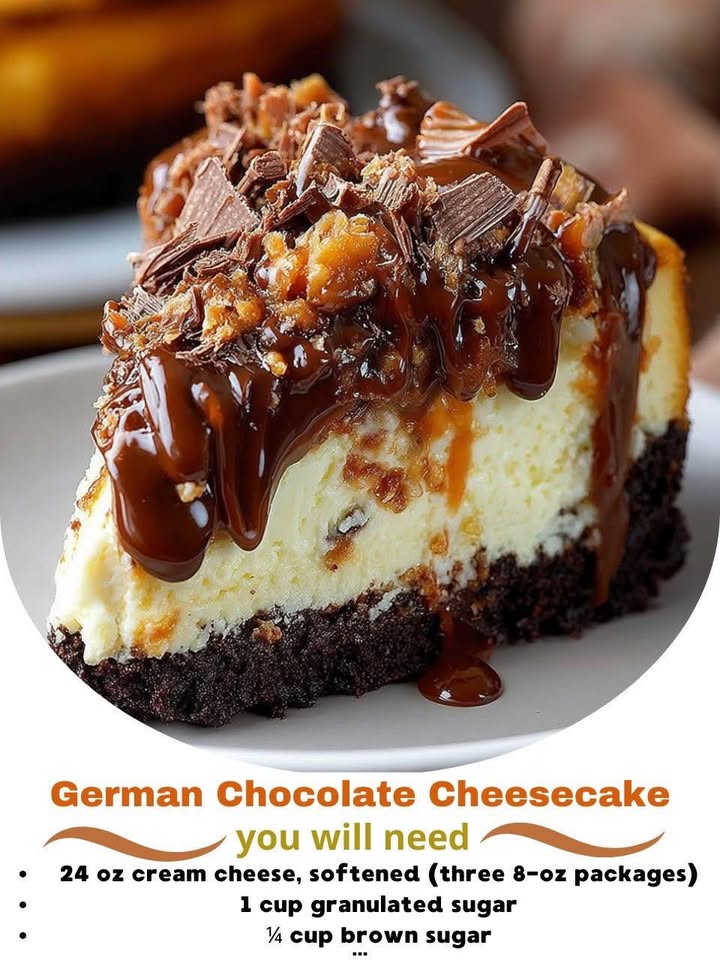
German Chocolate Cheesecake is a luxurious, decadent fusion dessert that masterfully bridges the rich heritage of traditional German chocolate cake with the creamy elegance of New York–style cheesecake. Far more than just a clever name, this confection honors the legacy of Sam German—who developed Baker’s German’s Sweet Chocolate in 1852—while boldly reimagining its signature flavors in an entirely new format. Unlike standard chocolate cheesecakes, German Chocolate Cheesecake features a deeply nuanced profile: bittersweet cocoa notes are elegantly balanced by caramelized coconut-pecan filling, toasted nuttiness, and subtle warm spices—all layered over a buttery graham cracker–walnut crust. Its velvety, dense-yet-airy texture, glossy surface, and dramatic visual presentation (often crowned with glossy ganache drizzle and candied pecans) make it a showstopping centerpiece for holidays, celebrations, or any occasion demanding indulgence with intention. This recipe isn’t merely about sweetness—it’s about reverence for craft, balance, and the alchemy that occurs when tradition meets innovation.
The History
The origins of German Chocolate Cheesecake are delightfully layered—much like the dessert itself—and rest at the intersection of American ingenuity and culinary evolution. To understand it, we must first clarify a common misconception: “German chocolate” has nothing to do with Germany. In 1852, American chocolate maker Samuel German developed a proprietary sweet baking chocolate for Baker’s Chocolate Company. It was named “Baker’s German’s Sweet Chocolate” in his honor—not as a geographic descriptor. The iconic German Chocolate Cake emerged in 1957, when a homemaker from Texas submitted a recipe using this specific chocolate to a Dallas newspaper; Baker’s promoted it heavily, and the cake—featuring its now-famous coconut-pecan frosting—became a national sensation by the early 1960s.
Fast forward to the late 1980s and 1990s: as home baking culture embraced experimentation and fusion trends gained momentum, bakers began deconstructing beloved classics. The idea of embedding the soul of German Chocolate Cake—the deep cocoa base, the sticky-sweet coconut-pecan filling, the warm spice undertones—into a rich, baked cheesecake structure was both logical and revolutionary. Early iterations appeared in regional cooking magazines and Southern food blogs, often labeled “German Chocolate Swirl Cheesecake” or “Coconut-Pecan Cheesecake.” Over time, bakers refined techniques—developing stable swirl methods, optimizing water bath protocols, and perfecting crust-to-filling ratios—until the modern German Chocolate Cheesecake emerged as a distinct genre: structurally sound, visually striking, and deeply flavorful without cloying sweetness. Today, it stands proudly alongside classics like New York and Oreo cheesecakes—not as a variant, but as a fully realized, culturally resonant dessert with its own devoted following.
Ingredients Breakdown
Every element of this German Chocolate Cheesecake serves a precise functional and sensory role. Below is a meticulous breakdown—not just of what goes in, but why each ingredient matters:
- Full-Fat Cream Cheese (32 oz / 900 g, room temperature): The structural and textural backbone. Must be truly room temperature (68–72°F) to emulsify smoothly—cold cream cheese causes lumps and air pockets; overheated or softened-too-long cheese introduces excess moisture and weakens stability.
- Granulated Sugar (1 ½ cups / 300 g): Provides sweetness, aids in aeration during mixing, and helps stabilize the protein matrix. A portion is reserved for the coconut-pecan topping to control caramelization.
- Sour Cream (1 cup / 240 g, full-fat, room temperature): Adds tang, moisture, and fat—critical for tenderness and preventing cracking. Low-fat versions lack sufficient fat content and yield chalky, dry results.
- Heavy Cream (⅔ cup / 160 ml, cold): Used only in the coconut-pecan layer to create a glossy, pourable consistency without thinning the cheesecake base. Cold cream prevents premature melting of the filling when swirled.
- Eggs (4 large, room temperature, plus 1 yolk): Eggs provide structure via coagulation; the extra yolk adds richness, emulsification power, and a silkier mouthfeel. Room temperature eggs incorporate more evenly and reduce mixing time—minimizing gluten development and air incorporation that can cause puffing and collapse.
- Vanilla Extract (2 tsp pure, alcohol-based): Enhances all other flavors and adds aromatic depth. Imitation vanilla lacks complexity and can taste medicinal under high heat.
- Unsweetened Cocoa Powder (¾ cup / 75 g, Dutch-processed preferred): Imparts deep, roasted chocolate flavor without acidity. Dutch-processed cocoa is alkalized, yielding smoother, less bitter notes and superior dispersion in batter. Natural cocoa works but may require slight acid adjustment and yields a sharper, fruitier chocolate tone.
- All-Purpose Flour (¼ cup / 30 g): A small but vital amount—acts as a gentle stabilizer, reinforcing the protein network without adding chewiness. Too much flour makes the cake dense and pasty; too little risks fissures and poor set.
- Sea Salt (1 tsp fine, non-iodized): Not just for seasoning—salt heightens sweetness perception, balances bitterness in cocoa, and strengthens gluten formation in the crust. Iodized salt can impart a metallic aftertaste.
- Graham Cracker Crumbs (1 ½ cups / 150 g, finely ground): Provides a sweet, honeyed, slightly gritty base. Freshly crushed crackers yield better adhesion and flavor than pre-ground boxes, which often contain anti-caking agents.
- Walnut Pieces (½ cup / 55 g, finely chopped & lightly toasted): Adds earthy depth and crunch contrast. Toasting unlocks oils and intensifies nuttiness—essential for harmony with the coconut-pecan layer.
- Unsalted Butter (6 tbsp / 85 g, melted & cooled): Binds the crust and contributes rich, clean dairy flavor. Salted butter risks oversalting; melted-and-cooled butter ensures even distribution without melting the crumbs.
- Light Brown Sugar (1 cup / 200 g, packed): For the coconut-pecan layer—its molasses content provides moisture, caramel depth, and acidity that cuts through richness. Dark brown sugar works but imparts stronger molasses notes that may overwhelm delicate coconut.
- Evaporated Milk (½ cup / 120 ml): Concentrated, unsweetened milk solids add creaminess and caramelization potential without excess water. Sweetened condensed milk would make the layer overly thick and saccharine.
- Large Egg (1, room temperature): Acts as binder and leavening agent for the topping—coagulates to set the filling while allowing gentle lift.
- Shredded Sweetened Coconut (1 ¼ cups / 85 g): Use *sweetened* for authentic flavor balance—unsweetened coconut is too dry and fibrous here. Toast lightly before folding in for aroma and texture contrast.
- Pecan Halves or Pieces (1 cup / 100 g, coarsely chopped): Toasted to amplify buttery, maple-like notes. Pecans are non-negotiable—walnuts lack the same caramel affinity, and almonds read as “bakery” rather than “German chocolate.”
- Ground Cinnamon (½ tsp), Ground Nutmeg (¼ tsp), and Pure Vanilla (1 tsp): Warm spice trio that echoes classic German chocolate cake—used judiciously to enhance, not dominate. Freshly grated nutmeg is infinitely superior to pre-ground.
Step-by-Step Recipe
- Prepare the Pan (24 hours ahead recommended): Wrap the exterior of a 9-inch springform pan *thoroughly* with two overlapping layers of heavy-duty aluminum foil, extending well above the rim. This prevents water bath leakage—a leading cause of soggy crusts and ruined cakes. Lightly grease the foil-wrapped sides and bottom with butter or non-stick spray. Set aside.
- Make the Crust (Day of baking, 30 min ahead): Preheat oven to 350°F (175°C). In a food processor, pulse graham crackers and walnuts until uniformly fine (no large shards). Add brown sugar and salt; pulse 2x to combine. Drizzle in melted butter while pulsing continuously until mixture resembles wet sand and holds together when pinched. Press firmly and evenly into the bottom and 1 inch up the sides of the prepared pan using the back of a spoon or flat-bottomed measuring cup. Bake 10 minutes until fragrant and lightly golden. Cool completely on a wire rack—do *not* skip cooling; warm crust absorbs moisture from filling.
- Toast Nuts & Coconut (While crust bakes): Spread pecans and coconut on separate parchment-lined baking sheets. Toast pecans at 350°F for 5–7 minutes until fragrant and golden at edges; cool completely. Toast coconut at 325°F for 3–4 minutes, stirring twice, until pale gold—cool completely. Store separately in airtight containers.
- Prepare Coconut-Pecan Filling (Day of baking, 20 min ahead): In a medium saucepan, combine brown sugar, evaporated milk, egg, cinnamon, nutmeg, and ½ tsp salt. Whisk constantly over medium-low heat until smooth and beginning to thicken (about 4–5 minutes). Remove from heat; stir in vanilla, then fold in cooled toasted coconut and pecans. Cool to room temperature—stirring occasionally—to prevent separation. Refrigerate 15 minutes to thicken further (should mound slightly when scooped).
- Make Cheesecake Batter (Day of baking, immediately after crust cools): Using a stand mixer fitted with paddle attachment (or hand mixer on low speed), beat cream cheese on medium-low for 2 minutes until completely smooth and glossy—scrape bowl and beater frequently. Add granulated sugar; beat 2 minutes more until fluffy and lump-free. Add sour cream and heavy cream; beat 1 minute until homogeneous. Add eggs one at a time, beating 30 seconds after each addition—scrape bowl thoroughly. Add vanilla, then cocoa powder and flour mixture (whisked together first); beat on low 45 seconds until just incorporated. Overmixing at this stage incorporates air → cracks. Batter should be thick, satiny, and free of streaks.
- Layer & Swirl (Critical Step): Pour ¾ of the batter into the cooled crust, smoothing top with offset spatula. Spoon chilled coconut-pecan filling in 8–10 dollops evenly spaced over batter. Top with remaining batter. Using a thin, flexible offset spatula or butter knife, gently drag through layers in a figure-eight pattern—just 3–4 passes. Do *not* over-swirl; you want defined marbling, not homogenization. Tap pan firmly on counter twice to release air bubbles.
- Water Bath Setup (Essential for Even Baking): Place springform pan inside a larger roasting pan. Carefully pour hot (not boiling) water into roasting pan until it reaches halfway up the sides of the springform. Use a kettle with a spout to avoid splashing water into batter.
- Bake with Precision: Place roasting pan on center oven rack. Bake at 325°F (163°C) for 1 hour 15 minutes—rotating pan halfway through. Cake is done when edges are puffed and set, center jiggles *slightly* like Jell-O (not liquid), and internal temperature reads 150–152°F (65–67°C) on an instant-read thermometer inserted 1 inch from edge. Avoid opening oven door for first 75 minutes.
- Cool Gradually (Non-Negotiable for Crack Prevention): Turn oven off. Crack oven door open 1 inch with a wooden spoon. Let cake cool in turned-off oven for 1 hour. Remove from water bath (carefully lift springform—foil will be hot!). Run thin knife around inner edge to loosen. Cool on wire rack at room temperature for 2 hours. Refrigerate uncovered for *at least* 12 hours—preferably 24–48 hours—for full flavor development, texture stabilization, and clean slicing.
- Final Touches Before Serving: Remove outer ring of springform. Use warm, dry knife (dipped in hot water and wiped clean between slices) for flawless cuts. Optional: garnish with extra toasted coconut, candied pecans, dark chocolate shavings, or a light drizzle of bourbon-infused chocolate ganache (1:1 dark chocolate to heavy cream + ½ tsp bourbon, cooled to ribbon stage).
Tips
- Temperature Discipline Is Everything: Every dairy and egg ingredient must be at true room temperature (68–72°F)—take them out 2–3 hours ahead. Cold ingredients cause curdling, lumps, and uneven baking. Use a digital thermometer to verify.
- Scrape Religiously: Scrape bowl, beater, and spatula after *every* addition—even mid-mix. Unincorporated cocoa or flour creates bitter streaks; unmixed cream cheese causes dense patches.
- Swirl Like a Sommelier, Not a Storm: Your goal is elegant marbling—not uniform blending. If your swirl disappears instantly, batter is too thin (overmixed or warm); if it resists movement, batter is too cold or over-thickened.
- Water Bath Water Must Be Hot, Not Boiling: Boiling water causes violent steam surges that crack the surface. Use water heated to 180–190°F (82–88°C).
- Thermometer > Timetables: Ovens vary wildly. An instant-read thermometer is the single most reliable tool—you’re aiming for 150–152°F (65–67°C) at the edge, *not* the center, which will continue cooking.
- Chill Time Is Not Optional—It’s Alchemy: Under-chilled cheesecake weeps, crumbles, and lacks cohesive flavor. 24 hours allows cocoa compounds to mellow, fats to fully crystallize, and coconut-pecan layer to meld seamlessly.
- Knife Technique Makes or Breaks Presentation: Wipe and reheat knife before *every* slice. A single damp, lukewarm blade leaves ragged edges and smears filling.
- Freeze for Long-Term Storage: Tightly wrap *fully chilled* cake (without garnishes) in plastic, then foil. Freeze up to 3 months. Thaw overnight in fridge—never at room temperature—to preserve texture.
- Rescue a Cracked Cake: Don’t panic! A light crack is common. Cover generously with ganache, caramel, or toasted coconut-pecan crumble. Or serve in elegant glasses with whipped cream and fresh berries—flavor remains impeccable.
Variations and Customizations
This recipe is a canvas—not a cage. Here are rigorously tested, chef-approved adaptations that preserve structural integrity and flavor harmony:
- Gluten-Free: Substitute gluten-free graham crackers (like Schar or Pamela’s) and certified GF oat flour for AP flour in batter. Ensure all extracts and cocoa are GF-certified. Crust binds best with 1 extra tbsp melted butter.
- Lower-Sugar / Refined-Sugar-Free: Replace granulated sugar with 1 cup monk fruit–erythritol blend (e.g., Lakanto Golden) + 2 tbsp pure maple syrup (reduce heavy cream by 1 tbsp). For coconut layer, use coconut sugar (adds molasses note) and unsweetened coconut. Expect slightly softer set and deeper color.
- Boozy Elegance: Infuse 2 tbsp heavy cream with 1 tsp espresso powder and 1 tbsp bourbon for batter. Add 1 tsp bourbon to coconut-pecan layer. Deepens complexity without alcohol sharpness.
- Decadent Ganache Swirl: Melt 4 oz 70% dark chocolate with ¼ cup heavy cream. Cool to 90°F. After pouring first batter layer, spoon ganache in circles, then top with remaining batter. Swirl *very* gently—ganache is denser and sinks faster.
- Spiced Variation: Add ¼ tsp ground cardamom and 1 pinch ground clove to cocoa-flour mixture. Complements coconut’s tropical notes and adds intriguing warmth.
- Crust Alternatives: Try a toasted almond–cocoa crust (replace walnuts with toasted almonds, add 2 tbsp cocoa to crumb mix) or a dark chocolate shortbread crust (substitute ¼ cup crushed chocolate shortbread cookies for graham crackers).
- Mini Versions: Bake in lined muffin tins (fill ⅔ full). Reduce bake time to 22–26 minutes at 325°F; water bath still required (use smaller roasting pan). Chill 8+ hours.
- Stovetop “No-Bake” Hybrid: For those avoiding oven use: Prepare no-bake cheesecake base (cream cheese, powdered sugar, whipped cream, cocoa), layer with chilled coconut-pecan filling, and set with 1 tsp unflavored gelatin (bloomed in 1 tbsp cold water, dissolved in 1 tsp hot cream). Chill 8+ hours. Texture differs (lighter, airier) but flavor remains faithful.
Health Considerations and Nutritional Value
A 1/12th slice (standard 9-inch cake) contains approximately:
- Calories: 485 kcal
- Total Fat: 32 g (19 g saturated, 1 g trans)
- Cholesterol: 125 mg (42% DV)
- Sodium: 290 mg (13% DV)
- Total Carbohydrates: 44 g (including 32 g sugars, 1 g fiber)
- Protein: 7 g
Nutritional Highlights & Considerations:
While undeniably indulgent, this cheesecake offers meaningful nutritional nuance beyond “empty calories.” The toasted pecans deliver heart-healthy monounsaturated fats, magnesium, and antioxidant vitamin E. Unsweetened cocoa powder is rich in flavanols—bioactive compounds linked to improved endothelial function and reduced oxidative stress. Coconut provides medium-chain triglycerides (MCTs), which are metabolized differently than long-chain fats and may support satiety. However, the high saturated fat content (primarily from cream cheese, butter, and coconut) warrants mindful portioning—especially for those managing LDL cholesterol or cardiovascular risk. The added sugars (both granulated and from sweetened coconut) contribute significantly to total carbohydrate load; individuals with diabetes should consult their dietitian regarding portion size and pairing (e.g., serving with a small green salad to slow glucose absorption). Gluten-containing ingredients (graham crackers, flour) make this unsuitable for celiac disease without verified GF substitutions. Lactose-intolerant individuals may tolerate small portions due to fermentation in sour cream and aging of cheeses—but lactase enzyme supplementation is recommended. For balanced enjoyment: pair one modest slice (about 3 oz) with black coffee or herbal tea, and follow with a walk—leveraging the dessert’s richness as a deliberate, savoring ritual rather than mindless consumption.
Ingredients
Makes one 9-inch cheesecake (12–14 servings)
For the Crust:
- 1 ½ cups (150 g) graham cracker crumbs (about 12 full sheets)
- ½ cup (55 g) walnuts, finely chopped and lightly toasted
- ¼ cup (50 g) light brown sugar, packed
- ½ tsp fine sea salt
- 6 tbsp (85 g) unsalted butter, melted and cooled
For the Coconut-Pecan Filling:
- 1 cup (200 g) light brown sugar, packed
- ½ cup (120 ml) evaporated milk
- 1 large egg, room temperature
- ½ tsp ground cinnamon
- ¼ tsp freshly grated nutmeg
- ½ tsp fine sea salt
- 1 tsp pure vanilla extract
- 1 ¼ cups (85 g) sweetened shredded coconut, lightly toasted
- 1 cup (100 g) pecan pieces, coarsely chopped and toasted
For the Cheesecake Batter:
- 32 oz (900 g) full-fat cream cheese, room temperature
- 1 ½ cups (300 g) granulated sugar
- 1 cup (240 g) full-fat sour cream, room temperature
- ⅔ cup (160 ml) heavy cream, cold
- 4 large eggs + 1 large egg yolk, room temperature
- 2 tsp pure vanilla extract
- ¾ cup (75 g) Dutch-processed cocoa powder
- ¼ cup (30 g) all-purpose flour
- 1 tsp fine sea salt
Directions
- Prep Pan: Wrap exterior of a 9-inch springform pan with two overlapping layers of heavy-duty aluminum foil, extending at least 3 inches above the rim. Lightly grease foil and pan bottom with butter or non-stick spray.
- Make Crust: Preheat oven to 350°F (175°C). Pulse graham crackers and walnuts in food processor until fine crumbs form. Add brown sugar and salt; pulse 2x. Drizzle in melted butter while pulsing until mixture resembles wet sand. Press firmly into bottom and 1 inch up sides of pan. Bake 10 minutes. Cool completely on wire rack.
- Toast Nuts & Coconut: On separate parchment-lined sheets, toast pecans at 350°F for 5–7 min; toast coconut at 325°F for 3–4 min, stirring twice. Cool completely. Store separately.
- Make Coconut-Pecan Filling: In saucepan, whisk brown sugar, evaporated milk, egg, cinnamon, nutmeg, and salt. Cook over medium-low, whisking constantly, until thickened (4–5 min). Remove from heat; stir in vanilla, then fold in cooled coconut and pecans. Cool to room temp, then refrigerate 15 min.
- Make Batter: Beat cream cheese on medium-low 2 min until smooth. Add sugar; beat 2 min until fluffy. Add sour cream and heavy cream; beat 1 min. Add eggs one at a time, beating 30 sec each—scrape bowl. Add vanilla. Whisk cocoa and flour; add to batter on low 45 sec until just combined.
- Layer & Swirl: Pour ¾ batter into crust. Dollop coconut-pecan filling evenly. Top with remaining batter. Swirl gently with knife in figure-eight (3–4 passes only). Tap pan firmly twice.
- Water Bath: Place pan in roasting pan. Pour hot (180–190°F) water halfway up springform sides.
- Bake: Bake at 325°F (163°C) for 1 hr 15 min, rotating halfway. Done when edges are set, center jiggles slightly, and internal temp reads 150–152°F at edge.
- Cool Gradually: Turn oven off. Crack door open 1 inch; cool 1 hr. Remove from water bath. Loosen edges with knife. Cool on rack 2 hrs. Refrigerate uncovered ≥12 hrs (ideally 24–48 hrs).
- Serve: Remove springform ring. Slice with warm, dry knife. Garnish as desired.
FAQ
- Can I make this without a water bath?
- No—this is non-negotiable. Without the gentle, moist heat of a water bath, the edges overbake before the center sets, causing severe cracking, sinking, and dry, grainy texture. Foil wrapping prevents leaks; it’s worth the effort.
- Why does my coconut-pecan layer sink?
- Two main causes: (1) Batter is too warm when layering—chill batter 15 min before swirling, or (2) Coconut-pecan filling is too warm or too thin—ensure it’s fully cooled and thickened in fridge before using.
- Can I use natural cocoa instead of Dutch-processed?
- Yes, but expect a sharper, fruitier chocolate note and slightly drier texture. Add ¼ tsp baking soda to neutralize acidity and improve rise. Avoid substituting in equal measure—natural cocoa is more acidic and less soluble.
- My cake cracked badly. Can I fix it?
- Absolutely. Cracks rarely affect flavor. Cover generously with glossy chocolate ganache, caramel sauce, or a thick layer of toasted coconut-pecan crumble. Or serve in parfait glasses with whipped cream and raspberries—presentation transforms perception.
- How do I prevent a soggy crust?
- Three keys: (1) Foil-wrap the pan *thoroughly*—no gaps; (2)