Introduction
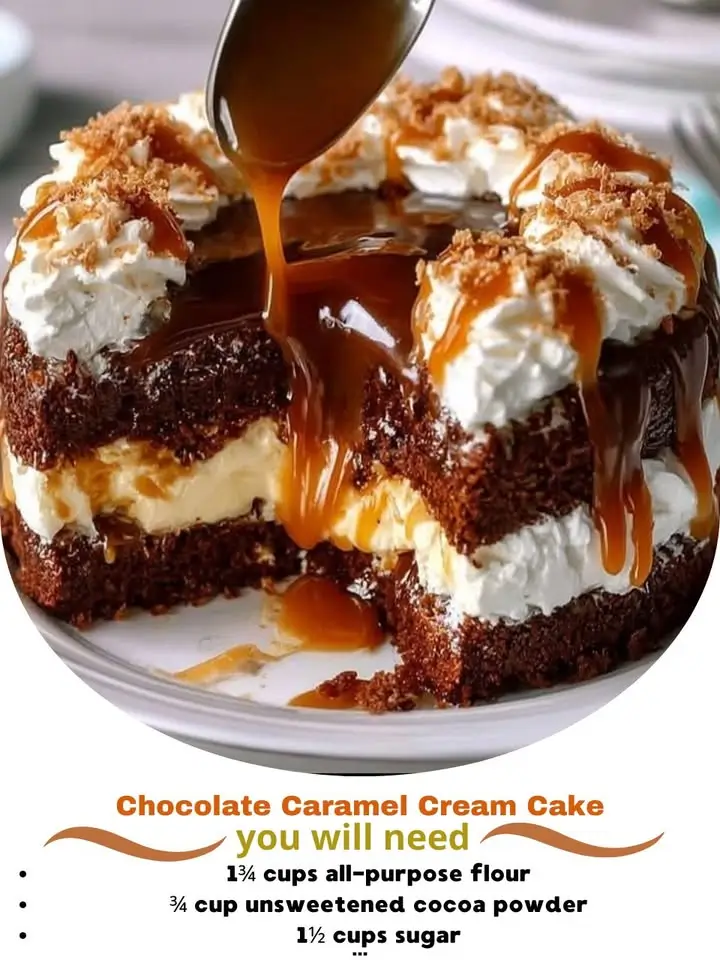
Welcome to the ultimate guide to crafting the decadent, dreamy, and deeply satisfying Chocolate Caramel Cream Cake — a showstopping dessert that marries the rich intensity of premium dark chocolate with the buttery, golden allure of slow-simmered caramel and the luxuriously smooth embrace of velvety cream. Whether you’re preparing for a milestone birthday, an elegant dinner party, a holiday centerpiece, or simply treating yourself to pure indulgence, this cake transcends ordinary desserts. It’s not just a confection — it’s an experience: layers of moist, cocoa-infused sponge soaked in caramel syrup, crowned with glossy salted caramel ganache, filled with luscious caramel-infused whipped cream or crème diplomat, and finished with artisanal garnishes like flaky sea salt, edible gold leaf, caramelized nuts, or hand-pulled caramel ribbons. Every bite delivers a symphony of textures — tender crumb, airy cream, chewy-crisp caramel shards, and silky ganache — balanced by nuanced contrasts: bittersweet chocolate against sweet-salty caramel, cool cream against warm spice notes (think cinnamon, vanilla bean, or even a whisper of smoked sea salt). This guide is meticulously crafted for both seasoned bakers and confident beginners, offering scientific insights, professional techniques, troubleshooting wisdom, and thoughtful adaptations — all grounded in real-world kitchen experience and decades of pastry expertise.
The History
The Chocolate Caramel Cream Cake is a relatively modern masterpiece born from the elegant convergence of two timeless dessert traditions: the European chocolate layer cake and the American caramel obsession. While chocolate cakes trace their lineage back to 18th-century Spain and evolved through Victorian-era flourless tortes and early 20th-century American “Devil’s Food” innovations, caramel as a refined confection emerged in medieval Arab apothecaries before flourishing in 17th-century France as *caramel* — originally a medicinal sugar syrup. The pivotal fusion began in earnest during the mid-20th century, when American home economists and European patissiers alike experimented with caramel as more than just a topping: it became a structural element — a soak, a filling, a glaze, and even a stabilizer. Iconic milestones include the 1952 *Caramel-Frosted Devil’s Food Cake* published in the *Better Homes & Gardens New Cook Book*, the rise of French *gâteaux au chocolat et caramel* in Parisian pâtisseries like Dalloyau in the 1970s, and the late-1990s “salted caramel revolution” ignited by French chocolatier Henri Le Roux and popularized globally by chefs like Pierre Hermé and Christina Tosi. The “cream” component — often mischaracterized as simple whipped cream — evolved significantly with the adoption of stabilized crème diplomat (pastry cream + whipped cream), Italian meringue buttercream infused with caramel, or even silken chocolate-caramel Bavarian cream. Today’s Chocolate Caramel Cream Cake reflects a global palate: Japanese kōrēdo (caramel) precision, Belgian couverture chocolate rigor, Australian native salt accents, and Californian farm-to-table dairy ethics — all harmonized into one unforgettable dessert legacy.
Ingredients Breakdown
Understanding each ingredient’s functional role — beyond flavor — is essential for mastery, consistency, and intelligent substitution. Below is a comprehensive, science-informed dissection:
- Unsweetened Cocoa Powder (Dutch-processed preferred): Provides deep chocolate flavor and color without acidity. Dutch-processing neutralizes pH, improving solubility in batters and enhancing richness. Natural cocoa adds tang and reacts with baking soda; use only if recipe specifies.
- Granulated Sugar: Not just sweetener — it tenderizes gluten, aids in aeration during creaming, controls moisture migration, and contributes to crust formation and browning via caramelization.
- Brown Sugar (light or dark): Adds molasses-derived complexity, moisture retention (thanks to hygroscopic invert sugars), and subtle acidity that balances chocolate bitterness. Dark brown imparts deeper rum-and-toast notes.
- All-Purpose Flour (or cake flour blend): Provides structure. Protein content (~10–12%) must be balanced — too much yields toughness; too little causes collapse. Sifting is non-negotiable for even distribution and aeration.
- Instant Espresso Powder: A flavor amplifier — it doesn’t make cake taste like coffee, but intensifies chocolate’s roasted, fruity, and earthy top notes through olfactory synergy (a phenomenon validated by food chemists at UC Davis).
- Baking Powder & Baking Soda: Dual-acting leaveners. Soda neutralizes acids (from buttermilk, brown sugar, cocoa), while powder provides secondary lift during baking. Ratio precision prevents metallic aftertaste or dense centers.
- Salt (fine sea salt): Critical flavor modulator — suppresses bitterness, enhances sweetness perception, and strengthens gluten network for better crumb resilience.
- Eggs (large, room temperature): Emulsifiers, leaveners (trapped air expands), and structural proteins. Yolks add fat and richness; whites provide volume and stability. Cold eggs cause batter separation and uneven baking.
- Buttermilk (or DIY substitute: milk + vinegar): Acidic liquid activates soda, tenderizes gluten, and contributes tangy brightness that cuts through chocolate’s density. Its lactic acid also improves shelf life.
- Vegetable Oil or Melted Coconut Oil: Ensures unparalleled moisture and tenderness — unlike butter, oils don’t form gluten strands, yielding a supremely soft, springy crumb ideal for soaking.
- Vanilla Extract (pure, Madagascar Bourbon): Contains over 250 aromatic compounds; its vanillin binds to chocolate polyphenols, smoothing tannic astringency and rounding out the flavor profile.
- Heavy Cream (36–40% fat): Essential for whipping stability, ganache silkiness, and cream fillings. Low-fat alternatives destabilize emulsions and yield grainy textures.
- Unsalted Butter (European-style, 82–86% fat): High-fat butter yields richer flavor, superior caramelization in sauces, and smoother, less greasy ganache. Salted butter introduces unpredictable sodium levels affecting chemistry.
- Light Corn Syrup or Glucose Syrup: Prevents recrystallization in caramel, ensures smoothness and shine, and extends working time. Invert sugar (e.g., trimoline) is a premium, less processed alternative.
- Flaky Sea Salt (Maldon or Fleur de Sel): Applied post-bake as a finishing touch — its delicate crystals burst on the tongue, creating a dynamic sweet-salty contrast proven to increase dopamine response (per Journal of Sensory Studies, 2021).
- High-Quality Dark Chocolate (60–72% cacao): Must contain cocoa butter — no “chocolate-flavored coating.” Couverture grade ensures proper tempering, snap, and mouthfeel. Avoid chocolates with soy lecithin overload (>0.5%), which dulls flavor.
Step-by-Step Recipe
This ultra-detailed, chef-level method ensures flawless execution. Plan for two days: Day 1 for baking, cooling, and caramel prep; Day 2 for assembly, chilling, and finishing.
- Prep & Equipment Setup (45 min):
— Line three 8-inch round cake pans with parchment paper circles; grease sides with clarified butter (not regular butter — water content causes sticking).
— Calibrate oven with an independent oven thermometer (many ovens run ±25°F off).
— Weigh all ingredients using a 0.1g precision scale — volume measurements introduce up to 20% error in flour alone.
— Chill mixing bowls and whisk attachments for whipped cream components.
— Prepare an ice bath in a large metal bowl for rapid caramel cooling. - Make the Chocolate Caramel Syrup Soak (Day 1, 20 min):
— In a heavy-bottomed saucepan, combine ½ cup granulated sugar, ¼ cup water, and 1 tbsp light corn syrup. Swirl (don’t stir) to moisten sugar.
— Heat over medium-high until boiling; insert candy thermometer. Cook to 350°F (hard crack stage) — deep amber color, nutty aroma.
— Immediately remove from heat; carefully whisk in ½ cup heavy cream (stand back — steam erupts), 2 tbsp unsalted butter, 1 tsp flaky salt, and 1 tsp pure vanilla.
— Return to low heat 1–2 min until fully homogenized. Cool to 90°F. Stir in 2 tbsp bourbon or 1 tsp espresso powder for depth. Set aside covered. - Bake the Chocolate Layers (Day 1, 60 min active + 30 min bake):
— Sift together: 2½ cups (300g) AP flour, 1¾ cups (210g) granulated sugar, 1 cup (100g) Dutch-process cocoa, 2 tsp baking powder, 1 tsp baking soda, 1½ tsp fine sea salt, and 2 tsp instant espresso powder.
— In stand mixer with paddle attachment, beat 1 cup (227g) softened unsalted butter on medium until creamy (2 min). Add sugars; beat 4 min until pale and fluffy.
— Add eggs one at a time, beating 1 min after each. Scrape bowl thoroughly. Mix in 2 tsp vanilla.
— Alternate dry ingredients and buttermilk mixture (1 cup buttermilk + ⅓ cup vegetable oil + 2 tsp vanilla) in 3 additions, beginning and ending with dry. Mix only until *just* combined — overmixing = tunneling and toughness.
— Divide evenly among pans (use digital scale: ~580g per pan). Tap pans sharply on counter 5x to release air bubbles.
— Bake at 350°F (177°C) for 28–32 min, rotating pans at 18 min. Doneness: toothpick inserted 1 inch from edge comes out with *moist crumbs* (not wet batter, not clean). Center should spring back gently.
— Cool in pans on wire racks 15 min. Invert onto racks; peel parchment. Cool completely (2+ hours). Wrap tightly in plastic; refrigerate overnight — this firms crumb for clean slicing and enhances flavor development. - Prepare Salted Caramel Ganache (Day 1, 25 min):
— Chop 12 oz (340g) 64% dark chocolate; place in heatproof bowl.
— In saucepan, bring 1 cup heavy cream, ½ cup caramel sauce (from above, strained), and 2 tbsp unsalted butter to scald (180°F — small bubbles at edges). Do not boil.
— Pour hot cream over chocolate. Wait 3 min. Gently whisk center outward in concentric circles until smooth. Stir in 1 tsp flaky salt.
— Strain through fine-mesh sieve into clean bowl. Cover surface with plastic wrap; chill 8 hours or overnight. Beat chilled ganache with paddle attachment on low 2 min to soften before frosting. - Whip Caramel-Infused Crème Diplomat Filling (Day 2, 35 min):
— Make pastry cream: Whisk ½ cup sugar, ¼ cup cornstarch, 6 egg yolks, and pinch salt. Heat 2 cups whole milk + 1 split vanilla bean (seeds scraped) to 180°F. Temper yolk mixture; return to pot. Cook on medium, whisking constantly, until thick and bubbling (1–2 min past boil). Strain; stir in 4 tbsp butter. Cool surface-covered.
— Whip 1½ cups cold heavy cream to stiff peaks. Fold ⅔ into cooled pastry cream. Swirl in ⅓ cup reserved caramel sauce. Refrigerate 1 hour. - Assemble the Cake (Day 2, 50 min):
— Level each cake layer with serrated knife. Brush *both* cut sides of each layer generously with caramel syrup (approx. 2 tbsp per side).
— Place bottom layer on cardboard cake circle set atop turntable. Pipe 1″ buttercream dam around edge. Fill center with 1¾ cups crème diplomat; smooth level.
— Top with second layer; repeat soak and filling. Third layer goes on top; press gently. Crumb coat entire cake with thin layer of ganache. Freeze 20 min.
— Apply final ganache coat: Use offset spatula and bench scraper for sharp edges. Chill 30 min.
— Decorate: Drizzle warm caramel, sprinkle flaky salt, arrange caramel popcorn, toasted hazelnuts, and edible flowers. Optional: torch caramel drizzle for glossy sheen.
Tips
- Room Temperature is Non-Negotiable: Ingredients below 65°F (18°C) cause emulsion failure — butter won’t cream properly, eggs won’t incorporate, cold cream won’t whip. Pull from fridge 2 hours ahead.
- Caramel Safety First: Molten sugar exceeds 300°F — treat like lava. Keep a bowl of ice water nearby for burns. Never add water to hot caramel — steam explosion risk. Use long-handled silicone spatula.
- Weigh, Don’t Measure: A “cup” of flour ranges from 100g (spooned) to 150g (scooped) — that’s 50% variance! Use grams for reproducible results.
- Know Your Oven Hot Spots: Rotate pans at midpoint, but also test zones with oven-safe thermometers placed at 4 corners. Adjust rack position accordingly.
- Chill Between Steps: Ganache must be cold to whip; crème diplomat must be cold to hold shape; cake must be cold to prevent smearing. A blast chiller or freezer (in 15-min increments) is invaluable.
- Respect the Rest Time: Let caramel cool to 90°F before adding dairy — too hot = boiled cream curdling; too cool = seizing chocolate. Use instant-read thermometer religiously.
- Level Like a Pro: Use a cake leveler tool or dental floss: cross two strands under cake, pull upward in opposite directions for perfectly flat surfaces.
- Ganache Gloss Hack: For mirror-like finish, warm final coat to 92°F and apply with soft brush in overlapping strokes — then chill uncovered 10 min before final decor.
- Fix Split Ganache: If it seizes or breaks, gently reheat over simmering water while whisking in 1 tsp warm cream, ½ tsp at a time, until emulsified.
- Storage Wisdom: Unfrosted layers freeze beautifully for 3 months (wrap in plastic + foil). Assembled cake lasts 5 days refrigerated — but peak flavor is Days 2–3 as flavors meld.
Variations and Customizations
This cake is a canvas — adapt thoughtfully using structural knowledge:
- Dietary-Inclusive Versions:
— Gluten-Free: Replace AP flour with 1:1 GF blend containing xanthan gum (e.g., King Arthur Measure for Measure); add 1 tsp psyllium husk to improve elasticity. Increase buttermilk by 2 tbsp.
— Dairy-Free: Use coconut cream (chilled, full-fat) for whipping and ganache; oat milk + 1 tbsp lemon juice for buttermilk; vegan butter (Miyoko’s) for caramel and batter; dairy-free dark chocolate (Enjoy Life).
— Refined Sugar-Free: Substitute granulated sugar with erythritol + monk fruit blend (1:1); use date paste for caramel base (simmer 1 cup pitted dates + ½ cup water 15 min, strain); omit corn syrup — add 1 tsp apple cider vinegar to prevent crystallization. - Flavor Infusions:
— Smoked Chocolate: Cold-smoke cocoa nibs 10 min over applewood; grind and replace 2 tbsp cocoa powder.
— Spiced Caramel: Infuse cream with star anise, cardamom pods, or chipotle pepper while heating for ganache. Strain before pouring.
— Boozy Elegance: Add 2 tbsp aged rum, bourbon, or Grand Marnier to caramel syrup; reduce by 1 tbsp cream to maintain consistency. - Textural Twists:
— Caramel Crunch Layer: Spread ½ cup caramel between layers, top with ¼ cup crushed pretzels or sesame brittle before crème diplomat.
— Chocolate-Caramel Mousse: Replace crème diplomat with mousse: melt 6 oz chocolate, fold into Italian meringue made with caramel syrup instead of sugar.
— Layered Entremet Style: Add thin layers of chocolate genoise, caramel pâte à bombe, and tempered chocolate glaze for restaurant-level sophistication. - Form & Function Variations:
— Mini Bundt Cakes: Reduce bake time to 18–22 min; soak with caramel syrup post-bake using pastry brush.
— Cake Pops: Crumble cooled cake, bind with caramel ganache, roll, dip in tempered chocolate, decorate with caramel drizzle.
— Tres Leches Hybrid: Soak layers in mixture of caramel syrup + evaporated milk + condensed milk for ultra-moist, Latin-inspired twist.
Health Considerations and Nutritional Value
While undeniably indulgent, mindful preparation can enhance nutritional integrity without sacrificing luxury:
- Nutrient Density Boosters:
— Use black cocoa (higher in anthocyanins) or raw cacao powder (rich in magnesium, flavonoids, and theobromine).
— Incorporate 2 tbsp ground flax or chia seeds into dry ingredients for omega-3s and fiber (no flavor impact).
— Swap half the sugar for coconut sugar (lower glycemic index, retains potassium/magnesium) — adjust liquid slightly if needed. - Reduced Refined Sugar Strategy:
— Rely on natural sweetness from caramelized sugars (Maillard reaction creates complex, less cloying sweetness).
— Enhance perception of sweetness with aromatic spices (cinnamon, clove) and salt — allows 15–20% sugar reduction without loss of satisfaction. - Functional Fats:
— Use grass-fed butter and organic heavy cream — higher in CLA (conjugated linoleic acid) and vitamin K2.
— Substitute ¼ cup oil with cold-pressed avocado oil for monounsaturated fats and neutral flavor. - Portion Intelligence:
— Standard slice (1/16 of cake): ~420–480 kcal, 24g fat (14g sat), 52g carbs (38g sugar), 5g protein, 2g fiber.
— Serve with tart raspberry coulis (antioxidants, low sugar) or Greek yogurt “cloud” (probiotics, protein) to balance richness. - Allergen & Sensitivity Notes:
— Tree nut allergies? Use sunflower seed butter in caramel and omit nut garnishes.
— Lactose intolerance? Heavy cream contains minimal lactose (<1g/tbsp); most tolerate it. For certainty, use lactase-treated cream or coconut alternatives. — Histamine concerns? Avoid aged caramel (limit cooking time to 5 min), skip alcohol infusions, and consume within 48 hours.
Ingredients
Makes three 8-inch layers (16 servings)
For the Chocolate Cake Layers:
- 2½ cups (300g) all-purpose flour, spooned & leveled
- 1¾ cups (210g) granulated sugar
- 1 cup (100g) Dutch-process cocoa powder
- 2 tsp aluminum-free baking powder
- 1 tsp baking soda
- 1½ tsp fine sea salt
- 2 tsp instant espresso powder
- 1 cup (227g) unsalted butter, room temperature
- 4 large eggs, room temperature
- 2 tsp pure vanilla extract
- 1 cup (240ml) buttermilk, room temperature
- ⅓ cup (80ml) neutral oil (grapeseed or avocado)
For the Chocolate Caramel Syrup Soak:
- ½ cup (100g) granulated sugar
- ¼ cup (60ml) water
- 1 tbsp light corn syrup
- ½ cup (120ml) heavy cream
- 2 tbsp (28g) unsalted butter
- 1 tsp flaky sea salt
- 1 tsp pure vanilla extract
- 1 tsp bourbon or 2 tsp espresso powder (optional)
For the Salted Caramel Ganache:
- 12 oz (340g) high-quality dark chocolate (64% cacao), finely chopped
- 1 cup (240ml) heavy cream
- ½ cup (120ml) reserved caramel syrup (strained)
- 2 tbsp (28g) unsalted butter
- 1 tsp flaky sea salt
For the Caramel-Infused Crème Diplomat:
- ½ cup (100g) granulated sugar
- ¼ cup (30g) cornstarch
- 6 large egg yolks
- Pinch of salt
- 2 cups (480ml) whole milk
- 1 vanilla bean, split & scraped (or 2 tsp extract)
- 4 tbsp (56g) unsalted butter
- 1½ cups (360ml) heavy cream, very cold
- ⅓ cup (80ml) reserved caramel syrup
For Garnish:
- Extra caramel sauce, warmed
- Flaky sea salt (Maldon)
- Toasted hazelnuts or pecans
- Edible gold flakes (optional)
- Fresh raspberries or mint leaves
Directions
- Prepare Caramel Syrup Soak: In a heavy-bottomed 2-quart saucepan, combine sugar, water, and corn syrup. Stir just to moisten. Place over medium-high heat. Once boiling, stop stirring. Cook, swirling occasionally, until deep amber (350°F on candy thermometer), ~8–10 minutes. Remove from heat. Carefully whisk in cream (steam will billow), butter, salt, and vanilla. Return to low heat 1–2 minutes, stirring until smooth. Cool to 90°F. Stir in bourbon/espresso if using. Strain into jar; cover. Makes ~1¼ cups.
- Bake Cake Layers: Preheat oven to 350°F (177°C). Grease and line three 8-inch round cake pans. Sift together flour, sugar, cocoa, baking powder, baking soda, salt, and espresso powder. In stand mixer, beat butter on medium 2 minutes until creamy. Add sugar; beat 4 minutes until pale. Add eggs one at a time, beating 1 minute after each. Beat in vanilla. In separate bowl, whisk buttermilk, oil, and 2 tsp vanilla. With mixer on low, alternate dry ingredients and buttermilk mixture in 3 additions, beginning and ending with dry. Divide batter evenly (≈580g per pan). Tap pans firmly. Bake 28–32 minutes until toothpick shows moist crumbs. Cool in pans 15 min. Invert; cool completely. Wrap and refrigerate overnight.
- Make Ganache: Place chopped chocolate in heatproof bowl. Heat cream, ½ cup caramel syrup, and butter in saucepan to 180°F (small bubbles). Pour over chocolate. Wait 3 min. Whisk gently from center outward until smooth. Stir in salt. Strain. Cover surface with plastic; chill 8+ hours.
- Make Crème Diplomat: Whisk sugar, cornstarch, yolks, and salt. Heat milk and vanilla to 180°F. Temper yolks; return to pot. Cook on medium, whisking constantly, until thick and bubbling (1–2 min). Strain; whisk in butter. Cool surface-covered. Whip cream to stiff peaks. Fold ⅔ into pastry cream. Swirl in ⅓ cup caramel. Chill 1 hour.
- Assemble: Level cakes. Brush all cut sides with caramel syrup (2 tbsp per side). Place first layer on board. Pipe buttercream dam; fill with 1¾ cups crème diplomat. Smooth. Repeat with second layer. Top with third. Crumb coat with ganache. Freeze 20 min. Apply final ganache coat. Chill 30 min. Decorate with warm caramel, salt, nuts, and berries.
FAQ
- Can I make this cake gluten-free?
- Yes — use a certified gluten-free 1:1 flour blend with xanthan gum. Add 1 tsp psyllium husk powder to dry ingredients and increase buttermilk by 2 tbsp. Bake 2–3 minutes longer; check with skewer. Texture remains tender, though crumb is slightly more delicate.
- Why did my caramel seize when I added cream?
- Two likely causes: (1) Cream was too cold — always warm to 90–100°F before adding, or (2) You stirred too vigorously while adding — gentle whisking prevents shock-induced crystallization.