Introduction
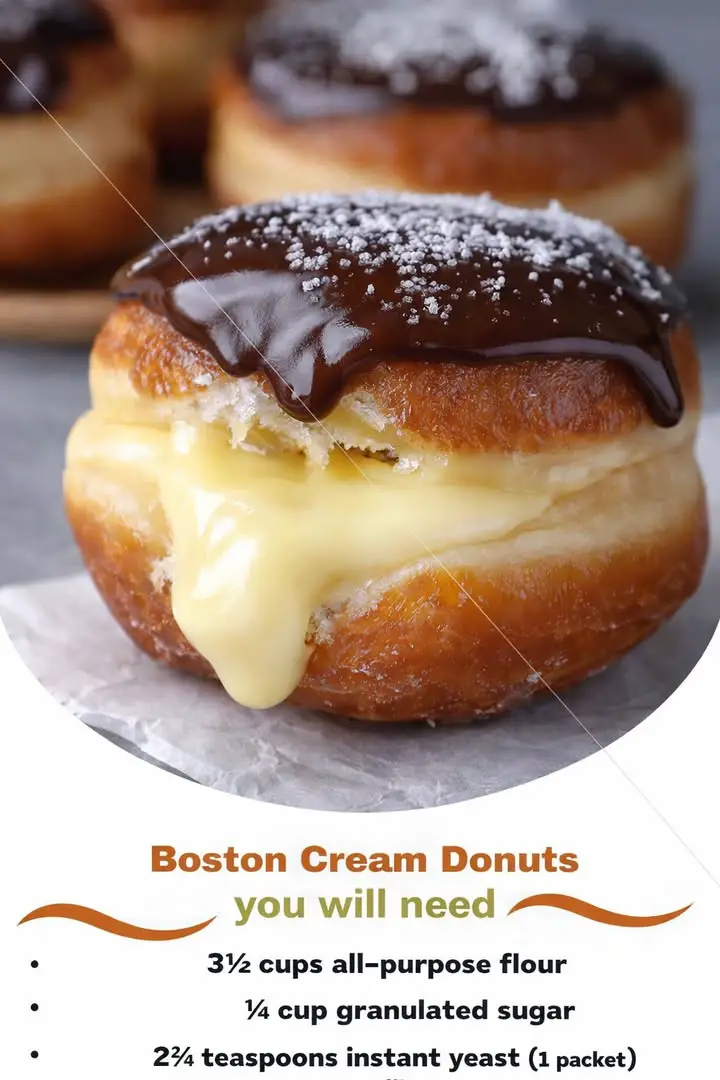
Boston Cream Donuts are the elegant, sophisticated cousins of the classic American donut — a harmonious marriage of tender, pillowy yeast-raised dough, luxuriously smooth vanilla pastry cream, and a rich, glossy chocolate glaze that shatters delicately with each bite. Unlike their fried, cakey, or heavily sugared counterparts, Boston Cream Donuts embody balance: soft but structured, sweet but not cloying, indulgent yet refined. Originating as a donut adaptation of the iconic Boston Cream Pie (Massachusetts’ official state dessert since 1996), this version transforms the layered cake-and-custard classic into a handheld, shareable, and deeply comforting treat. Whether enjoyed warm from a neighborhood bakery, carefully crafted at home on a Sunday morning, or served at a spring brunch alongside fresh berries and café au lait, the Boston Cream Donut is more than a pastry — it’s a nostalgic embrace, a testament to thoughtful technique, and a celebration of contrast: airy dough against velvety filling, cool cream beneath warm chocolate, subtle vanilla cutting through deep cocoa notes. In every bite lies a story of New England ingenuity, French-inspired custard mastery, and American love for joyful, unapologetically delicious desserts.
The History
The roots of the Boston Cream Donut stretch back to the mid-19th century — not in a donut shop, but in the refined kitchens of Boston’s Parker House Hotel (now the Omni Parker House), where chef M. Sanborn invented the Boston Cream Pie around 1856. Despite its name, it was never a pie — rather, two layers of soft, golden sponge cake sandwiched with rich vanilla custard and crowned with a sleek, dark chocolate glaze. The “pie” moniker likely stemmed from early American usage, where “pie” often referred to any open-faced or layered dessert baked in a pie tin — and the original was indeed baked in a shallow, round pan resembling a pie dish. By the 1870s, the dessert had become a Boston institution, immortalized in cookbooks and praised by culinary critics for its restrained elegance amid an era of increasingly ornate confections.
Fast forward to the 1950s–60s: the American donut boom, fueled by rising automobile culture and suburban expansion, inspired bakers to reinterpret regional classics in portable, mass-producible formats. Dunkin’ Donuts — founded in Quincy, Massachusetts, just south of Boston — played a pivotal role. In 1958, they introduced the “Boston Kreme” donut, deliberately evoking local pride while adapting the pie’s essence for high-volume production: yeast-leavened rings (later filled rounds), machine-injected pastry cream, and a quick-dip chocolate coating. Though simplified for scale, Dunkin’s version sparked nationwide fascination — introducing millions to the concept of a *filled*, *glazed*, *custard-based* donut. Independent bakeries soon followed, elevating the standard with house-made custards, brioche-enriched doughs, and single-origin chocolate glazes. Today, artisanal versions abound — from Brooklyn apothecary-style donuts with Madagascar bourbon vanilla bean flecks to Pacific Northwest iterations using locally roasted hazelnut-infused cream and heirloom cacao glazes — proving that the Boston Cream Donut is not static history, but a living tradition, continuously reimagined with reverence and creativity.
Ingredients Breakdown
Every exceptional Boston Cream Donut rests on three meticulously balanced components — each deserving careful ingredient selection and intentional proportioning. Below is a comprehensive, chef-level breakdown of why each element matters:
Dough Ingredients
- High-Protein Bread Flour (10–12% protein): Provides essential gluten structure for lift and chew without toughness. All-purpose flour may be substituted, but yields a slightly denser crumb and less resilient rise.
- Whole Milk (warmed to 105–110°F / 40–43°C): Adds richness, tenderness, and natural sugars (lactose) that feed yeast and promote browning. Skim milk sacrifices flavor and texture; buttermilk introduces tang that competes with vanilla.
- Fresh Active Dry Yeast or Instant Yeast: Fresh yeast offers nuanced fermentation aromas; instant yeast provides reliability and faster activation. Avoid expired or temperature-shocked yeast — the foundation of rise depends entirely on vitality.
- Granulated Sugar: More than sweetness — it accelerates yeast activity, enhances crust color via Maillard reaction, and retains moisture. Brown sugar adds molasses depth but can darken the crumb undesirably.
- Unsalted Butter (softened, not melted): Enriches dough, tenderizes gluten strands, and contributes to flaky-yet-soft layering when laminated (optional). Clarified butter may be used for higher smoke point during frying, but loses dairy aroma.
- Egg Yolk (plus whole egg optional): Yolks add fat, emulsification power, and golden hue. A whole egg increases volume and binding; extra yolk deepens richness and improves shelf life.
- Sea Salt (fine, non-iodized): Critical for flavor balance and gluten regulation — too little yields bland, slack dough; too much inhibits yeast. Kosher salt is preferred for even dissolution.
- Vanilla Extract (pure, not imitation): Adds aromatic complexity that complements — never overpowers — the filling. Mexican or Tahitian varieties offer floral nuance; avoid alcohol-heavy extracts that may curdle custard later.
Pastry Cream (Vanilla Crème Pâtissière)
- Whole Milk & Heavy Cream Blend (typically 3:1 ratio): Milk delivers clean vanilla flavor and proper setting temperature; cream adds unctuous mouthfeel and prevents graininess. Ultra-pasteurized milk works but may yield slightly thinner set.
- Granulated Sugar: Controls viscosity and stabilizes egg proteins. Confectioners’ sugar dissolves too quickly and lacks structural integrity.
- Egg Yolks (room temperature): Provide thickening power and luxurious silkiness. Using only yolks (not whole eggs) ensures smoothness and avoids rubberiness. Organic, pasture-raised yolks impart deeper color and richer flavor.
- Cornstarch & Pastry Flour (or tapioca starch) blend: Cornstarch delivers clarity and shine; pastry flour adds body and prevents “break” under heat. Arrowroot may substitute but lacks freeze-thaw stability.
- Madagascar Bourbon Vanilla Bean (seeds scraped + pod steeped): Far superior to extract — offers floral, woody, caramelized notes and visible speckles that signal authenticity. Paste or powder may augment but shouldn’t replace the bean.
- Unsalted Butter (cold, cubed): Added off-heat to emulsify and enrich. European-style (82–84% fat) yields superior sheen and melt-in-mouth texture.
- Pinch of Fine Sea Salt: Heightens all other flavors and balances sweetness.
- Optional: Rum or Grand Marnier (½ tsp per cup cream): Adds aromatic lift and inhibits crystallization — use sparingly so as not to mask vanilla.
Chocolate Glaze
- High-Quality Semisweet or Bittersweet Chocolate (60–70% cocoa): Must contain cocoa butter — no “chocolate-flavored coating” or hydrogenated oils. Valrhona, Callebaut, Guittard, or Ghirardelli baking bars are ideal. Cocoa percentage adjusts bitterness/sweetness balance.
- Heavy Cream (scalded, not boiling): Emulsifies chocolate smoothly and controls thickness. Cold cream causes seizing; boiling evaporates too much water, yielding brittle glaze.
- Corn Syrup or Glucose Syrup (optional but recommended): Prevents sugar crystallization, extends shine, and improves flow. Light corn syrup is neutral; golden syrup adds butterscotch nuance.
- Unsalted Butter (room temperature): Adds gloss, flexibility, and satiny mouthfeel. Too cold = lumps; too warm = greasy separation.
- Vanilla Extract or Powder: Reinforces flavor bridge between cream and chocolate.
- Pinch of Espresso Powder (optional): Deepens chocolate flavor without adding coffee taste — a pro baker’s secret.
- Food-Grade Cocoa Butter (for ultra-gloss finish): Used in minute amounts (¼ tsp per 100g chocolate) to enhance sheen and snap — common in premium patisseries.
Step-by-Step Recipe
This detailed, professional-grade method yields approximately 12–14 perfectly portioned Boston Cream Donuts — tender, evenly risen, flawlessly filled, and gleaming with chocolate. Plan for ~4 hours total (including fermentation and chilling time). Precision, timing, and temperature control are paramount.
Phase I: Dough Preparation & Fermentation (90–120 minutes)
- Activate Yeast: In a small bowl, combine ¼ cup warm whole milk (105–110°F), 1 tbsp granulated sugar, and 2¼ tsp (one packet) active dry yeast. Stir gently and let sit 5–8 minutes until foamy and fragrant. (If using instant yeast, skip activation and add directly with dry ingredients.)
- Mix Dry Ingredients: In the bowl of a stand mixer fitted with a dough hook, whisk together 4 cups (500g) bread flour, ¼ cup (50g) sugar, 1½ tsp fine sea salt, and 1 tsp pure vanilla extract.
- Combine Wet Ingredients: To the yeast mixture, add remaining warm milk (1 cup, ~105°F), 2 large egg yolks, 1 whole egg, and 6 tbsp (85g) softened unsalted butter. Whisk until homogenous.
- Form Dough: With mixer on low, gradually add wet mixture to dry. Increase speed to medium-low and knead 6–8 minutes until dough is smooth, supple, and pulls away cleanly from bowl sides. It should pass the “windowpane test”: stretch a small piece thinly enough to see light through without tearing.
- First Rise (Bulk Fermentation): Transfer dough to a lightly oiled bowl, cover tightly with plastic wrap or damp linen, and let rise in a draft-free, warm spot (75–78°F) for 1 hour 15 minutes — or until doubled in volume. Gently press finger into dough; if indentation holds slowly, it’s ready.
- Divide & Shape: Punch down gently to degas. Turn onto a lightly floured surface and divide into 12–14 equal pieces (65–70g each). Roll each into a smooth ball, then flatten slightly and use a floured 3-inch round cutter to stamp out centers (save scraps for mini donuts or cinnamon rolls). Place shaped donuts on parchment-lined sheet trays, spaced 2 inches apart. Cover loosely and rest 15 minutes.
- Second Rise (Proofing): Cover trays with oiled plastic wrap and proof at 78–80°F for 45–60 minutes — until puffy, jiggly, and nearly doubled. They should retain a gentle fingerprint when lightly pressed.
Phase II: Frying (15–20 minutes)
- Heat Oil: Fill a heavy-bottomed Dutch oven or electric fryer with 3–4 inches of peanut, canola, or rice bran oil. Heat to 350–360°F (177–182°C). Use a deep-fry thermometer — accuracy is non-negotiable. Too cool = greasy, dense donuts; too hot = burnt exterior, raw center.
- Fry in Batches: Carefully slide 2–3 donuts at a time into oil using a spider strainer or slotted spoon. Do not overcrowd. Fry 1 minute 15 seconds per side — flipping once — until deep golden brown and internal temperature reaches 205°F. Adjust heat as needed to maintain stable temperature.
- Drain & Cool: Remove with spider, drain vertically on wire rack set over parchment. Cool completely (at least 30 minutes) before filling — warm donuts absorb cream and become soggy.
Phase III: Pastry Cream (45 minutes + chilling)
- Steep Milk: In a heavy-bottomed saucepan, combine 2 cups whole milk, ½ cup heavy cream, scraped seeds + pod of 1 vanilla bean, and ¼ tsp salt. Bring just to scald (small bubbles at edges, 180°F), then remove from heat, cover, and steep 20 minutes.
- Whisk Egg Mixture: In a separate bowl, whisk 6 large egg yolks, ¾ cup (150g) sugar, ¼ cup (30g) cornstarch, and 2 tbsp pastry flour until pale and ribbon-like.
- Temper & Cook: Reheat milk mixture to scalding. Slowly pour 1 cup hot milk into yolk mixture, whisking constantly. Then pour tempered yolk mixture back into saucepan. Cook over medium-low heat, whisking vigorously and scraping bottom/sides, until thick, bubbling, and cohesive (~5–7 minutes). Do not boil vigorously.
- Finish & Chill: Remove from heat. Whisk in 4 tbsp (57g) cold unsalted butter and 1 tsp pure vanilla extract. Strain through fine-mesh sieve into clean bowl. Press plastic wrap directly onto surface to prevent skin. Chill minimum 3 hours — preferably overnight — stirring once after 1 hour to release steam and ensure even set.
Phase IV: Chocolate Glaze (10 minutes)
- Prepare Chocolate: Finely chop 12 oz (340g) high-quality semisweet chocolate. Place in heatproof bowl.
- Heat Cream: In small saucepan, scald ⅔ cup (160ml) heavy cream — bring to just below simmer (190°F).
- Emulsify: Pour hot cream over chocolate. Let sit 2 minutes. Whisk gently from center outward until smooth and glossy. Whisk in 1 tbsp light corn syrup, 2 tbsp (28g) room-temp butter, ½ tsp vanilla, and pinch espresso powder (if using).
- Adjust Consistency: For dipping: glaze should coat back of spoon and hold ribbon for 3 seconds. If too thick, add warm cream ½ tsp at a time. If too thin, chill 5 minutes and rewhisk.
Phase V: Assembly (15 minutes)
- Fill Donuts: Fit a piping bag with a ½-inch round tip (or use Bismarck tip). Fill with chilled pastry cream. Insert tip diagonally ¾ inch deep into side of each cooled donut. Squeeze steadily until donut feels full and cream begins to seep slightly — approx. 2–3 tbsp per donut. Wipe excess.
- Glaze: Hold donut by underside. Dip top surface into glaze, swirling gently to coat fully. Lift straight up, allowing excess to drip back into bowl. Place glaze-side up on wire rack over parchment.
- Set Glaze: Let sit at cool room temperature (68–72°F) for 20–30 minutes until chocolate is firm to touch and glossy. Do not refrigerate — condensation will dull shine.
- Final Touch (Optional): While glaze is still tacky, sprinkle with flaky sea salt, crushed toasted hazelnuts, or edible gold dust for visual drama and textural contrast.
Tips
- Yeast Vigilance: Always verify yeast viability — especially if stored long-term. Proof in warm milk/sugar: if no foam forms within 10 minutes, discard and start fresh. Temperature shock (e.g., cold milk added to yeast) kills activity instantly.
- Dough Temperature Matters: Ideal dough temp after mixing is 77–79°F. Too cold = sluggish rise; too warm = blown-out gluten and sour off-notes. Use cool ingredients in summer; slightly warmer in winter.
- Proofing Perfection: Under-proofed donuts collapse when fried; over-proofed ones tear or float unevenly. Use the “poke test” religiously — and note ambient humidity: high humidity slows evaporation, requiring shorter proof times.
- Fry Oil Discipline: Filter and strain oil after each use. Discard after 3–4 batches or if smoking, darkening, or smelling acrid. Reusing degraded oil imparts rancid flavor and poor texture.
- Custard Clarity Secret: Whisk constantly while cooking — especially as it thickens. Scrape corners and bottom to prevent scorching or lumps. A silicone whisk head helps navigate narrow pans.
- No-Split Glaze Guarantee: Never add cold cream to melted chocolate — always scald cream first. Never stir with water or steam. If glaze seizes, add ½ tsp warm cream and whisk vigorously until fluid returns.
- Filling Technique: Chill pastry cream thoroughly — warm cream melts dough interiors. Use a food-safe marker to dot donut tops where to insert tip — ensures consistent, centered fill without blowouts.
- Storage Wisdom: Best eaten same-day. Store unfilled, unglazed donuts in paper bag at room temp up to 8 hours. Filled/unglazed: refrigerate up to 12 hours (cover loosely). Glazed: consume within 6 hours — chocolate dulls and cream weeps over time.
- Reheating Hack: To revive day-old donuts: place on parchment in 325°F oven for 4–5 minutes — restores slight crispness without drying. Never microwave — turns cream rubbery and dough gummy.
- Batch Scaling: When doubling, mix dough in two separate batches. Overloading mixer bowl compromises gluten development and temperature control — leading to inconsistent rise and texture.
Variations and Customizations
The Boston Cream Donut’s structure invites endless innovation — honoring its heritage while embracing global flavors, dietary needs, and seasonal inspiration. Below are thoughtfully developed variations, tested for structural integrity and flavor harmony:
Flavor Infusions
- Lavender-Honey Pastry Cream: Steep 1 tsp culinary lavender buds with milk; replace ¼ cup sugar with local wildflower honey. Finish with lemon zest for brightness. Pair with white chocolate glaze.
- Matcha-Yuzu Glaze: Whisk 1 tsp high-grade ceremonial matcha into warm chocolate glaze; add 1 tsp yuzu juice and zest. Fill with black sesame pastry cream for Japanese-inspired contrast.
- Bourbon-Pecan Cream: Simmer 2 tbsp bourbon with milk; toast ½ cup chopped pecans, fold into cooled custard. Top with dark chocolate glaze sprinkled with candied pecans.
- Raspberry Rose: Fold ¼ cup seedless raspberry jam into pastry cream; infuse glaze with ½ tsp rose water and dip in crushed dried raspberries.
Dietary Adaptations
- Gluten-Free: Substitute 1:1 gluten-free bread flour blend (with xanthan gum); add 1 tsp psyllium husk powder to improve elasticity. Proof 20% longer — GF dough rises slower.
- Vegan: Use soy milk + 1 tbsp apple cider vinegar (vegan “buttermilk”), flax eggs (2 tbsp ground flax + 5 tbsp water), and vegan butter. Pastry cream: blend silken tofu + coconut cream + cornstarch + agar-agar. Glaze: dairy-free dark chocolate + coconut cream.
- Low-Sugar: Replace half sugar in dough with erythritol; use monk fruit-sweetened chocolate for glaze. Pastry cream: thicken with tapioca + inulin, sweeten with stevia glycerite. Note: texture differs — expect softer crumb and less glossy glaze.
- Protein-Enriched: Add 2 scoops unflavored whey or collagen peptides to dry dough ingredients; boost custard with Greek yogurt (replace ¼ cup milk) and extra yolk.
Textural & Structural Twists
- Brioche Boston Cream: Enrich dough with 3 extra egg yolks and ¼ cup honey. Results in golden, eggy, tender crumb with superior keeping quality.
- Cruller-Style: Pipe dough through star tip into hot oil for ridged, spiral-shaped donuts — increases surface area for glaze adhesion and cream absorption.
- Stuffed & Swirled: After first rise, roll dough into rectangle, spread with chocolate-hazelnut spread, roll and slice into “cinnamon roll” style donuts — fry, fill with cream, glaze.
- Mini Boston Creams (Bostini): Scale down to 2-inch rounds — perfect for tasting menus or kids’ parties. Fry at same temp, reduce time to 50 seconds per side.
Seasonal & Artisanal Editions
- Pumpkin Spice (Fall): Add 2 tsp pumpkin pie spice + ¼ cup pumpkin purée (reduced by simmering) to dough. Fill with maple-tinged custard; glaze with spiced white chocolate.
- Peppermint Mocha (Winter): Infuse milk with crushed candy canes; add 1 tsp instant espresso to custard. Glaze with dark chocolate + crushed peppermints.
- Strawberry Basil (Spring): Macerate ½ cup diced strawberries with basil; fold into stabilized custard. Glaze with ruby chocolate for natural pink hue.
- Blueberry Lavender (Summer): Swirl blueberry compote into custard; finish glaze with lavender-infused white chocolate drizzle.
Health Considerations and Nutritional Value
While Boston Cream Donuts are inherently indulgent, understanding their nutritional profile empowers mindful enjoyment — whether for occasional celebration, balanced meal planning, or accommodating specific health goals. Below is a detailed analysis per standard-sized (3.5-inch diameter) donut (approx. 110g), based on the recipe above:
Nutritional Snapshot (Per Donut)
- Calories: 385–420 kcal
- Total Fat: 18–21g (including 10–12g saturated fat from butter, cream, and chocolate)
- Carbohydrates: 52–56g (including 28–32g added sugars from dough, custard, and glaze)
- Protein: 6–8g (from eggs, milk, flour)
- Fiber: 1–1.5g (naturally occurring in flour — minimal unless whole grain variation used)
- Sodium: 290–330mg (primarily from salt in dough and butter)
- Calcium: ~85mg (10% DV) — from dairy components
- Vitamin A: ~120mcg RAE (15% DV) — from egg yolks and butter
- Iron: 2.1mg (12% DV) — mostly non-heme iron from flour
Key Health Considerations
- Sugar Awareness: The majority of sugar comes from added sources (granulated sugar in dough, custard, and glaze). One donut contains nearly the FDA’s recommended daily limit (≤25g) for added sugars. Opting for reduced-sugar glaze or omitting dough sugar cuts ~10g added sugar.
- Saturated Fat Context: While high in sat fat, the fats are predominantly from whole-food dairy and chocolate — containing beneficial nutrients like vitamin K2 (in butter), flavonoids (in dark chocolate), and conjugated linoleic acid (in grass-fed dairy). Moderation remains key for cardiovascular health.
- Glycemic Impact: Refined flour + high sugar content yields high glycemic load — rapid blood sugar spike followed by crash. Pairing with protein (e.g., Greek yogurt) or fiber (e.g., mixed berries) mitigates this effect.
- Allergen Profile: Contains major allergens: wheat (gluten), dairy (milk, butter, cream), eggs, and soy (in many chocolate bars). Always verify labels for soy lecithin or nut cross-contamination if severe allergies exist.
- Digestive Notes: Yeast-raised dough is generally easier to digest than chemically leavened cakes. However, high-fat, high-sugar composition may trigger reflux or sluggish digestion in sensitive individuals — consider smaller portions or earlier-in-the-day consumption.
- Artisanal Advantage: Homemade versions avoid preservatives (e.g., calcium propionate), artificial colors, hydrogenated oils, and excessive emulsifiers found in many commercial versions — supporting cleaner label preferences.